Politico Articles About Military Health System Reform and SECDEF Comment
Just keeping you informed…
Over the last few days there have been two prominently featured articles about reforming the Military Health System (MHS). The first was this article:
Esper eyes $2.2 billion cut to military health care
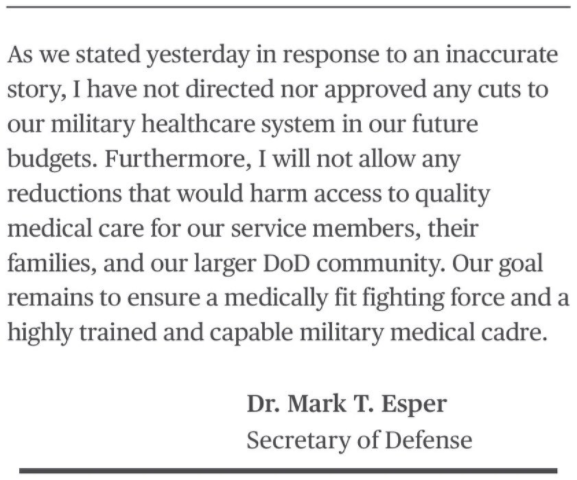
But then the SECDEF put this message out on social media:
Then there was this second article:
Trump rejects Pentagon’s proposed cuts to military health care
In addition, Military Times put this out as well:
Trump shoots down Pentagon proposal to cut troops’ health care
SUPERB-SAFETY Framework for Attending-Resident Communication
This is a nice framework sent to me from the Chief Medical Officer of Naval Medical Forces Atlantic. “SUPERB” is the framework for attendings to set expectations for the resident regarding overnight communication. “SAFETY” is the framework for the resident regarding when to seek communication with their attending if it is not made clear in advance.
You can see the full framework here:
SUPERB_SAFETY (PPT Version)
SUPERB_SAFETY (PDF Version)
Modified Dates for Flight and Dive Application to Align with GME Dates
Please see the message below that better aligns the application timeline for Undersea Medicine and Flight Surgery due to the COVID-altered GME timeline. Summary…Flight and Dive applicants will find out if they were selected the same date as they will for GME (6 JAN 2021) and have 2 weeks to accept/decline on the same day they do that for GME (20 JAN 2021).
MSGID/GENADMIN/SECNAV WASHINGTON DC/-/MAR//
SUBJ:/MODIFY BUMEDINST 1520.42A TO ALIGN WITH UNDERSEA MEDICINE AND AEROSPACE MEDICINE OFFICER CANDIDATE APPLICATION DUE DATES IN BUMEDNOTE 1524//
REF/A/DOC/ BUMEDINST 1520.42A/BUMED/31JUL19//
REF/B/DOC/ BUMEDNOTE 1524/BUMED/31JUL20//
NARR/REF A IS THE APPLICATION GUIDANCE FOR UNDERSEA MEDICAL OFFICER AND AEROSPACE MEDICINE PROFESSIONAL TRAINING. REF B IS THE 2020 JOINT SERVICE GRADUATE MEDICAL EDUCATION SELECTION BOARD APPLICATION PROCEDURES OUTLINING THE COVID-19 UPDATED CANDIDATE APPLICATION DUE DATES. REF A MUST BE MODIFIED TO ALIGN WITH REF B.//
RMKS/1. This ALNAV announces a modification to BUMEDINST 1520.42A to align with BUMEDNOTE 1524, which describes the COVID-19 altered timeline for Graduate Medical Education Application. Undersea Medicine (UM) and Aerospace Medicine (AM) Officer candidate application due dates are now the same as set-forth in the BUMEDNOTE 1524. Specifically, the updated deadline for acceptance/declination is 20 JAN 2021.
2. Mission. Align deadlines for Navy graduate medical education selection program, Undersea Medical Officer and Aerospace Medical Officer programs.
3. Policy. This ALNAV applies to all uniformed military Navy and Marine Corps personnel submitting an UM or AM Officer Candidate application during the remainder of Fiscal Year 2020 and Fiscal Year 2021.
4. Point of Contact. Please direct all questions to CAPT Joel Schofer, Deputy Chief, Medical Corps / UM Specialty Leader, joel.m.schofer.mil@mail.mil, (703) 681-8917; CAPT Mucciarone, UM Specialty Leader, james.mucciarone@navy.mil, (808) 473-5789; or CDR Robert Krause, AM Specialty Leader, robert.j.krause.mil@mail.mil, (757) 444-3520.
5. Released by RADM Bruce L. Gillingham, Surgeon General, U.S. Navy.
BT
#0001
UNCLASSIFIED//
Finance Friday Articles
Terrance Odean is a professor of finance at UC Berkeley. His Vimeo videos are from an online personal finance course he taught titled “Making Smart Financial Decisions.” I’ve watched 15 or so of them, and they are about 10 minutes long, high quality, and educational. If you are looking for a financial education check them out here:
https://vimeo.com/terranceodean
Here are my favorite articles this week:
3 Financial Lessons From Covid-19
Academically Verified Investment Strategies that Failed
Massive Deficits and Historical Investment Implications
Here are the rest of the articles:
5 misconceptions I had about ETFs
12 Things to Know About the TSP L Funds
A Story of Residency Homeownership
How to Find College Scholarships to Help Your Child Graduate Debt-Free
How to Use an Emergency Fund Without the Stress
How to Use Real Estate to Pay for College
The Definitive Guide to the All Weather Portfolio
The Economics of Home Ownership
The Hardest Investing Questions to Answer
The Most Counterintuitive Recession Ever
The Pros and Cons of Miniscule Savings Account Yields
The Three Biggest Obstacles That Prevent You from Succeeding
Throwback Thursday Classic Post – Step 3 to Crush the Thrift Savings Plan – Asset Allocation
The Thrift Savings Plan (TSP) is the military’s retirement account. Learning how to maximize its utility should be high on your financial priority list. At MCCareer.org, I’m going to create a guide that will show you how to crush it with the TSP. We already showed you step 1 and step 2 in that guide. Here’s step 3…
The 3rd Step to Crush the TSP – Asset Allocation
You’ve probably heard that you shouldn’t put all of your eggs in one basket. That is what asset allocation is all about…making sure your eggs are in multiple baskets.
Asset allocation can be complex. There are entire books written about nothing but asset allocation, like The Intelligent Asset Allocator: How to Build Your Portfolio to Maximize Returns and Minimize Risk
What Assets are Available in the TSP?
There are only five assets available:
- G Fund – US government bonds specially issued to the TSP
- F Fund – US government, corporate, and mortgage-backed bonds
- C Fund – stocks of large and medium-sized US companies
- S Fund – stocks of small to medium-sized US companies (not included in the C Fund)
- I Fund – international stocks of more than 20 developed countries
What is not available? There are a few major asset classes unavailable. You cannot invest in real estate or international bonds. International emerging markets may be added to the I Fund is the TSP board can ever sort out the politics. If you want exposure to any of these asset classes right now, you’ll have to get them in your other investment accounts, like your IRA or taxable account.
How Do I Pick My Asset Allocation?
If in step 2 you decided to use L Funds, you don’t need to pick an asset allocation for your TSP. The L Fund takes care of it for you.
If you are not going to use L Funds, one way to decide on an asset allocation is to take this Vanguard survey. At the top of the page it will give you a suggested allocation, such as 80% stocks and 20% bonds.
Another way is to borrow from trusted investment experts. Here are a few opinions.

- 20-30s – bonds 10-25%, stocks 75-90%
- 40-50s – bonds 25-35%, stocks 65-75%
- 60s – bonds 35-55%, stocks 45-65%
- 70s – bonds 50-65%, stocks 35-50%
- 80s+ – bonds 60-80%, stocks 20-40%
- 20-30s – bonds 0%, stocks 100%
- 40s – bonds 0-10%, stocks 90-100%
- 50s – bonds 15-25%, stocks 75-85%
- 60s – bonds 20-30%, stocks 70-80%
- 70s – bonds 40-60%, stocks 40-60%
- 80s+ – bonds 50-70%, stocks 30-50%
Mr. Ellis is a little more aggressive than Mr. Malkiel because he recommends a higher allocation of stocks.
There are other ways to come up with a reasonable asset allocation, such as financial “rules of thumb.” The founder of Vanguard, John Bogle, is famous for creating the “age in bonds” rule of thumb. It says that whatever your age is, that is the percentage of your investments that should be in bonds. The rest should be in stocks.
For example, I’m 44 years old, so his rule would say I should have 44% in bonds and 56% in stocks.
This rule has been criticized as being too conservative, so some have changed it to 110 or 120 minus your age as the percentage you should have in stocks. For example, for me this would mean:
- 110 minus age 44 = 66% in stocks, the rest (34%) in bonds
- 120 minus age 44 = 76% in stocks, the rest (24%) in bonds (this is actually very close to my asset allocation as of 9 AUG 2020, 75% stocks and 25% bonds)
There are certainly other ways to come up with your asset allocation. You could ask a financial advisor. You could read other books. You could read other blog posts, like this one on the Bogleheads Wiki.
What About Other Assets Like Your Pension and Social Security?
This is a tough issue. Some would argue that pensions and social security are income streams and that they should not play into your asset allocation decision. This is what Vanguard argues. Others would argue that they are “bond-like” and should be factored into your asset allocation and counted as a large pile of bonds. Here are a few thoughts on the subject from blogs I follow and trust:
- The Oblivious Investor – How Pensions and Social Security Affect Asset Allocation
- Humble Dollar – A Price on Your Head
The Bottom Line – Asset Allocation
Somehow you have to figure out your desired asset allocation. The info above will hopefully facilitate that. Once you have a target asset allocation, now you have to apply it to the investments available in the TSP. Take the 4th Step…invest.
National Capital Consortium Program Directors for Pathology, Dermatopathology, Peds GI, and ENT
Here are the announcement/recruitment letters for the Program Director positions:
- SG Announcement for NCC Program Director Search – Pediatric Gastroenterology signed
- SG Announcement for NCC Program Director Search – Pathology Residency signed
- SG Announcement for NCC Program Director Search – Otolaryngology Residency signed
- SG Announcement for NCC Program Director Search – Dermatopathology Fellowship signed
The memorandum to the Surgeons General requests the widest dissemination of the announcement to ensure that all physicians desiring an assignment as a Program Director have the opportunity to apply.
Here is the DoD Policy and Selection Criteria for GME Program Directors, as well as the ACGME requirements for these positions:
- ACGME requirements for Pediatric Gastroenterology PD qualifications
- ACGME requirements for Pathology Residency PD qualifications
- ACGME requirements for Otolaryngology PD qualifications
- ACGME requirements for Dermatopathlology PD qualifications
Please note: Applicants are required to submit a CV, bio, and Letter of Intent to apply for the position. All nominees need to send me the requested documents by COB 24 AUG 2020 at joel.m.schofer.mil < at > mail.mil.
- An applicant’s CV must include a section about faculty development activities that they have done.
- An applicant’s CV must demonstrate at least 3 years of documented education and/or administrative experience, as well as ongoing clinical activity in the (sub)specialty for which they are applying.
- An applicant’s CV must demonstrate current board certification in the (sub)specialty in which they are applying. Current medical licensure must also be documented on the CV.
- An applicant’s CV must demonstrate current ongoing scholarly activity.
- The Letter of intent must include the candidate’s level of commitment to GME and the Program Director position, including the number of years they are willing to serve, and that if selected, that they will accept the position.
If you have any questions, please feel free to contact Jerri Curtis, M.D. at jerri dot curtis < at > usuhs dot edu.
Latest COVID-Related Travel Updates
Here is the 3 AUG 2020 COVID-19 Travel Restrictions Installation Status Update.
Here is the 6 AUG 2020 Force Health Protection Guidance – Supplement 12:
On Thursday, Aug. 6, 2020, the Department of Defense released Force Health Protection Guidance – Supplement 12, which provides guidance for DOD personnel traveling during the Coronavirus Disease 2019 pandemic. Supplement 12 provides pre- and post-travel guidance for the force health protection of military members, their families, DOD civilian employees and DOD contractors.
The guidance details information on the following:
- Steps to be taken during Restriction of Movement
- Determining whether to travel
- Travel guidance in addition to Restriction of Movement
- Additional guidance to assist commanders with travel decisions
- Additional guidance for Reserve and National Guard personnel
The guidance can be found here.
 Joel Schofer's Career Planning Blog