Throwback Thursday Classic Post – Commandant of the Marine Corps: Notes on Designing the Marine Corps of the Future
Here’s a link to General Berger’s article:
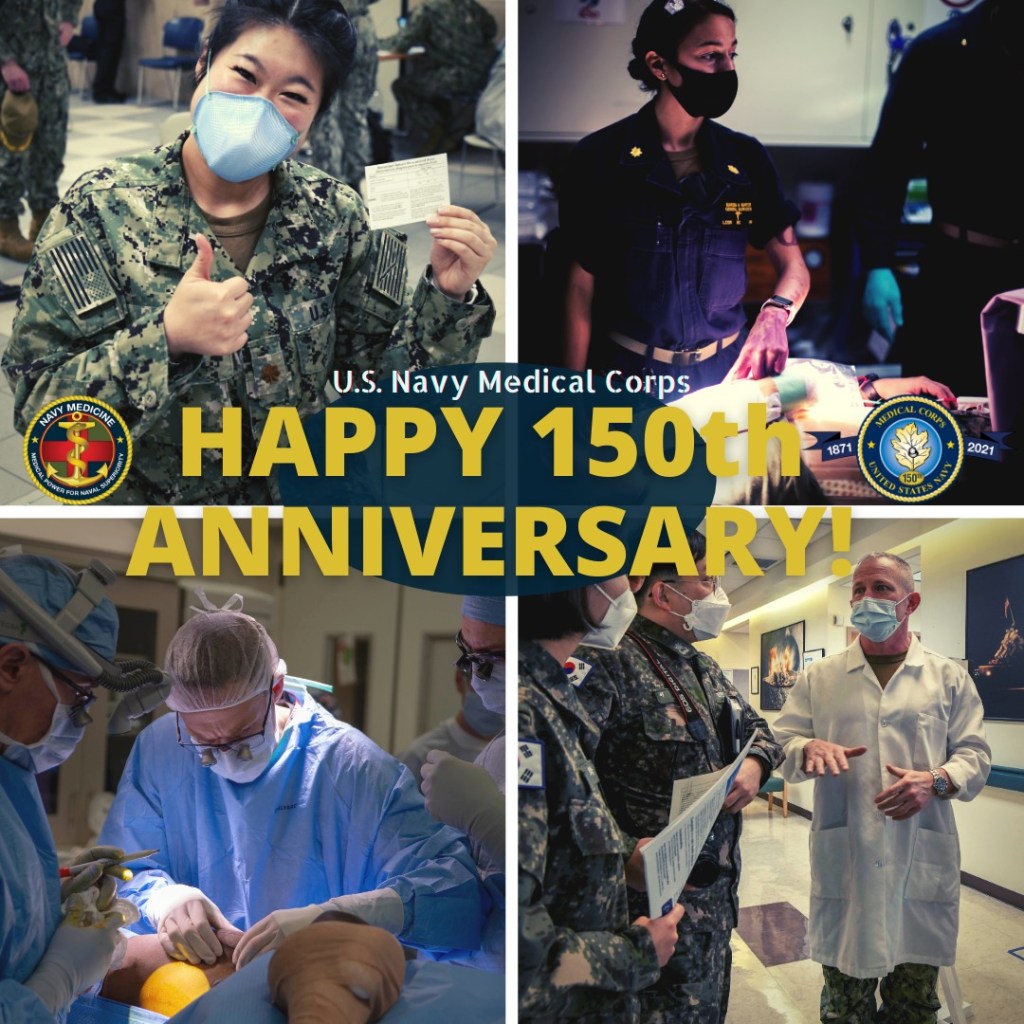
Happy 150th Birthday, Medical Corps! Live Facebook Cake Cutting at 1130 EST
Don’t forget to join RDML Hancock, Chief of the Medical Corp, for the FaceBook Live cake cutting event today at 1130 EST on the Office of the Medical Corps Chief Facebook page.
FY22 O6 Promotion Opportunities and the Documents Provided to the Boards
The FY22 convening order is out:
The O6 promotion opportunities are:
- DC – 90%
- MC – 90%
- MSC – 50%
- NC – 50%
You can see the historical MC stats here:

In addition, here are all the documents provided to the promotion boards. When I have time, I’ll break them all down and analyze them, but I wanted to post them here for your reading pleasure:
Put Retirement First
Jonathan Clements was a longtime personal finance columnist for The Wall Street Journal, and he offers great advice at the best price you can get (free) on his blog Humble Dollar. Here is one piece of advice from his site:
“PUT RETIREMENT FIRST. Are you socking away at least 12% of your pretax income toward retirement, including any matching contribution to your employer’s retirement plan? To amass enough for retirement, you may need to throttle back other financial ambitions, including the size of the house you buy and how much you help your kids with college costs.”
This advice is about two things, savings rate and priorities. First, let’s tackle savings rate.
One of the seminal moments in my financial life occurred when I read the book The Automatic Millionaire by David Bach. In that book was a table that said something like this:
- If you want to be poor and work your entire life, save < 10 percent of your gross or pre-tax income.
- If you want to be normal and retire at a traditional age, save 10-20 percent of your gross or pre-tax income.
- If you want to be rich and retire early, save 20 percent or more of your gross or pre-tax income.
You can probably guess how my story ended…I saved 20 percent. Then I increased by 1 percent every 1-3 months until I hit 30 percent, which has been my savings rate ever since. This is probably the #1 reason I am financially independent. The #2 reason is the value of my military pension.
As Mr. Clements discusses, when you put retirement first it isn’t just about your savings rate, though. It is also about priorities.
You can’t borrow money to retire, therefore you need to max out your retirement savings before you start saving money for your kids’ education.
You need to max out your retirement savings before you buy a house that is larger than you really need.
You need to max out your retirement savings before you pay for private school.
You need to max out your retirement savings before you purchase a new car or a used luxury car.
It’s your life and it’s your retirement. Get your priorities straight and make retirement your #1 financial priority.
SG Message: We Are At War – Are You Protecting Your Community?
Esteemed Shipmates:
This message is for our entire Navy Medicine team, especially those who have concerns about receiving COVID-19 vaccinations. As your Surgeon General, my first concern is your safety. I would never allow you to go into a combat zone without flak and Kevlar. By the same token, I am concerned that Navy Medicine personnel are electing to serve on the front lines of the war against COVID every day without the single best protection we have: the SARS-CoV-2 vaccine. The vaccine is our “biological body armor,” a safe, highly effective defense against a virus which can cause serious long term disability, even in those minimally symptomatic and, in over 500,000 cases so far, death. Tragically, we have lost seven active duty sailors, (four in the last month) and 53 Department of the Navy civilians thus far. Fortunately, our scientific panel, world class experts in their fields, assure me that the benefits of the vaccine far, far, outweigh possible side effects.
I recognize that receiving a COVID vaccine is voluntary. Absent a presidential waiver, I cannot make a COVID vaccine either mandatory or a readiness requirement. The choice is yours, and I ask that you make the best choice for your own health and, importantly, for those around you. Frankly, many have asked “what’s in it for me” noting that even if they get the vaccine they will not see an immediate relaxation of our current public health restrictions. As the adage “a journey of a thousand miles starts with a single step” reminds us, all of us have a small but very important role to play by getting vaccinated. It is estimated that 75% or more of us need to be vaccinated if we are to achieve the community immunity that will allow that return to normalcy. We are each a part of several communities: those of our families, friends, co-workers and the neighborhoods in which we live. Communities depend upon shared, coordinated actions to thrive and reach their “common” vision of happiness. This sometimes requires compromise and sacrifice. The COVID pandemic is one of those times. Please consider the impact of not getting vaccinated on your community. Ignore biased social media, examine the science and reach out to a trusted medical provider to address your reservations. We are truly in this together.
You are an ambassador of Navy Medicine and are on the front lines serving our patients every day. Sailors, Marines, Civilians and Contractors look to you as the source of medical knowledge and expertise. YOU are the doc they know. Each of us must become an exemplar if we are to defeat this virus. As medical ambassadors, we need to communicate the science and facts about these vaccines to our friends, families, and fellow service members. As I noted above, it is a biological body armor against a virus responsible for killing more than half a million Americans. I encourage our entire enterprise to be engaged in COVID conversations both within and outside our lifelines. If you know someone who has questions about receiving the vaccine, speak to them, make sure they are making an informed choice with accurate information. If they decide to get the vaccine, ask them to act and get it as soon as possible. Please share your own experiences, and help educate them on the tremendous benefits these low-risk vaccines provide not only for them, but for their shipmates, their families, and the community at large.
That the vaccines are available now is a triumph of medical research that began more than a decade ago. They are our safest and best weapon against this unrelenting adversary. By simply rolling up your sleeve you can don this amazing biological body armor, make a personal contribution to community immunity and project medical power – what a great return on a small but critically important investment!
We need everyone in Navy Medicine to join their vaccinated arms as we lead from the front in protecting all of the communities in which we live and serve.
With my continued respect and admiration, SG
V/R,
Bruce L. Gillingham, MD, CPE, AOA
RADM, MC, USN
Surgeon General, U.S. Navy
Chief, Bureau of Medicine and Surgery
Need Orthopedic Surgeons for Emergency War Surgery and Combat Orthopedic Trauma Surgery Course – 25-26 MAR, San Antonio
There are openings for this course 25-26 MAR 2021 in San Antonio, which you can read about here:
It is not centrally funded and would need to be funded by your command, but it would get you a lot of progress toward meeting your readiness criteria and KSAs. The POC is:
Laura A. Martinez
Navy Medicine CeTARS/Quota Manager, Education Operations (M7)
Naval Medical Forces Support Command (NMFSC)
Commercial: (210) 808-9651 DSN: 420-9651 Cell: (910) 333-7239
Email: check the global
DHA set to takeover all military hospitals by end of 2021, even after transition halt during pandemic
Here’s a link to the article:
 Joel Schofer's Career Planning Blog