Finance Friday Articles
- 2023 TRICARE Costs Announced
- 6 Takeaways from the Bogleheads Conference
- How Do the Wealthy Invest?
- I Bonds and TIPS: Which Inflation-Indexed Bond Should You Buy Now?
- Know Your Net Worth
- Specializing in the Military
- The Power of Anti-Goals
- Walking the Inflationary Highwire
- When I Get Stupid
- Wiser in 21 Ways
- Worst Year Ever for Bonds
How to Request Promotion Board Letters from the Medical Corps Chief
RDML Valdes wants to be transparent and selective about writing letters to selection boards. His desire is that if he writes a letter to a selection board endorsing a physician it is meaningful and a very deserving candidate. Attached is the guidelines for submitting a request for a letter.
All request must be endorsed by the officers current CO. Then the request needs to be submitted to the Deputy Corps Chief Office by 1 DEC for the upcoming O6 board. We will review the request, ensure complete packages and present the top candidates to RDML Valdes for consideration.
MC Policy & Practice Officer – O5/O6
Policy and Practice Officer, Medical Corps – The Medical Corps Chief seeks qualified officers to fill the O-5/O-6 level position as Policy and Practice Officer for the Medical Corps Chiefs Office. The selected individual must possess the required experience and demonstrate exceptional knowledge, skills and abilities to perform and execute the duties and responsibilities as outlined at the attached position description. The assignment is 36 months, and the primary duty location is in Falls Church, Virginia. The selected individual should arrive no later than Jan 1, 2023, with early reporting authorized.
Prospective applicants should send a CV and BIO to CAPT Teresa Allen (contact in the global) NLT Friday, November 18, 2022.
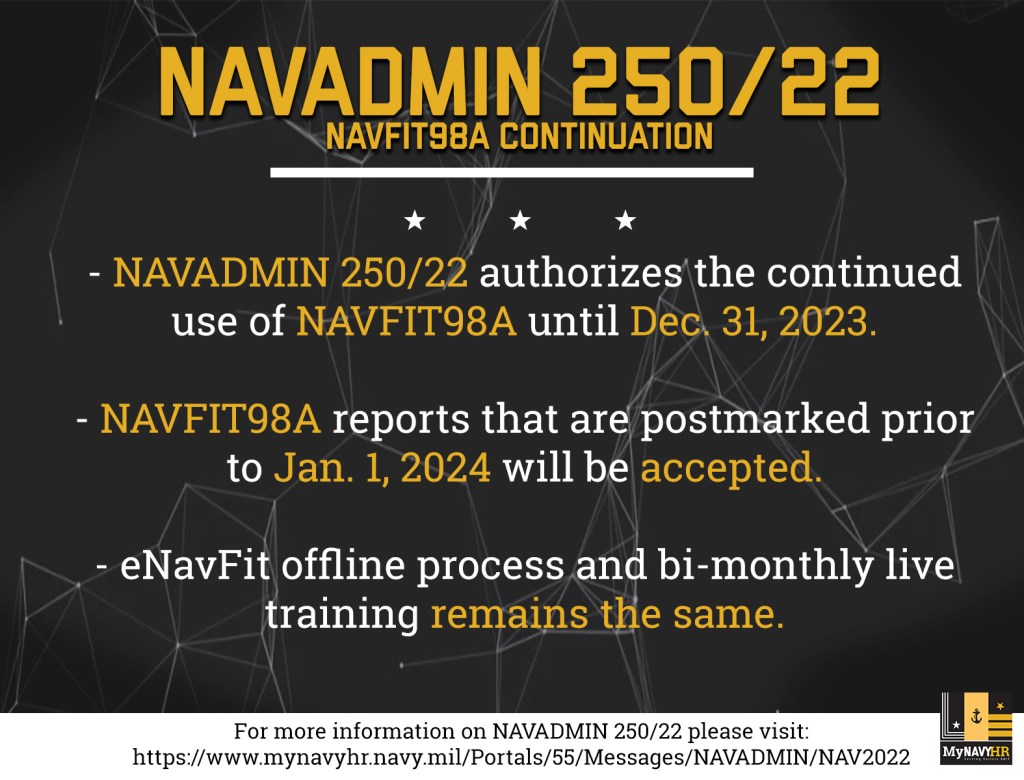
NAVFIT98A Use Allowable Until 31 DEC 2023
ROUTINE
R 032100Z NOV 22 MID200012864292T
FM CNO WASHINGTON DC
TO NAVADMIN
INFO ZEN/CNO WASHINGTON DC
BT
UNCLAS

NAVADMIN 250/22

MSGID/GENADMIN/CNO WASHINGTON DC/N1/NOV//

SUBJ/ENAVFIT IMPLEMENTATION UPDATE//

REF/A/MSG/CNO WASHINGTON DC/241616ZNOV21//
REF/B/DOC/BUPERSINST 1610.10F/01DEC21//
REF/C/MSG/CNO WASHINGTON DC/141834ZJAN22//

NARR/REF A IS BUPERSINST 1610.10F, NAVY PERFORMANCE EVALUATION.
REF B IS NAVADMIN 267/21, TALENT MANAGEMENT TASK FORCE AND ENAVFIT.
SYSTEM.
REF C IS NAVADMIN 004/22, ENAVFIT AVAILABILITY FOR ACTIVE COMPONENT AS
ALTERNATIVE TO NAVFIT98A.//

RMKS/1.  This NAVADMIN provides a status update on eNavFit latency issues at
the Fleet level and the sunset date for NAVFIT98A.
    a.  Navy Personnel Command (NPC) deployed eNavFit to the Reserve
Component in December 2021 as described in reference (a) and to the Active
Component in February 2022 as described in reference (b).
Reference (c) includes the policy for eNavFit.  To date over 37,000 summary
groups have been created and over 27,500 appraisals have been received and
entered into Sailors official military personnel file by NPC via eNavFit.
    b.  NPC has authorized the continued use of NAVFIT98A until 31 December
2023 as an alternative while NPC resolves eNavFit challenges common with new
software product implementation.
Numerous fixes and enhancements to eNavFit have been implemented since the
initial release and NPC continues to receive Fleet feedback which enables
updates on a continuous bases.
    c.  NAVFIT98A will sunset on 31 December 2023.  NAVFIT98A reports
postmarked prior to 1 January 2024 will be accepted.  After
1 January 2024 NPC will only accept reports generated from eNavFit to
include printed reports.

2.  All Sailors can access eNavFit through BUPERS Online (BOL) for online
evaluation and fitness report drafting, routing, signature, review, and
submission.  While in BOL, click the *eNavFit Program* link.  Users must
access eNavFit via Google Chrome, Firefox, or Safari web browsers.
Microsoft Edge and Internet Explorer web browsers are not compatible and
will cause system errors.

3.  Commands are reminded eNavFit has been designed to support environments
with regular internet connectivity, intermittent internet connectivity, or
no internet connectivity.  Commands entirely offline may use eNavFit forms
to print, wet sign, and mail completed reports and summary letters to NPC.

4.  Performance evaluation training materials, including the eNavFit user
guide, video tutorials, best practices, and frequently asked questions are
available on the NPC website at
https://www.mynavyhr.navy.mil/Career-Management/Performance-
Evaluation/eNavFit.  The PET/eNavFit team will continue providing live
training sessions via Microsoft Teams on a bi-monthly basis through fiscal
year 2023.

5.  For questions concerning eNavFit, contact the MyNavy Career Center at
(833) 330-6622 or via e-mail at askmncc(at)navy.mil.

6.  This NAVADMIN will remain in effect until superseded or canceled,
whichever occurs first.

7.  Released by Vice Admiral Richard J. Cheeseman, Jr., N1.//

BT
#7978
NNNN
UNCLASSIFIED//
Back Dated Special Pay Requests Due 3 DEC
Here are some bullets about the recently released pay plan from the Medical Corps Chief’s Office:
- Eligible members have until 3 Dec 2022 to be able to submit requests effective for 1 Oct 2022 without having to use the retroactive templates. Any request submitted and dated on, or after, 4 Dec 2022 for an effective date more than 30 days prior will be required to use the retroactive templates.
- BUMED cannot guarantee pay before end of year tax cutoff for an acceptance letter received on, or after, 1 December 2022. If received after 1 December for an effective date in calendar year 2022, and it does not get paid in tax year 2022, then the member could receive two payments in tax year 2023.
- Additional guidance can be found at the BUMED Special Pays webpage https://www.med.navy.mil/Special-Pays/
- Contact your local special pays representative with processing questions.
CY23 PFA NAVADMIN
BLUF – This NAVADMIN announces a single Physical Fitness Assessment (PFA)
Cycle for calendar year (CY) 2023. There will be no excellent or above incentive exemption for CY23.
ROUTINE
R 041950Z NOV 22 MID200080418893U
FM CNO WASHINGTON DC
TO NAVADMIN
INFO CNO WASHINGTON DC
BT
UNCLAS

NAVADMIN 251/22

PASS TO OFFICE CODES:
FM CNO WASHINGTON DC//N1//
INFO CNO WASHINGTON DC//N1//
MSGID/GENADMIN/CNO WASHINGTON DC/N1/NOV//

SUBJ/PHYSICAL READINESS PROGRAM CALENDAR YEAR 2023 PHYSICAL FITNESS
ASSESSMENT CYCLE ANNOUNCEMENT//

REF/A/DOC/OPNAV/22APR22//
REF/B/DOC/OPNAV/APR21//
REF/C/DOC/OPNAV/FEB22//
REF/D/DOC/BUPERS/01DEC21//
REF/E/DOC/OPNAV/JAN22//

NARR/REF A IS OPNAVINST 6110.1K, PHYSICAL READINESS PROGRAM INSTRUCTION.
REF B IS NAVY PHYSICAL READINESS PROGRAM GUIDE 4, BODY COMPOSITION
ASSESSMENT.
REF C IS NAVY PHYSICAL READINESS PROGRAM GUIDE 5, PHYSICAL READINESS TEST.
REF D IS BUPERSINST 1610.10F, NAVY PERFORMANCE EVALUATION SYSTEM.
REF E IS NAVY PHYSICAL READINESS GUIDE 8, MANAGING PFA RECORDS FOR PREGNANT
SAILORS//

RMKS/1.  This NAVADMIN announces a single Physical Fitness Assessment (PFA)
Cycle for calendar year (CY) 2023.

1.  CY23 PFA Cycle.  The PFA cycle will be conducted from 1 February to 30
November 2023 in line with references (a) through (c).
Additional Physical Readiness Guides are located at:
https://www.mynavyhr.navy.mil/Support-Services/21st-Century-
Sailor/Physical-Readiness/Guides/.  CY23 PFA cycle will be labeled *PFA Cycle
1 2023* in PRIMS-2.
    a.  CFLs and Assistant CFLs (ACFL) will enter official CY23 PFA cycle
results under this label in PRIMS-2 and retain official body composition
assessment and physical readiness test score sheets for five years in line
with reference (a).  CFL and ACFLs are reminded to log into their PRIMS-2
account every 30 days to keep their account from being deactivated.
    b.  Sailors have access to their physical readiness historical data
through MyNavy Portal, My Records and will electronically submit their
Physical Activity Risk Factor Questionnaire via MyNavy Portal upon receiving
their commands 10-week notification.
    c.  There will be no excellent or above incentive exemption for CY23.  In
line with reference (a), commanders, commanding officers, and officers-in-
charge are encouraged to use incentive programs for the physical readiness
program (special liberty, award certificates, etc.).
    d.  Fitness Report and Evaluation Guidance.  In line with reference (d),
commands should enter a 1-letter code indicating the result of each official
PFA conducted during the reporting period in block 20.  Format for block 20
must be from oldest to most recent PFA performed during the reporting period.

2.  Responses to Fleet Feedback.  The following items are provided for
clarification to frequently asked questions:
    a.  CY22 PFA Closeout.  CFLs must enter PFA data by 30 November
2022 in PRIMS-2.
    b.  Postpartum Sailors.  In line with references (a) and (e), Sailors
remain in a pregnancy status from the time pregnancy is confirmed by a
military Health Care Provider (HCP) or civilian HCP until the end of the 12
months following a qualifying birth event.
Sailors with pregnancy (postpartum) status which expires during the official
PFA cycle are exempt from participation in the PFA cycle.

3.  For additional information, members may contact the Physical Readiness
Program Office:
    a.  For policy related questions via e-mail at PRP(at)navy.mil.
    b.  For PRIMS-2 related questions via e-mail at PRIMS(at)navy.mil.
    c.  For policy or PRIMS-2 related questions via phone at (901) 874-2210/
DSN 882.

4.  This NAVADMIN will remain in effect until superseded or canceled,
whichever occurs first.

5.  Released by Vice Admiral Richard J. Cheeseman, Jr., N1.//

BT
#0001
NNNN
UNCLASSIFIED//
 Joel Schofer's Career Planning Blog