Author: Joel Schofer, MD, MBA, CPE
2022 Update – What Should You Do If You Didn’t Promote?
If you are particularly interested in this post, I’m sorry. You or someone you care about probably failed to promote. In reality, nowadays it is normal and expected to fail to promote to O5 and O6, so you have company. Here are my suggestions for those that fail to promote.
Try to Figure Out Why You Didn’t Promote
First, try to figure out why you didn’t promote. Because the promotion board members are not allowed to speak about your board, you’ll never actually find out why you failed to promote, but you can usually take a pretty educated guess if you talk to the right people (like me).
If any of these things happened to you, they are likely a main reason you didn’t promote:
- Any PFA/BCA failures.
- Legal issues, such as a DUI or any other legal trouble.
- Failure to become board certified.
There are other things that could happen to you that make it difficult but not impossible to promote. They include:
- You have not been operational or deployed at all, or you have done so much less than your peers.
- Having non-observed (NOB) fitreps before the board, such as those in full-time outservice training.
- Spending too much time in the fleet as a GMO, Flight Surgeon, or UMO. This is mostly because it causes you to come into zone for O5 while you are still in GME, and is more of a problem if your residency is long.
- Never getting a competitive early promote (EP) fitrep. Many officers who fail to select have never had a competitive EP fitrep in their current rank. This can be because they were stationed places without competitive groups and they get 1/1 fitreps, or it can be because they were in a competitive group and did not break out and get an EP. To me this is the #1 ingredient to promote…competitive EP fitreps. If you don’t have them, you are really up against it unless you are in a senior operational position that carries a lot of weight.
- Receiving potentially adverse fitreps. This most commonly happens when you are at an operational command and your reporting senior is not someone who is used to ranking Medical Corps officers, although it could happen for other reasons (like your reporting senior felt you deserved this type of fitrep). The most common situation would be if there is a competitive group of 2 officers but both are given must promote (MP) fitreps instead of 1 getting an EP and the other the MP. When both get an MP, it reflects poorly on both officers unless the reason for this is CLEARLY explained in the fitrep narrative, which it often is not. The other thing that happens is that a reporting senior gives you a 1/1 MP instead of a 1/1 EP. If you are ever getting a 1/1 fitrep, make sure you get an EP. You should consider getting a 1/1 MP an adverse fitrep. If there is no way around this, often because the reporting senior has a policy that they don’t give newly promoted officers an EP, make sure that this policy is clear in the fitrep narrative.
- Having a declining fitrep. Mostly this happens when you go from getting an EP to an MP on your fitrep under the same reporting senior. If it is because you changed competitive groups, like you went from being a resident to a staff physician, that is understandable and not a negative. If you didn’t change competitive groups, though, make sure the reason you declined is explained.
- Making it obvious to the promotion board that you didn’t update your record. The most obvious ways a promotion board will know you didn’t update your record is if your Officer Summary Record (OSR) is missing degrees that you obviously have (like your MD or DO) or if many of the sections of your OSR are either completely blank or required updating by the board recorders. Remember that although promotion board recorders will correct your record for you, anything they do and any corrections they make are annotated to the board. While a few corrections are OK, you don’t want a blank record that the recorders had to fill in. It demonstrates that you didn’t update your record.
Who Actually Promotes?
So who actually promotes to O5 and O6? In general, the officer who promotes has:
- Achieved board certification.
- Spent time in both a military treatment facility and in the operational or headquarters setting.
- A demonstrated history of excellence as an officer. In other words, whenever they are in a competitive group, they successfully break out and get an EP fitrep. Being average is just not good enough anymore.
- No PFA failures, legal problems, declining fitreps, or potentially adverse fitreps.
- Updated their record, and if they previously failed to select they reviewed their record with their Detailer and actively worked to improve it.
What Do You Do If You Failed to Promote?
Realize that it is not the end of the world. Based on the recent promotion board statistics (which you can get in the Promo Prep), most officers were passed over for O5 or O6, but a large number of the officers selected were from the above zone group.
If you do nothing, you will continue to get looked at by promotion boards until you retire, resign, or are forced out of the Navy. There is no limit to the number of chances you get to promote and your record will be evaluated for promotion every year. That said…
You need to try to promote. Consider sending a letter to the promotion board. What do you say in this letter? First, briefly state that you want to be promoted and to continue your career in the Navy. Second, explain what a promotion would allow you to do that you can’t do at your current rank. Answer the question, “Why should they promote you?”
For example, if you want to be a Department Head at a large military treatment facility (MTF), a senior operational leader, or a Residency Director (or whatever you want to do), tell them that you need to be promoted to be competitive for these jobs. The Navy wants to promote leaders. Make it clear to them that you are a motivated future leader.
Try and get letters of support to attach to your letter. These letters should be from the most senior officers who can personally attest to your value to the Navy. In other words, it is probably better to get a letter from an O6 who knows you well than a 3 star who doesn’t. If you are not sure who to ask for letters, ask those more senior to you or your Detailer for advice. Your Specialty Leader is always someone to consider if he/she knows you well and can speak to your contributions to the specialty and Navy.
Have your record reviewed by your Detailer, Specialty Leader, other trusted senior advisor, or by me. Because of promotion board confidentiality, you will never know the reason(s) you did not promote, but most of the time experienced reviewers can come up with an educated guess. They’ll often find things that you were not even aware of, like potentially adverse fitreps, or information missing from your record. My promo prep document will help you as well.
Do everything you can to get “early promote” or “EP” fitreps. This is largely accomplished by continually striving for positions of increased leadership. You need to get a job that has historically led to a promotion while keeping in mind that the new MC career path emphasizes that all need to be operational.
As a LCDR who got passed over for CDR, try to get one of these jobs and excel at it (this list is not exhaustive and these positions are not the only path to CDR, but they are a good start):
- Assistant Program Director
- Division/Department Head
- Fleet Surgical Team (FST) Specialty Staff
- Global Health Engagement (GHE) Staff Officer
- Group/Senior Flight Surgeon (FS)
- Medical Battalion Specialty Staff
- Medical Executive Committee (MEC) Member
- Regimental Surgeon
- Senior Undersea Medical Officer (UMO)
- Ship or Group Senior Medical Officer (SMO)
- SMO/Medical Director
If you are a CDR who got passed over for CAPT, try to get one of these jobs and excel at it:
- Assistant Specialty Leader or Specialty Leader
- Chief Medical Officer (CMO)
- Director/Large Department Head at a NMRTC/MTF
- Division/Group/Wing Surgeon
- FST Officer-in-Charge (OIC) / CATF Surgeon
- GHE, Headquarters, or Navy Personnel Command (PERS) Staff
- Group UMO
- LHA/LHD/CVN SMO
- MEC Chair
- OIC
- Program Director
- Senior GHE Billet
Meet with your chain-of-command. After you’ve been passed over is not the time to be passive. You need to sit down with your leadership and get an honest assessment from them of how you’re doing and what they would recommend continuing to advance your career. You may not like what you hear, but it is better to find out early if they don’t think you’re doing a good job or that you are unlikely to break out on your fitreps. That way you can try and put yourself in a better situation by changing commands.
Things You Should Not Do
In addition to the above list of things you should do, there are a few things you should not do:
- Do not lie in your letter to the board. In other words, don’t tell them you want to do Executive Medicine if you don’t really want to. Your record reads like a book, and if it tells a story that is contrary to what your letter says, this is unlikely to help you and may hurt you.
- Do not send long correspondence. Promotion boards have to read everything sent to them, and a long letter may not be appreciated. Keep it brief and to the point.
- Do not ask your current CO to write you a letter to the board if they’ve done an observed fitrep on you. His or her opinion about you should be reflected on that fitrep, so they don’t need to write you a letter. If they’ve never given you an observed fitrep or there is some new information not reflected on prior fitreps, they could either write you a letter or give you a special fitrep. Ultimately it is up to them whether they do either of these or none.
- Do not discuss anything adverse unless you want the board to notice and discuss it. This issue comes up frequently and people will ask me for advice, but ultimately it is up to the individual officer. The one thing I can guarantee is that if you send a letter to the board and discuss something adverse, they will notice it because they will read your letter! If you think there is a chance the adverse matter will get overlooked, it is probably better not to mention it and keep your fingers crossed.
Never Stop Trying
Those are my tips for those who find themselves above zone. Most importantly, if you want to promote, NEVER STOP TRYING. You can usually stay in as a LCDR for 20 years, and I personally know of people who got promoted their 9th look!
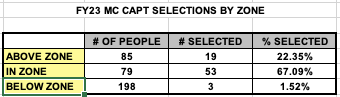
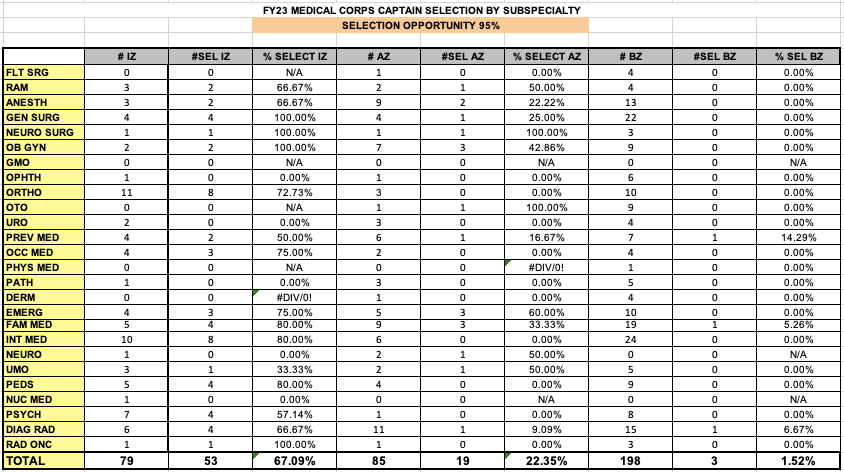
FY23 O6 Promotion Board Stats
I don’t have the detailed stats for all the Corps, so here is the PERS file with the basic and diversity stats for MC, NC, MSC, and DC:
Here are the detailed stats for the MC:


June Sailor-to-Sailor Newsletter
Shipmates around the world!
Your MyNAVY HR Team is proud to bring you another informative “Sailor-to-Sailor” newsletter. But it’s only informative if you click the link and read the news we bring you every month. In this edition we welcome VADM Rick Cheeseman as our new CNP and bid farewell to VADM John Nowell who retired after 38 years of faithful service. We also focus on updates to DPMAP and what’s available in the current SRB. Check out the story on the Hometown Area Recruiting Program benefits for both enlisted and officers. And June is the month that we in the DoD recognize the service of all the Sailors, Marines, Soldiers, Airmen, and Guardians who are part of the LGBTQ+ community!
This link is your gateway to enlightenment: https://go.usa.gov/xJXaJ
Need more enticing? Other stories in this month’s edition include:
– How to Become a Certified Navy Coach
– How Surveys Help Shape Your Navy World
– Supercharge Your Career with MilGears Tools – Here’s How
Again, for all the news you can use, click here: https://go.usa.gov/xJXaJ
If you have questions or comments about the newsletter, you can reach us on our social media properties @MyNavyHR on Facebook, Twitter and Instagram to have your voices heard.
V/r,
MyNavy HR
Finance Friday Articles
- Divide and Rule
- Like the phoenix, the 60/40 portfolio will rise again
- Paying for Your Child’s College Education with the Post-9/11 GI Bill
- Real-Life Strategies to Mitigate Sequence-of-Return Risk
- S&P 500 Sector Quilt
- Stocks on Sale
- Tax Shelter When Selling Your House
- The Real Problem With Inflation
- Underspending in Retirement: A Sign of Fulfillment or Fear?
Basic Readiness Officer Course (BROC) 2.0 is Now Live on Navy E-Learning
Naval Medical Leader & Professional Development Command (NMLPDC) Courses
(1) Basic Readiness Officer Course (B-ROC)
Course Description: The Basic Readiness Officer Course is the first course in the Medical Department Officer’s Learning Continuum. B-ROC is a four unit course in which all units must be completed to receive credit. The course is designed for junior Medical Department Officers in the paygrades O1 to O3 to introduce the organization, structure, business practices, and operational policies of the Naval Medical Department. B-ROC fulfills 8 of the 36 Joint Medical Executive Skills Program (JMESP) competencies.
Funding: There is no cost for this online course.
Process: Available online through Navy E-Learning following the steps below:
1. Navigate to Navy E-Learning (NEL)
2. Select tab “Course Catalog” and cut and paste the following course catalog numbers into the search:
Module(s) Search with Course ID Numbers (CINs)
| B-ROC Unit 1: Organizational Structure, Relationships, and Policy, use | CFHP-NMLPDC-21-BROC-U1-V02 |
| B-ROC Unit 2: Utilization and Management of Resources Course, use | CFHP-NMLPDC-21-BROC-U2-V02 |
| B-ROC Unit 3: Operational Policies and Procedure, use | CFHP-NMLPDC-21-BROC-U3-V02 |
| B-ROC Unit 4: Navy Medicine Division Officer (DIVO)/ Department Head (DH) Functions and Sailorization, | CFHP-NMLPDC-21-BROC-U4-V02 |
* Notes:
(1) There is an Ashore vs. Afloat BROC = same course, but Afloat BROC is designed to work within the more IT constrained/restrictive bandwidth Afloat IT environment.
(2) Completion of any BROC version or BMDOC counts for course credit.
3. Select ENROLL for Shore or Afloat BROC and each unit and add to Learning Plan
4. Return to tab My Learning and LAUNCH Course
Other information:
1. Service School: Like BMDOC, BROC is NOT a Service School. BROC will only auto-reflect in the electronic training jacket and not on the OSR since BROC is not a service school.
2. Prerequisite to AROC: BROC is once again a prerequisite for the Advanced Readiness Officer Course (AROC); HOWEVER, if you already completed BMDOC (in its entirety), you have satisfied the prerequisite and are NOT required to complete BROC.
3. All BROC Modules must be completed in their entirety to meet the overall course requirement.
Course POCs:
NEL Functional Issues: For functional issues at the Navy eLearning (NEL) website contact the NEL help desk. Functional issues are broken links or errors or improper course transitions between coursework, quizzes and tests.
Leadership and Accountability ALNAV
ROUTINE
R 022013Z JUN 22 MID200001775961U
FM SECNAV WASHINGTON DC
TO ALNAV
INFO SECNAV WASHINGTON DC
CNO WASHINGTON DC
CMC WASHINGTON DC
BT
UNCLAS

ALNAV 036/22

MSGID/GENADMIN/SECNAV WASHINGTON DC/-/JUN//

SUBJ/LEADERSHIP AND ACCOUNTABILITY ALNAV//

RMKS/1.  Since taking the oath to serve as Secretary of the Navy, one of my
three enduring priorities is empowering our people.  We do this through a
culture of warfighting excellence built on leadership that exudes treating
others with dignity and respect.  While serving as your Secretary these past
10 months, several issues have come across my desk for decision or review
that galvanized the significance of steadfast leadership and total
accountability in our Department of the Navy (DON).  I fully endorse the
leadership principles and expectations shared in the Chief of Naval
Operations' "Charge of Command" and the "Command and Leadership" summary
outlined in the Commandant's Planning Guidance.  There are a few tenets to
highlight.
Leaders in key roles - especially those in command - are selected based on
years of training, experience, qualifications, established requirements, and
a multitude of distinct factors.  These leaders are the best and most fully
qualified.  The special trust, confidence, and responsibility placed on the
leaders in command also brings a higher level of accountability.  The Command
and Leadership section of General David H. Berger's Planning Guidance states
that "elite organizations do not accept mediocrity and they do not look the
other way when teammates come up short of expectations."  When leaders'
actions or inactions result in the loss of life or capital resources or
simply lower our standards, the senior leadership of the DON has a
responsibility to determine the root cause and hold responsible persons
appropriately accountable.  Leaders in command have the ultimate
responsibility for capital resources entrusted to us by Congress and the
American taxpayer.
I would encourage all leaders - especially those in command - to continually
assess your team's performance, to communicate early and often on material
readiness and resources shortfalls as well as impediments to improvement and
always ask for help when needed.  Clear command and control (C2) is
paramount.  I challenge each of you in positions of leadership to precisely
understand your C2 and what authorities and responsibilities you hold under
your charge.  Admiral Michael M. Gilday's "Charge of Command" states that
although we have no tolerance on key issues such as Sexual Assault or
Harassment, we are not a zero-defect organization.  I agree that not every
mistake should end one's career of service.  Learning from mistakes is an
essential part of evolving into a better leader and ultimately a better
organization.
In closing, I am proud of each and every one of you who serves.  While
leadership at times may be challenging, it is incredibly rewarding and will
shape us to be the very best version of ourselves.  We must cherish the
special trust, confidence, and responsibility that comes with command and
should never take it for granted.  The lives of our Sailors, Marines, and DON
civilians depend on it.  Our Nation demands it.

2.  Released by the Honorable Carlos Del Toro, Secretary of the Navy.//

BT
#0001
NNNN
UNCLASSIFIED//
 Joel Schofer's Career Planning Blog