Playing the Game and Managing Your Military Career
What better to do during a global pandemic than listen to a screencast about managing your career! Here are the PPT slides I used for it:
Playing the Game – Managing Your Military Career
More Stringent DoD Travel Restrictions Released Stopping All Domestic Travel
Below is the text from this original DoD article/release dated 13 MAR 2020. FAQs are here as well.
Today, the Deputy Secretary of Defense David L. Norquist approved new travel restrictions for service members, DoD civilians, and their families assigned to DoD installations, facilities and surrounding areas within the United States and its territories. This restriction will halt all domestic travel, including Permanent Change of Station, and Temporary Duty. This restriction will also pause civilian hiring at DoD installations and components for persons who do not reside within the hiring entity’s local commuting area.
Additionally, service members will be authorized local leave only, following Service guidelines. This new guidance is effective March 16 and continues through May 11.
Similar to other travel guidance regarding COVID-19, travel exceptions may be granted for compelling cases where the travel is mission-essential, for humanitarian reasons, or warranted due to extreme hardship. Approval authority for these exceptions belongs to the Combatant Commander, the Service Secretaries, the Chief Management Officer, or the Director of the Joint Staff, but may be delegated.
The Department will continue to issue additional guidance with regard to the COVID-19 as conditions warrant. Our goal is to remain ahead of the virus spread so our military force remains effective and ready.
For more information on the CDC travel restrictions, visit https://wwwnc.cdc.gov/travel/notices/.
We encourage all DOD personnel to visit https://www.defense.gov/Explore/Spotlight/Coronavirus/for information on staying healthy during the outbreak. The Department will issue follow-on guidance on this directive prior to implementation.
What is an Active Duty Credit Alert?
One option that military personnel have to protect their credit is to use an active duty alert. What exactly is an active duty alert?
A 12 month active duty alert is available if you are active duty in the US military. In addition to the normal fraud alert that civilians can use, your name is removed from prescreened credit or insurance offers you get in the mail for 2 years. It is designed to protect your credit while you are deployed, but you don’t have to be deployed to use it. We have this placed on our credit on a continuous basis to prevent fraud.
It forces businesses to take reasonable steps to verify your identity before issuing credit in your name. If you provide a telephone number when you place the alert, a business must either contact you at the telephone number you provided or take other reasonable steps to verify your identity. This helps them confirm that the credit application is really from you and not from someone who has stolen your identity. If you actually are deployed and are difficult to reach, you can assign a personal representative to answer for you, place, or remove the alert.
You can end the alert before 12 months, or request another one when the initial one expires.
You can place a fraud alert or active duty alert by visiting any one of the three nationwide credit reporting agencies – Equifax , Experian , or TransUnion. The one that you contact must notify the other two. You also can find links to their websites at IdentityTheft.gov/CreditBureauContacts.
COVID-19 NAVADMIN That Discusses PCS and Travel
Below is the recently released NAVADMIN. Again, it is long, but if you are PCSing, traveling, have board exams coming up, want to go to a conference, etc. I’d take the time to read the relevant parts:
UNCLASSIFIED//
PRIORITY
P 122210Z MAR 20 MID510001053027U
FM CNO WASHINGTON DC
TO NAVADMIN
INFO SECNAV WASHINGTON DC
CNO WASHINGTON DC
BT
UNCLAS

NAVADMIN 064/20

MSGID/NAVADMIN/CNO WASHINGTON DC/CNO/MAR//

SUBJ/NAVY MITIGATION MEASURES IN RESPONSE TO CORONAVIRUS OUTBREAK//

REF/A/OPLAN/NORTHCOM/DOD GCP-PI&ID-3551-13/15OCT13//
REF/B/INST/DODI 6200.03/28MAR19//
REF/C/MEMO/OSD/30JAN2020//
REF/D/EXORD/JOINT STAFF J3/012240ZFEB20//
REF/E/MEMO/OSD/07FEB2020//
REF/F/MEMO/OSD/25FEB2020//
REF/G/NAVADMIN/OPNAV/071613ZFEB20//
REF/H/NAVADMIN/OPNAV/112054ZFEB20//
REF/I/NAVADMIN/OPNAV/051456ZMAR20//
REF/J/GENADMIN/JOINT STAFF/051908ZMAR20//
REF/K/MEMO/JOINT STAFF/06MAR2020//
REF/L/MEMO/OSD/10MAR2020//
REF/M/MEMO/OSD/11MAR2020//
REF/N/ALNAV/SECNAV/025-20//
REF/O/MEMO/OSD/11MAR2020//
NARR/REF A IS DEPARTMENT OF DEFENSE (DOD) GLOBAL CAMPAIGN PLAN FOR PANDEMIC
INFLUENZA AND INFECTIOUS DISEASE.
REF B IS DODI 6200.03, PUBLIC HEALTH
EMERGENCY MANAGEMENT WITHIN THE DOD.
REF C IS MEMO FROM UNDER SECRETARY OF DEFENSE FOR PERSONNEL AND READINESS
PROVIDING FORCE HEALTH PROTECTION GUIDANCE FOR PERSONNEL RETURNING FROM CHINA
DURING THE NOVEL CORONAVIRUS (COVID-19) OUTBREAK.
REF D IS SECDEF-APPROVED EXORD THAT DIRECTS USNORTHCOM TO EXECUTE ITS
PANDEMIC PLAN 3551-13 AND SUPPORTING GEOGRAPHIC COMBATANT
COMMANDERS TO EXECUTE THEIR PANDEMIC PLANS IN RESPONSE TO THE NCOV (COVID-19)
OUTBREAK.
REF E IS SUPPLEMENT 1 TO REF C.
REF F IS SUPPLEMENT 2 TO REF C.
REF G IS NAVADMIN 033/20, OPNAV REPORTING GUIDANCE SUPPORTING DOD RESPONSE TO
THE COVID-19 OUTBREAK.
REF H IS NAVADMIN 039/20, UPDATED DOD GUIDANCE FOR MONITORING PERSONNEL
RETURNING FROM CHINA DURING THE NOVEL CORONAVIRUS OUTBREAK.
REF I IS NAVADMIN 058/20, UPDATED NAVY GUIDANCE DURING THE NOVEL CORONAVIRUS
OUTBREAK.  REF J IS JOINT STAFF MESSAGE FOR DOD COVID-19 PASSENGER
SCREENINGGUIDELINES FOR OVERSEAS MILITARY TRANSPORTATION TERMINALS.
REF K IS JOINT STAFF FORCE HEALTH PROTECTION GUIDANCE TO MITIGATE THE RISK OF
COVID-19 TRANSMISSION.
REF L IS MEMO FROM UNDER SECRETARY OF DEFENSE FOR PERSONNEL AND READINESS
PROVIDING FORCE HEALTH PROTECTION GUIDANCE FOR THE USE OF PERSONAL PROTECTIVE
EQUIPMENT AND NON-PHARMACEUTICAL INTERVENTIONS DURING THE CORONAVIRUS DISEASE
2019 OUTBREAK.
REF M IS MEMO FROM UNDER SECRETARY OF DEFENSE FOR PERSONNEL AND READINESS
PROVIDING FORCE HEALTH PROTECTION GUIDANCE FOR PERSONNEL TRAVELING DURING THE
NOVEL CORONAVIRUS OUTBREAK.
REF N IS ALNAV 025/20, FORCE HEALTH PROTECTION GUIDANCE FOR THE DEPARTMENT OF
NAVY.
REF O IS MEMO FROM SECRETARY OF DEFENSE FOR TRAVEL RESTRICTIONS FOR DOD
COMPONENTS IN RESPONSE TO CORONAVIRUS DISEASE.//

POC/RADM KARL THOMAS/OPNAV N3N5B/703-692-9291/KARL.O.THOMAS1(AT)NAVY.MIL/
RADM JEFFREY JABLON/OPNAV N13/703-604-5040/JEFFREY.JABLON(AT)NAVY.MIL/
RADM GAYLE SHAFFER/OPNAV N093B/703-697-7399/GAYLE.SHAFFER(AT)MED.NAVY.MIL//

RMKS/1.  This NAVADMIN announces further measures to mitigate the spread of
COVID-19 throughout the Navy enterprise and amplifies DoD and DON references
(o) and (n) guidance for Navy military members.  It summarizes and repeats
applicable guidance where appropriate so that this will serve as a one-stop
information source.
    1.A.  Background.  The DoD has transitioned to Phase Two Mitigation of
reference (a), the global campaign in response to the COVID-19 outbreak.  The
U.S. Centers for Disease Control and Prevention (CDC) is now reporting over
100,000 cases worldwide, to include cases in the U.S.  During the COVID-19
outbreak, the DoD and Navy will continue to protect and preserve the
operational effectiveness of forces worldwide in accordance with (IAW)
references (a) and (b).  Utilizing force health protection guidance (FHPG)
from the Under Secretary of Defense for Personnel and Readiness (USD (P&R))
provided in reference (c) and (m), USNORTHCOM is executing its pandemic plan
and geographic combatant commanders are executing their supporting pandemic
plans IAW reference (d).  In compliance with updated USD (P&R) FHPG issued in
references (e) and (f), Office of Chief Naval Operations (OPNAV) published
initial reporting guidance supporting DoD response to the COVID-19 outbreak
in reference (g) and updated that guidance in references (h) and (i).
    1.B.  Role of the CDC.  As the leading U.S. government Public Health
Agency, the CDC continues to assess the risk of COVID-19 and to provide
guidance for those residing in the U.S. and traveling abroad.  Because CDC
guidance is principally tailored for persons residing in the continental U.S.
(CONUS), some CDC COVID-19 guidance may have limited applicability for
commanders, particularly those outside the United States, and is not
recognized by other sovereign nations.  While DoD continues to follow the
lead of the CDC, when needed, additional military specific measures are
authorized to mitigate risk to U.S. forces stationed or deployed around the
world, and to protect Service Members, DoD civilian employees, and their
family members.  USD (P&R) FHPG issued in reference (m) provides guidance for
DoD personnel traveling during the novel coronavirus outbreak.
    1.C.  CDC Travel Health Advisories.  The CDC provides travel health
advisories at https://www.cdc.gov/coronavirus/2019-ncov/travelers/index.html.
The levels of advisories are noted below and will be referenced in this
NAVADMIN (note that CDC warning levels DO NOT apply to
CONUS):
Level 1  Watch, practice usual precautions (risk of limited community
transmission)
Level 2  Alert, practice enhanced precautions (sustained (ongoing) community
transmission)
Level 3  Warning, avoid nonessential travel (widespread sustained (ongoing)
transmission)
    1.D.  Department of the Navy (DON) Civilian Guidance.  The DON civilian
workforce  more than 220,000 strong  plays an integral role in supporting our
Sailors and building, manning and maintaining our ships and submarines.
Working shoulder to shoulder with our military members, it is imperative to
have alignment between DON civilian and military COVID-19 policy and
guidance.  To avoid any ambiguity, DON civilian guidance is contained in
reference (n).
    1.E.  Military Health Protection Guidance.  The Secretary of Defense
(SECDEF) has provided explicit Force Health Protection Guidance in both
references (c) and (m) which is more restrictive than CDC guidance.
Commanders must read both documents in their entirety and ensure they are
following the Service Member actions spelled out in this guidance.  Local
Commanders can be more restrictive based on Command location, local community
transmission, risk to mission and risk to force.  Each and every Sailor must
ensure they proactively manage and minimize their personal risk to exposure,
and that of their families.  Commands are charged with ensuring they track
and monitor each Sailor and aggressively follow SECDEF guidance in these
references.

2.  Mission.  All commands will take specific actions to mitigate the spread
of COVID-19 worldwide and adhere to the policies and reporting requirements
contained in this NAVADMIN.

3.  Policy.  In order to maintain force health protection, readiness of the
force and mitigate the risk of transmission among personnel, the Secretary of
Defense directed a stop movement to affected countries and areas effective 13
Mar 2020 in reference (o).  This includes all forms of travel to include
Permanent Change of Station, Temporary Duty and leave.  This order will
remain in effect until 13 May 2020, 60 days after implementation:
    3.A.  Permanent Change of Station (PCS).  Service Members and dependents
under OCONUS PCS orders to locations designated CDC COVID-19 Warning Level 3
or CDC COVID-19 Alert Level 2 will follow the guidance in section 3.A. of
this NAVADMIN.  Note that CDC warning levels DO NOT apply to CONUS.  CONUS
PCS moves may continue for now, UNODIR.
          3.A.1.  PCS orders to or from CDC COVID-19 Warning Level 3
locations.  Service Members and their dependents under PCS orders to or from
a CDC COVID-19 Warning Level 3 location will stop movement.  This policy
applies to currently designated CDC COVID-19 Warning Level 3 locations, or
those designated Level 3 at a later date.
                  3.A.1.a.  Service Members who have detached from their
parent command prior to the date of this NAVADMIN and are in transit are
directed to contact Navy Personnel Command (NPC) for follow-on guidance per
paragraph 5.A.  NPC is standing by to address each specific case and will
authorize entitlements based on current location and situation.
                  3.A.1.b.  Detaching and gaining commands shall make every
effort to contact affected Service Members enroute to/from their command to
advise them of the contents of this message.
          3.A.2.  PCS orders to CDC COVID-19 Alert Level 2 locations.
Service Members under PCS orders to a CDC COVID-19 Alert Level 2 location
will execute orders.  Dependents of Service Members executing accompanied PCS
orders to a CDC COVID-19 Alert Level 2 location will delay travel to the CDC
COVID-19 Alert Level 2 location until 13 May 2020, 60 days after
implementation.  This policy applies to currently designated CDC Alert
Level 2 locations and those designated at a later date.  For Service Members
with dependents, non-concurrent dependent travel entitlements will vary
depending on each case.  NPC is standing by to address each specific case and
authorized entitlements based on current location and situation.
    3.B.  Other Official Travel (Meetings, Conferences, Site Visits, etc).
          3.B.1.  All other official travel by Service Members to or from a
country designated as CDC COVID-19 Warning Level 3, will require an exception
IAW paragraph 3.E.  All other official travel by Service Members, including
within CONUS, is strongly discouraged.  If required, official travel must be
determined to be mission essential and will be approved by the first flag
officer or senior executive service member (SES) in the chain of command of
the traveler.
          3.B.2.  All OCONUS travel, other than those countries designated as
CDC COVID-19 Warning Level 3, for Selected Reserve personnel conducting
annual training or other duty shall be IAW Geographic Combatant Commander
(CCDR) or Navy Component Commander COVID-19 policy.  Selected Reserve travel
to a CDC COVID-19 Warning Level 3 location shall be in accordance with this
NAVADMIN.
    3.C.  Travel for Official Training.
          3.C.1.  Service Members or initial accessions travel from an OCONUS
CDC COVID-19 Alert Level 2 location to attend formal training in CONUS must
be determined to be mission essential and will be approved by the first flag
officer or SES in the chain of command of the traveler, require advance
coordination with the training command and will comply with Navy Component
Commander guidance concerning pre- and post- travel medical screening and
reception procedures to include restriction of movement (ROM).
          3.C.2.  Service Members or initial accessions traveling from an
OCONUS CDC COVID-19 Warning Level 3 location to attend formal training in
CONUS require an exception as outlined in paragraph 3.E. and will coordinate
with the training command prior to approval.
          3.C.3.  Service Members currently in training who are from a CDC
COVID-19 Alert Level 2 or higher location are authorized to complete training
and return to their parent command.
    3.D.  Personal Leave and Liberty.  Commanders and commanding officers
shall carefully review OCONUS/CONUS leave and liberty plans to minimize
personnel traveling to locations that have declared a public health
emergency, even within CONUS.  These decisions should be based on local
community transmission, risk to mission and risk to force, as well as
personal hardship or family concerns of the individual.  Approval authority
for leave requests to areas for which a travel advisory has been issued by
the CDC for countries other than COVID-19 Warning Level 3, is the first flag
officer or SES in the chain of command.  Leave or personal travel to a COVID-
19 Warning Level 3 Country requires a waiver as outlined in paragraph 3.E.
    3.E.  Exceptions.
          3.E.1.  Individuals pending retirement or separation within the
next 60 days are exempt from this stop movement.
          3.E.2.  Commanding officers and officers in charge may request an
exception to paragraphs 3.A. through 3.D. in the following cases:  (1)
determined to be mission essential, (2) necessary for humanitarian reasons,
or (3) warranted due to extreme hardship.  Mission-essential travel refers to
work that must be performed to ensure the continued operations of mission
essential functions, as determined by the local Commander.
                  3.E.2.a.  Navy Personnel Command (PERS-4) is authorized to
approve or deny stop movement exceptions for PCS travel in paragraphs 3.A.
and 3.C.  Approvals of exception requests shall be made via message traffic
to all concerned and will specify whether dependents are authorized to
accompany the Service Member.  OCONUS Commanders endorsement is required.
Upon receipt of an approved exception, Transaction Service Center or
Personnel Support Detachment/personnel offices will process the Service
Member for transfer to the gaining command.  Send all exception requests to
pers451(at)navy.mil with the subject line PCS EXCEPTION REQUEST.  Exception
request formats will be provided by PERS-4 and posted on MyNavy
Portal.  Service Members who are granted an exception and are traveling from
a CDC COVID-19 Warning Level 3 or Alert Level 2 location will receive
guidance from NPC concerning Navy Component Commander pre- and post-travel
medical screening and reception procedures to include ROM.
                  3.E.2.b.  The first flag officer or SES in the chain of
command is authorized to approve or deny stop movement exceptions for
official travel in paragraph 3.B., and for official training, not associated
with a PCS, in paragraph 3.C. and for leave in paragraph 3.D.  Service
members who are granted an exception and are traveling from a CDC COVID-19
Warning Level 3 or Alert Level 2 location will comply with Navy Component
Commander guidance concerning pre- and post- travel medical screening and
reception procedures to include ROM.
    3.F.  Actions upon return from a CDC COVID-19 Alert Level 2 or higher
location or if in close contact with a confirmed COVID-19 infection.
          3.F.1.  Service Members who travel or have traveled in the prior 14
days to or through a CDC COVID-19 Warning Level 3 or Alert Level 2 location
will immediately notify their chain of command and be placed in a 14 day ROM
status.  Immediate supervisors will not require Service Members to report to
their duty location or otherwise disregard the ROM.  Service Members will
comply with reference (m) and Navy Component Commander guidance concerning
pre- and post-travel medical screening and reception procedures to include
ROM.  Commanders may, pursuant to DoD and Navy regulations and policies,
authorize telework opportunities, permissive TAD/TDY or work from home as
necessary.
          3.F.2.  Service Members who have had close contact with someone
with a confirmed COVID-19 infection and feel sick with a fever, cough or
difficulty breathing shall:
                  3.F.2.a.  Inform their Senior Medical Department
Representative immediately.
                  3.F.2.b.  Seek medical care immediately.  Before going to
the office of a doctor or emergency room, call ahead to provide recent travel
locations and symptoms.
                  3.F.2.c.  Avoid contact with others.
                  3.F.2.d.  Stay home except to get medical care.
                  3.F.2.e.  Cover mouth and nose with tissue or sleeve (not
hands) when coughing or sneezing.
    3.G.  Conferences.  All Navy personnel shall maximize the conduct of
virtual conferences, meetings and classes to the fullest extent.  Holding
conferences are discouraged and must be approved by a Navy Component
Commander, Deputy Fleet Commander, Task Force Commander or Navy Region
Commander charged with hosting the conference.
    3.H.  General Health Guidance.  Compliance with CDC guidance is critical
to minimize the spread of COVID-19.  All personnel shall:
          3.H.1.  Wash hands often with soap and water for at least 20
seconds, especially after going to the bathroom, before eating, and after
blowing your nose, coughing or sneezing.  If soap and water are not readily
available, use an alcohol-based hand sanitizer with at least 60 percent
alcohol.  Always wash hands with soap and water if hands are visibly dirty.
          3.H.2.  Avoid close contact with people who are sick.
          3.H.3.  Avoid touching your eyes, nose and mouth.
          3.H.4.  Stay home when you are sick.
          3.H.5.  Cover your cough or sneeze with a tissue, then throw the
tissue in the trash.
          3.H.6.  Clean and disinfect frequently touched objects and surfaces
using a regular household cleaning spray or wipe.
          3.H.7.  Maximize open doors within area with equivalent
classification levels.
          3.H.8.  Minimize meetings of more than five persons.
          3.H.9.  Practice social distancing.
          3.H.10.  Minimize attendance at large group gatherings outside of
the workplace (for example concerts and sporting events with large
attendance).
    3.I.  Supplemental Guidance for Commanders.
          3.I.1.  IAW reference (m), Commanders should identify and track all
Service Members who travel or have a history of travel in the prior 14 days
to, through or from a CDC COVID-19 Alert Level 2 or Warning Level 3 OCONUS
location.  This includes travel by military or commercial means as well as
private conveyance and includes all forms of travel to include PCS, temporary
duty and leave.  Commanders shall ensure Service Members implement the
following actions for the next 14 days:
                  3.I.1.a.  Implement self-observation, i.e., take
temperature twice a day and remain alert for fever (>100.4 degrees F or 38
degrees C) and remain alert for fever, cough or difficulty breathing.
                  3.I.1.b.  To the extent possible implement social
distancing, i.e., remain out of congregate settings, avoid mass gatherings
and maintain 6 feet or 2 meter distance from others when possible.
                  3.I.1.c.  If individuals feel feverish or develop measured
fever, cough or difficulty breathing, immediately self-isolate, limit contact
with others and seek advice by telephone from the appropriate healthcare
provider to determine whether medical evaluation is required.
          3.I.2.  Commanders will adhere to DoD guidance for personnel
traveling during the novel coronavirus outbreak per reference (m) to include
COVID-19 screening at overseas military transportation terminals per
reference
          (j).  Commanders will review the supplemental risk-based measures
and observe the operational risk level mitigation actions for COVID-19
outlined in reference (b).
          3.I.3.  For individuals traveling OCONUS to OCONUS, Commanders will
ensure travel is mission essential and follow the guidance listing in
reference (o) if compelling exceptions are necessary.  Military air crew are
exempt from the requirements in this NAVADMIN, but will ensure they actively
practice social distancing and prudent measures to mitigate potential contact
and COVID-19 transmission.
          3.I.4.  Commanders will comply with status of forces agreements
when applicable.
          3.I.5.  Consider measures to place mission essential shore staffs
on alternating day or port/starboard work rotations.
          3.I.6.  Use maximum latitude to authorize telework, liberal leave,
permissive TDY as necessary to minimize spread within your teams.
          3.I.7.  Implement social distancing techniques for any meetings you
conduct.

4.  Regular Reporting.  For CONUS commands, ensure your point of contacts
submit accurate and timely COVID-19 daily reports and CCIRs to USFFC for
consolidation and subsequent reporting to OPNAV.  For OCONUS commands, ensure
your POCs submit accurate and timely COVID-19 daily reports and CCIRs to
Fleet Commanders for consolidation and subsequent reporting to OPNAV.  Navy
commands will report the following CCIRs immediately through their chain of
command and via OPREP where appropriate:
    4.A.  Any confirmed cases of COVID-19 among Navy Service Members, DoD
civilians, or military family members.  In addition, a report should be made
if a command learns of a confirmed case with an assigned contractor,
    4.B.  The death of a Navy Service Member, DoD civilian, Navy contractor
or family member due to COVID-19,
    4.C.  Any shortage of medical personal protective equipment (PPE) or test
kits,
    4.D.  Installation or facility closures,
    4.E.  Installation or facility is unable to meet isolation requirements,
    4.F.  Any change to health protection condition (HPCON).

5.  Points of Contact.
    5.A.  Sailor Support.  Service Members with questions regarding this stop
movement or entitlements for PCS travel should contact the MyNavy Career
Center (1-833-330-6622) or email ASKMNCC(AT)NAVY.MIL.  Detailers are ready to
support all order modifications and commands should work with their placement
officers.
    5.B.  Medical Questions.  BUMED Watch:  703-681-1087/1125 or NIPR
EMAIL: usn.ncr.bumedfchva.list.bumed---2019-ncov-response-cell@mail.mil.
    5.C.  Reporting Requirements.  OPNAV Battle Watch Captain at
703-692-9284.

6.  The Navy will ensure the best possible Navy-wide Force Health Protection
for its Sailors, civilian employees and family members. However, all members
of the Navy family must do their part by adhering to CDC guidelines as they
relate to basic hygiene and human interaction.  The Navy will remain focused
on meeting our global commitments while also ensuring the health and well-
being of our Service Members, Navy civilians and our families.

7.  Released by ADM R. P. Burke, Vice Chief of Naval Operations.//

BT
#0001
NNNN
UNCLASSIFIED//
Finance Friday Articles
Here are my favorites:
3 Reasons Why You Should Invest in Bonds
Can You Handle 100% of Your Money in Stocks During a Correction?
Four Opportunities Due to Coronavirus
Here are the rest of the articles:
3 tips for trading in volatile markets
20 Things You Need to Know About Asset Protection
All-Equity ETF Portfolio Doesn’t Add Up
Asset Allocation (Part 3): What’s in My Dream Bucket?
Bearing Up – 4 Lessons from Previous Bear Markets
Buying a $3 Million Umbrella Insurance Policy for $170 Per Year
Creating an Overreaction Plan for the Coronavirus
How the Coronavirus is Impacting Commercial Real Estate
It’s time to change the retirement planning conversation
Making the best of a market downturn
Partner, Parent, or Physician? A False Dilemma
Should We Buy Our Dream House?
The Best Cities To Buy Real Estate In America
The One Guarantee in the Stock Market
The Potential Impact of Coronavirus on Private Real Estate Investments
The Relationship Between Recessions and Market Crashes
Why Does The Stock Market Go Up Over Time?
Why Hospital Administrators Should Eat Last
Why I’m More Worried About the Bond Market Than the Stock Market
Why I Still Work (Even Though My Physician Husband Out-Earns Me)
Why One Mother Left Her GI Fellowship to Raise a Family
ALNAV Dictating Restrictions Due to COVID-19
The ALNAV came out and is pasted below. I’d summarize, but you should probably just read it.
I know…I know…you’re allergic to reading an ALNAV. Take some Benadryl and Prednisone and read it! (Or you can read this Military Times article or the SECDEF memo.)
Especially if you are PCSing or are (were?) traveling anytime soon.
UNCLASSIFIED//

ROUTINE

R 121914Z MAR 20 MID110000460428U

FM SECNAV WASHINGTON DC

TO ALNAV

INFO SECNAV WASHINGTON DC
CNO WASHINGTON DC
CMC WASHINGTON DC

BT
UNCLAS

ALNAV 025/20

MSGID/GENADMIN/SECNAV WASHINGTON DC/-/MAR//

SUBJ/VECTOR 15 FORCE HEALTH PROTECTION GUIDANCE FOR DEPARTMENT OF THE NAVY//

REF/A/MEMO/OSD/30JAN20//

REF/B/MEMO/OSD/07FEB20//

REF/C/MEMO/OSD/25FEB20//

REF/D/MEMO/OSD/11MAR20//

REF/E/MEMO/OSD/11MAR20//

REF/F/MEMO/JCS/06MAR20//

REF/G/GENADMIN/JCS/04FEB20//

REF/H/MEMO/OPM/03MAR20//

REF/I/NAVADMIN/OPNAV/033-20//

REF/J/NAVADMIN/OPNAV/058-20//

REF/K/NAVADMIN/OPNAV/039-20//

REF/L/MARADMIN/082-20//

REF/M/MARADMIN/150-20//

NARR/REF A IS MEMO FROM UNDERSECRETARY OF DEFENSE FOR PERSONNEL AND READINESS
PROVIDING FORCE HEALTH PROTECTION GUIDANCE FOR PERSONNEL RETURNING FROM CHINA
DURING THE CORONAVIRUS DISEASE 2019 (COVID-19) OUTBREAK.  REF B IS SUPPLEMENT
1 TO REF A. REF C IS SUPPLEMENT 2 TO REF A.  REF D IS SUPPLEMENT 4 TO REF A
AND REF E. REF E IS MEMO FROM SECRETARY OF DEFENSE (SECDEF) PROVIDING
GUIDANCE TO TRAVEL RESTRICTIONS FOR DEPARTMENT OF DEFENSE (DOD) COMPONENTS IN
RESPONSE TO COVID-19.  REF F IS A MEMO FROM DIRECTOR OF JOINT STAFF TO JOINT
STAFF PERSONNEL.  REF G IS THE JOINT STAFF GENERAL ADMIN ON THE COVID-19.
REF H IS THE OFFICE OF PERSONNEL MANAGEMENT (OPM) PRELIMINARY GUIDANCE TO
AGENCIES DURING COVID-19.  REF I IS NAVADMIN 033/20, WHICH IS THE OPNAV
REPORTING GUIDANCE SUPPORTING DOD RESPONSE TO COVID-19 OUTBREAK.  REF J IS
NAVADMIN 058/20 IS AN UPDATED NAVY GUIDANCE DURING THE COVID-19 OUTBREAK.
REF K IS NAVADMIN 039/20 AN UPDATED DOD GUIDANCE FOR MONITORING PERSONNEL
RETURNING FROM CHINA DURING THE COVID-19 OUTBREAK.  REF L IS MARADMIN 082/20
THE U.S. MARINE CORPS DISEASE CONTAINMENT PREPAREDNESS PLANNING GUIDANCE FOR
COVID-19.  REF M IS MARADMIN 150/20 THE U.S. MARINE CORPS DISEASE CONTAINMENT
PREPAREDNESS PLANNING GUIDANCE FOR COVID-19; COMMANDERS RISK-BASED MEASURED
RESPONSES.

RMKS/1.  This ALNAV provides guidance to Department of the Navy (DON)
personnel and commands on the COVID-19 outbreak and is subject to additional
guidance provided by the SECDEF.  Anticipate modifications to this policy
over the next several weeks as more information becomes available.  The
COVID-19 outbreak continues, with the Centers for Disease Control and
Prevention (CDC) reporting over 100,000 cases worldwide, to include over
1,000 cases in the United States.

2.  Effective 13 March 2020, all DON personnel, including, active, reserve,
civilian, and foreign military under DON authority, shall comply with this
guidance to mitigate the risk of further transmission of COVID-19.  Our
priority is to ensure the welfare and safety of DON personnel and their
families, and to ensure mission readiness and success.

3.  Individual and Workplace Preventative Measures.  During the COVID-19
outbreak, the DoD will continue to protect and preserve the operational
effectiveness of forces worldwide in accordance with utilizing Force Health
Protection Guidance (FHPG) from the Undersecretary of Defense for Personnel
and Readiness provided in references (a) through (e), FHPG for the Joint
Staff references (f) and (g), and preliminary Office of Personnel Management
(OPM) guidance to agencies during COVID-19 reference (h).
In accordance with references (a) and (d), the following guidelines will help
minimize the spread of COVID-19:
    a.  Appropriately wash hands with soap and water for at least 20 seconds.
If soap and water are unavailable, use an alcohol-based hand sanitizer that
contains at least 60 percent alcohol.
    b.  Avoid touching eyes, nose, and mouth.
    c.  Avoid close contact with those who are sick.
    d.  Cover your cough or sneeze with a tissue or sleeve.
    e.  Clean and disinfect frequently touched objects and surfaces using an
appropriate disinfectant cleaning solution.
    f.  Minimize large group meetings or gatherings and implement social
distancing, by maintaining six feet or two meter distance from others when
possible.
    g.  Personnel who have symptoms of acute respiratory illness shall remain
home until they are free of fever (100.4of or 37.8oc or greater using an oral
thermometer) without the use of medication.
    h.  Personnel who arrive at work and appear to have acute respiratory
illness symptoms will be separated from other employees and sent home.  DON
military and civilian employees should be placed on sick leave or annual
leave or if able, allowed to telework if the employee is telework ready.

4.  Official and Personal Travel:
    a.  Official Travel:  Effective immediately travel to, from, or through
Outside the Continental United States (OCONUS) CDC Travel Health Notice (THN)
level 3 locations is prohibited. Mission essential travel to locations other
than CDC THN level 3 locations is permitted.  Defer non-mission essential
travel to all locations until further notice.
    b.  Authority to Waive Policy:  Waiver authority of the policies
delineated in this guidance, when mission critical, is delegated to the
Commandant of the Marine Corps (CMC) and Chief of Naval Operations (CNO),
and/or their designees but not below the level of General Officer, Flag
Officer, or Senior Executive Service for approval.
    c.  Temporary Additional Duty (TAD) and Permanent Change of Station (PCS)
Travel:  All military and civilian personnel on TAD and PCS orders to, from,
or through OCONUS CDC THN level 3 locations are on hold until further notice.
Gaining and detaching commands should use authorities such as delay travel or
temporary duty travel on a case-by-case basis in order to decrease the
financial impact to Service Members delayed due to this policy.  Service
Members should be placed in a telework, sick-in-quarters, or other non-
chargeable leave status for the duration of the hold.
    d.	 DON Military Personnel:  Personal or government-funded leave
with
travel to, from, or through OCONUS CDC THN level 3 locations is not
authorized.  Waiver authority designees may approve exceptions for personal
travel to, from, or through OCONUS CDC THN level 3 locations.
    e.  DON Civilian Employees:  Official travel to, from, or through OCONUS
CDC THN level 3 locations is not authorized for DoD civilian employees.  DON
civilian employees with approved leave to OCONUS CDC THN level 1, 2, or 3 may
continue to travel to their desired locations but should be advised of the
health risk they may assume and requirements outlined in paragraph 5.  Upon
return from approved leave, DON civilian employees who are telework ready may
be asked to telework for 14 days or more in order to ensure they have not
been exposed to the virus.  Civilian personnel hiring actions for positions
in CDC THN level 2 and level 3 designated locations are postponed for non-
essential civilian personnel until restrictions are lifted.
    f.  Family Members:  Concurrent official travel for family members of
Service Members and civilian personnel is denied to CDC THN level 2 and 3
locations for the next 60 days.  Early return of dependent request process
and approval authority remain consistent with current policies.
    g.  Retiring or Separating Service Members Within the Next 60 Days:
These restrictions do not apply to retiring or separating Service Members
unless there is a need for self-quarantine per CDC guidelines.
    h.  Waivers or Exemption:  Individuals traveling under a waiver or
exemption remain subject to travel screening protocols.  Waivers may be
granted, by waiver authority, for compelling cases where the travel is:  (1)
determined to be mission essential; (2) necessary for humanitarian reasons;
and (3) warranted due to extreme hardship.  Waivers are to be done on a case-
by-case basis, shall be limited in number, and shall be coordinated between
the gaining and losing organizations.
    i.  DON travelers should carefully plan travel to ensure their scheduled
flights do not transit through or originate in OCONUS CDC THN level 2 or 3
locations.  Travel on military aircraft shall ensure a screening of personnel
is conducted at the point of embarkation.  At a minimum:
        (1) Questionnaire to assess risk of exposure;
        (2) Temperature check; and
        (3) Visual check for signs and symptoms of COVID-19.
    j.  DON personnel traveling to or from a non-CDC THN level 2 or 3
location will inform their immediate supervisor of their travel itinerary and
a history of all locations traveled through and visited.
    k.  Transition to military or DoD contracted aircraft for DoD sponsored
travelers coming from or going to CDC level 2 or 3 designated areas, to the
greatest extent practical.

5.  DON military and civilian personnel who have returned in the past 14 days
from countries or areas identified as OCONUS CDC THN level 2 or 3 locations,
or who have had close contact with someone with a confirmed infection of
COVID-19, will immediately notify their supervisor following service specific
guidelines:  Navy see references (i) through (k) and Marine Corps see
references (l) through (m).  Minimum self-quarantine procedures must follow
CDC issued guidelines at https://www.cdc.gov/coronavirus/2019-ncov.
Civilians subject to quarantine who are telework ready may be asked to
telework.  Employees who are not telework ready may be granted weather and
safety leave in accordance with OPM guidance.

6.  Pursuant to DoD and service regulations and policies, commands will
maximize the proportion of the workforce who may be eligible to perform their
duties via telework by ensuring appropriate personnel have a completed
telework agreement in place in accordance with command policy.  Leadership
will identify and inform all military and civilian personnel designated as
mission essential who must report to duty during an outbreak.

7.  Foreign Visits:  Consistent with Joint Chiefs of Staff policy, all
foreign visits are cancelled until further notice.  Exceptions may be granted
by CMC, CNO, and/or their designated representative(s).

8.  All daily reporting requirements outlined in the above references will be
followed unless modified or cancelled by the appropriate organization.

9.  Released by the Honorable Thomas B. Modly, Acting Secretary of the
Navy.//

BT
#0001
NNNN
UNCLASSIFIED//
Throwback Thursday Classic Post – Did You Really Fail to Select for Promotion?
If your name was not on the promotion list, you probably weren’t selected for promotion. There is, however, a chance that you actually were selected for promotion but your name was removed after the promotion board. Why would this happen?
After promotion boards there are some systems that are “scrubbed” to ensure that no adverse or reportable information exists for the officers selected by a promotion board or by an administrative board (the CO/XO/CMO/OIC board, for example). Here is a chart that shows you the systems that are checked:

As you can see, if you have problems with your security clearance, the Inspector General, Naval Criminal Investigative Services, or any legal issues, your name could be removed and your promotion put on hold. How do you tell if this happened to you?
First, go to BUPERS On-Line and click on the link for “Advancements/Selection Boards” as pointed out with the large arrow:
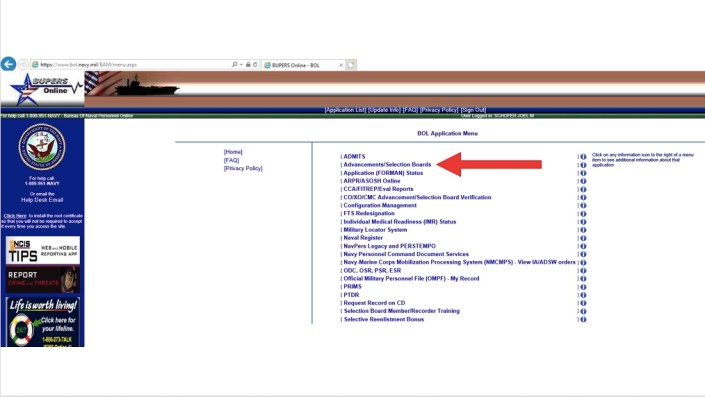
Now you should see a screen similar to this one:

As you can see, I was a “SELECT” for O6. If you actually were a non-select for promotion you’d see a “N” where my “S” is. If you were “scrubbed” from the promotion list, you’ll see an “H” for HOLD.
If you don’t see anything, then you didn’t fail to select. You probably weren’t looked at by the board. This most often happens to people who trained in the NADDS program in civilian training programs and weren’t on active duty for a whole year. Sometimes, though, these people will show up on the reserve promotion lists, so don’t lose hope until you check that list as well. As of now, the FY19 LCDR list for the reserves isn’t out yet.
If you are on hold, I’d contact your Detailer to try and find out why.
Director and Deputy Director of Professional Education at NMRTC Lejeune – O5+
The Director of Professional Education (DPE) and Deputy DPE positions will be opening at NMRTC Camp Lejeune this spring/summer. They are hoping to have at least one of the positions filled by the end of April.
If you have interest and clearance from your Detailer, the info is in the position descriptions below:
Assistant/Deputy Chief of GME and Medical Director of the Darnall Medical Library at WRNMMC – O4+
Details are in this document, and applications are due 23 MAR. Make sure you are already at WRNMMC or USUHS or have Detailer clearance to apply:
Director of Branch Clinics in 29 Palms
The Director of Branch Clinics (DBC) position for NMRTC-29 Palms is opening. The deadline for applications is 1 APR 2020 with the ability to assume duties in MAY 2020. All inquiries can be addressed to LCDR Jeremy Ramsey (contact in the global). Details are in this document:
As usual, you need clearance from your Detailer to apply.
 Joel Schofer's Career Planning Blog