Throwback Thursday Classic Post – Updated Instructions on How to Get the Executive/Expeditionary Medicine and Managed Care AQDs
You have your Detailing colleagues to thank for the update below…
How to Get the Executive/Expeditionary Medicine and Managed Care AQDs
Please go to the website below and use the “sign up” link. The new JMESP website address is:
https://jmesp.med.navy.mil/home
Please see “User Guidance” options at the website for instructions for both returning and new users available on the homepage. Under “All Users” is a PowerPoint presentation on how to add data. If you had an account in the old system (check maiden name if applicable), all you have to do to enter the site is reset your password. If did not have an account follow steps to establish an account.
Information on the other two Executive Medicine AQDs (67B Expeditionary and 67G Managed Care) is provided on the page, as well as a “Frequently Asked Questions.”
Now that you are on the website in your account follow these steps:
- Enter data.
- Courses (Check course for all services, e.g. “Combat Casualty Care” is an Army course and “MedXellence is a Joint-USUHS course)
- Education (Masters or higher required)
- Positions (by Corps)
- Certifications
- There is no need to send supporting documents unless requested.
- On the Competencies Attained if all boxes are checked, send us an e-mail: usn.bethesda.navmedprodevctrmd.list.nmpdc-jmesp@mail.mil. For MC, MSC and DC, provide your Detailer’s name; for NC your Planner’s name; if Reserve your Reserve Affairs Officer name. We will send verification for awarding. Member is copied on awarding e-mail.
- If boxes are not checked click on the lowercase letter ‘i” to see which competencies remain; you may satisfy remaining competencies (with the exception of Regulations) through Joint Medical Executive Skills online courses accessed through the following steps:
- Click Distance Learning
- Select courses associated with competency(ies) as listed on the chart (*If more than one module is indicated for the course, complete all modules).
- Courses generally take about an hour since they are not meant to make you an expert, but to provide you an overview of what to expect from your staff as CO/XO.
- Upon completion of online courses return to the website and add courses.
- Now if all boxes are checked, send us an e-mail: usn.bethesda.navmedprodevctrmd.list.nmpdc-jmesp@mail.mil. For MC, MSC and DC, provide your Detailer’s name; for NC your Planner’s name; if Reserve your Reserve Affairs Officer name. We will send verification for awarding. Member is copied on awarding e-mail.
General Program Information
The joint medical executive skills program formalizes the process designed to meet the congressional mandate which states in National Defense Authorization Act NDAA 1991, Sec. 8096. That “No appropriated funds used to fill the commander’s position at any MTF with a healthcare professional unless the candidate can demonstrate professional administrative skills.” This includes Commanding Officers, Executive Officers, and TRICARE Lead Agents prior to assignment.
JMESP is not a course, but a process through which officers are exposed to the congressionally mandated (through NDAA) 36 executive competencies through the following:
- Education: Master’s Degree or higher
- Approved Courses: Courses offered through Military Academic Institutions and Organizations, and service military medical departments’ sponsored courses. See Distance Learning for LEADS (formerly JMESI) courses located in Joint Knowledge Online.
- Experience: In both primary and certain collateral duties, executive and other board membership at military treatment facilities, operationally.
- Certification: Through medical and other health professional board certifying organizations and agencies.
If you have question not answered here, or at the website, contact usn.bethesda.navmedprodevctrmd.list.nmpdc-jmesp@mail.mil which includes both JMESP staff members for assistance.
Weekly GME Application Assistance Calls Starting Today
In an effort to assist with questions members may have regarding the GME application process, the Navy GME office will start holding weekly application assistance open call tel-cons – the dial-in information is below.
Currently we have only been able to reserve 50 ports (maximum available without additional justification) so would ask that only those individuals with questions dial-in. If we find that 50 ports is inadequate we will request additional ports in subsequent weeks. Of course, individuals are always welcome to email any questions to the email address in the BUMEDNOTE 1524 – usn.bethesda.navmedprodevctrmd.mbx.gme-sb@mail.mil.
Date – every Wednesday, starting 26 AUG until JSGMESB on 7 DEC 2020
Time – 1200-1300 (eastern)
Dial-In Numbers:
- Commercial, (210) 249-4234
- DSN, 421-3272, (312) for Overseas DSN
*** The Conference ID and PIN are needed to dial in***
Conference ID: 2477# Pin Code: 145720#
Aerospace Medicine Program Director and NAMI Academics Director
Please see the announcement below from the Flight Surgery Specialty Leader:
Colleagues,
I know a few of you have already talked to me or have asked about both the Program Director for the Aerospace Medicine Residency as well as the NAMI Academics Director for the flight surgeon program. The PD billet typically come with an extended set of orders, although they may be only written for 3 years, 5-6 years is not atypical. The Academics Director job is typically a 3-4 year billet. I lay this out so you know what you are getting yourselves into and understand this is not a 2 years and then retire plan. There is a small number of you that are eligible for these positions and this e-mail is directed at you, but I will be sending the announcement to the Corps Chief’s Office as well. There may be some interest outside of AMS for the Academics Director position, but that individual will need to have been active in flight surgery recently. The PD job obviously requires you to be board certified is Aerospace Medicine, so if you are not currently BC, then you need to sit for your boards in OCT and pass them. Research, leadership positions and the breadth of your experience will also factor into your application.
The application will include your biography, CV and a separate personal statement for each position. For each position, address you’re your motivation to assume that job and what your vision for the program is over a 5 and 10 year period. I know you will not be there for 10 years, but what do you want the program to look like in the future. How will increased UAV usage effect training? What about the gradual conversion of “GMO/OMO”’s to board certified physicians. How would that impact Flight Surgery Training? How would straight through training effect the RAM and what would that internship look like? These are some real questions that may need to be addressed during your time in the seat. Please keep this to 1-2 pages.
We will have a board to review the applications who will then select the next PD and Academics Director. The board will consist of the NAMI OIC, the incumbent, myself .and former TYCOM surgeons.
I know everyone is under different stresses, depending on their current billet, but please send me you applicant packages NLT 18 September. The intent is to have a decision made by October, so turnover plans can begin and the incoming PD and Academics Director can participate in resident selection as well as flight surgeon selection.
Please note this date is different than what I have on the announcement, since I did not get this out yesterday as expected.
Thanks!
V/R,
Rob
Robert J. “Biff” Krause, MD, MPH, CIME
CDR, MC (AMS), USN
Aerosapce Medicine Analyst
Naval Safety Center (Code 14A)
Specialty Leader, Aerospace Medicine and Flight Surgery
What are KSAs?
KSAs are Knowledge, Skills, and Abilities that Naval personnel are supposed to possess in order to do their jobs well. In order to ensure Naval medical personnel meet and exceed their operationally-focused KSAs, Navy Medicine is developing standardized enterprise-wide Naval Medical Readiness Criteria (NMRC), in support of readiness performance metrics. I stole that from slide 2 of this 4 slide PPT deck, which you should read as it provides some background:
As you can see from this portion of slide 3, the NMRCs are a work in progress and are actively in development:
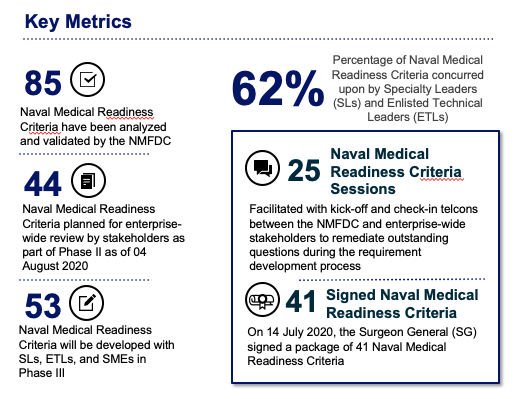
That said, the SG signed this memo on 14 JUL 2020 establishing the NMRCs in these 2 attachments:
Enclosure 1 – Combat Casualty Care Team
Enclosure 2 – Non-Combat Casualty Care Team
You should check out these attachments and see if your specialty has approved NMRCs.
How will people actually monitor and achieve these NMRCs? The Naval Medical Force Development Center (NMFDC), a part of BUMED, is developing dashboards to easily allow individuals and commands to see where they stand on their NMRCs. Once developed, it will be the Navy Medicine Readiness and Training Commands/Units (NMRTC/Us) that work to get their personnel ready and meeting their NMRCs.
If you look at the NMRCs, you’ll notice that they each have 3 categories:
- Category 1 – Core Practice/Clinical Currency – Fundamental training and skills, usually obtained through medical education and maintained through Medical Treatment Facility (MTF) experience and/or partnerships. This category of requirements links to the attainment of core practice, clinical currency, and KSA Threshold for medical personnel. ***Note that this is how KSAs fit into NMRCs, as part of category 1.***
- Category 2 – Expeditionary Skills for Readiness/Readiness Currency – Combat Specialty Knowledge – Individual skills specific to operating in an expeditionary environment. Category 2 Readiness Criteria ensures transference of Category 1 skills to the expeditionary environment, including patient care during combat operations. Category 2 Readiness Criteria also includes general platform training requirements for an individual specialty across the potential operating environment to which the individual would be assigned. This category of requirements links to the attainment of readiness currency.
- Category 3 – Platform Training for Readiness – Readiness Proficiency/Operational Platform – Team/Unit-level training specific to a platform or unit to which a Service member is assigned. This category of requirements links to the attainment of readiness proficiency and, as such, joint interoperability.
In other words, for me it isn’t just about being a competent Emergency Physician who meets his Emergency Medicine KSAs (Category 1) but also about applying that competence to the expeditionary setting (Category 2) and the specific platform I’m assigned to (Category 3).
If after reading this summary you have questions about KSAs, please ask your Specialty Leader. If they don’t know the answer, NMFDC is probably the next stop for answers (contact info is on page 2 of the SG’s memo) but the Corps Chief’s Office can certainly help with anything that is unresolved. CDR Wendy Arnold, Policy & Practice Officer, would be the first stop and her contact info is in the global address book. Lastly, you can always contact me.
ABC News – COVID-19 Diaries: Military physicians share inside look at efforts to save civilian patients in overburdened hospitals
Here’s a link to this article that discusses some Navy units deployed in CONUS in support of COVID-19:
Finance Friday Articles
Here are my favorites this week:
Earning Income in Multiple States
HOW REAL ESTATE AFFECTS YOUR TAXES
How Does the Fed “Prop Up” the Stock Market? (Interest Rates and Stock Prices)
Here are the rest of the articles:
6 Reasons Index Funds Remain King
8 Things Savvy Investors Understand
Asset Allocation (Part 2): The Risk / Growth Bucket
How to achieve investing success now and in the future
Lessons Driving an $800 Car Can Teach Your Kid
Risk Is Never as Simple as It Seems
Should You Use a Donor-Advised Fund?
Statistics Are Bloodless Things
The Flying V-Shaped Recoveries
Why Chasing Returns is a Sure Way to Lose: A Lesson From History
Throwback Thursday Classic Post – The New Medical Corps Career Progression Slide – What Does It Mean to You?
(As we resume travel and speak to MC Officers at different commands, it is clear that many have not seen the new career pathway, so I’m reposting this. Please pass it to all you know in the MC. Thanks.)
Navy Medicine has been undergoing a lot of change. We have a new Surgeon General, a new Corps Chief, and a renewed focus on readiness. With these changes come a new career progression and path for the Medical Corps (MC) Officer (PDF version, PPT version). Let’s take a look at the new model and discuss some of the ways it will impact you as your career progresses. We’ll start at the top of the slide and work our way down, translating it into action items for every MC Officer.
Intent and Expectations
What should a MC Officer note in this section? To be competitive for promotion, you need to have been operational AND clinical. The days of camping at Military Treatment Facilities (MTFs) are over. Everyone needs to be operationally relevant, and this is consistent with the most recent changes in the O6 promotion board convening order. It can be with the Surface Force, Fleet Marine Force (FMF), Undersea, Air, Special Operations, Joint environment, Expeditionary Combat Command, or any other operational setting you find yourself in. It doesn’t matter how or in what setting, but everyone needs to be operationally relevant.
Action #1 – Deliberately develop your operational relevance.
Recommended Medical and Professional Development Path
Very simply, this spells out your educational pathway. Completing residency and becoming board certified is not a new concept or path for the MC Officer. What is new, though, is the expectation that everyone will serve in an operational setting by the time they are up for promotion to O5 and in a more senior operational role before they are up for O6. The concept of everyone becoming an Operational Medical Officer (OMO) is explained in detail at the bottom of the slide.
In addition to serving as an OMO, the expectation is that those who want to serve in more senior roles will complete Joint Professional Military Education Levels I and II (JPME I/II) and obtain formal management or leadership training, such as a Master’s in Business Administration or similar degree.
Action #2 – Start JPME I now if you haven’t already, and develop a strategy and timeline with your mentors to obtain more senior education.
High Reliability Organization Training
The new SG is a huge proponent of high reliability, and Navy Medicine is constantly striving to adopt the principles of a High Reliability Organization (HRO). Many of the classes mentioned on the career path slide are undergoing modifications and updates to incorporate high reliability education.
Action #3 – Attend or complete the listed HRO courses.
Example Assignments
The example assignments are divided into Fleet and Navy Medicine Readiness and Training Command/Unit (NMRTC/U) positions. They are also stratified according to the typical ranks at which they would occur. These are general guidelines and variability will certainly occur, so be flexible. For example, we know that it takes a minimum of seven years to become a Neurosurgeon, so their path will vary. Other specialties that require longer training are in a similar situation. As a result of this, we are going to ask each Specialty Leader to take this generic career path and modify it for their own specialty.
Another takeaway from this portion of the slide is to alternate between operational assignments and NMRTC/U assignments where you are serving primarily in a clinical role, likely at an MTF. Time at the MTF will allow you to solidify your individual clinical skills and contribute to our Graduate Medical Education mission. After that tour, return to the operational setting in a more senior role. Rinse and repeat this pattern as your career progresses.
Action #4 – Print the career path slide and get a red and black pen. In black circle the jobs, roles, and courses you’ve already done. In red circle ones you’d like to do. When it is time for your next set of orders, jump from realm where you currently are (Fleet or NMRTC/U) to the other and aim for one of the positions to the right that you circled in red.
An Example – My Career Path
Just to visualize the way we are encouraging you to use the career path slide, let’s take a look at My Career Path. I circled the things I’ve done in black, and the things I’d like to do in red.
As a 19 year O6, I have a lot of black ink, but there are some red circles to the right indicating the things I’d like to do. As the Deputy Corps Chief, I am currently in a senior headquarters role toward the right end of the Fleet portion. Most likely, my next career move will be to obtain JPME II or enter Executive Medicine as an Executive Officer (XO) because completing an XO and Commanding Officer (CO) tour is mandatory before I can compete for the more senior leadership roles. Use a similar analysis of where you’ve been (black ink) and where you want to go (red ink) to come up with options for your next career move.
Summary
The new MC career path should serve as the basic framework around which you structure your career. A quick summary of the actions you should take include:
- Deliberately develop your operational relevance.
- Start JPME I now if you haven’t already, and develop a strategy and timeline with your mentors to obtain more senior education.
- Attend or complete the listed HRO courses.
- Circle the jobs, roles, and courses you’ve already done in black. Circle ones you’d like to do in red. When it is time for your next set of orders, jump from the realm where you currently are (Fleet or NMRTC/U) to the other and aim for one of the positions to the right that you circled in red.
 Joel Schofer's Career Planning Blog