DHA Ready Reliable Care High Reliability Organization Awards
Details for these awards are in the following files:
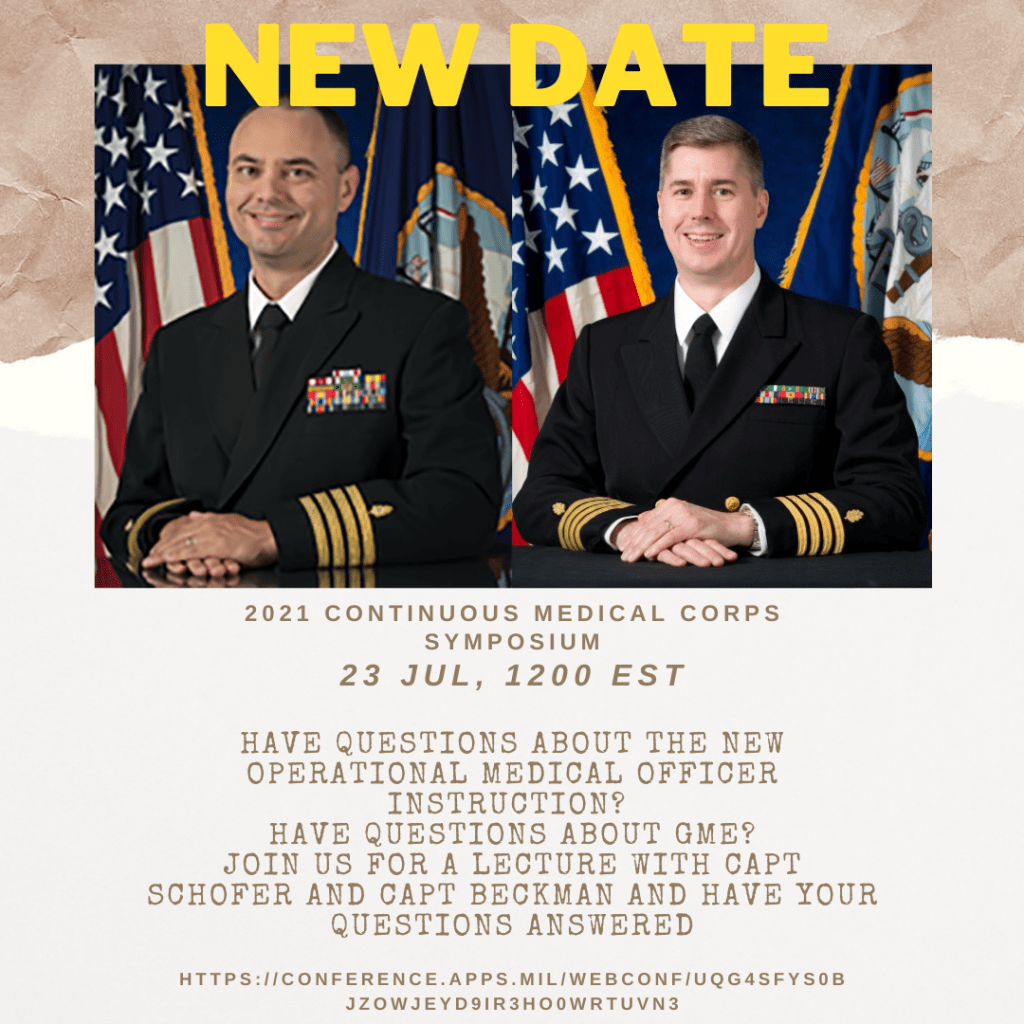
Rescheduled Operational Medical Officer and GME Q&A Session – Friday at Noon Eastern
The GME and OMO talk has now been rescheduled for 23 July at 1200 EST. Please join us virtually at https://conference.apps.mil/webconf/uqg4sfys0bjzowjeyd9ir3ho0wrtuvn3 to have your questions answered regarding the new OMO instruction and GME Note that was just released.
The session will be recorded for asynchronous viewing and that link will be available following the session. Please direct any questions to LCDR Jennifer Eng-Kulawy in the Corps Chief’s Office (contact in the global).
Virtual Senior Leadership Course Openings
The two Senior Leadership Courses (hosted by Naval Leadership and Ethics Center) in August still have several vacancies. Courses are currently being conducted virtually, so it is a great opportunity to get the training and save command travel funding. Dates for the courses are 2-6 Aug and 9-13 Aug, and registration is via CANTRAC. More info follows.
Course Description: The Navy Senior Leader Course (SLC) presents a 5-day seminar for Navy Senior Officers at the pay grade of O6, O5 and O5 selects. This course is designed to facilitate formal leadership and ethics education for Navy Senior Officers to support Fleet Centered Leader Development (FCLD) and the CNO’s Leader Development Outcomes. The course will prepare senior officers heading to fleet-wide positions requiring responsible, and comprehensive leadership abilities by promoting professional growth in ethics, self-awareness, leader development, and decision making. SLC is an education class not a training class taught using the adult learning environment that benefits from seminar participation and experiential learning focusing on inter-active leadership development. All students will participate in a personality assessment that is required to be complete prior to the class convening.
Process: Officers requesting SLC must contact their Command Staff Education and Training (SEAT) officer. SEAT Officers will register officers utilizing CeTARS / eNTRS. The class CIN is H-7C-0107; the Newport class CDP is 19UT; and the Dam Neck class CDP is 19UV.
The Newport Course POC is CDR Jill Skeet, NC, USN and has offered to assist anyone have issues registering via CANTRAC.
July Sailor-to-Sailor Newsletter
Shipmates,
With July marking the start of the Navy’s first PFA cycle in over a year and a half, this month’s edition of our Sailor-to-Sailor newsletter, leads off with what Sailors need to know about some new rules now in place. Also, we have featured a wrap up of some of the significant topics discussed at last month’s CNP Worldwide Town Hall broadcast.
Here’s the link to the July newsletter: https://go.usa.gov/x6hGy
Other highlights in this month’s edition include:
– Coaching in the Ranks is Important – Here’s Why
– MyNavy HR Transformation to Revolutionize Personnel and Pay Systems
– Blended Retirement System CY 2022 Continuation Pay Announced
– Changes Coming to CLREC Navy Global Deployer App
Your feedback on the Sailor-to-Sailor newsletter is always welcome. You can reach us at MyNavyHR@navy-mil or on our social media properties @MyNavyHR on Facebook, Twitter and Instagram to have your voice heard.
Thank you for everything you are doing and stay safe!
V/r,
The MyNAVY HR Team
Finance Friday Articles
- 5 best states for veterans to retire
- Courtside Seat for Estate Planning
- Financial Considerations for Moonlighting as an Independent Contractor
- I DON’T KNOW HOW TO INVEST AND I’M AFRAID OF MAKING EXPENSIVE MISTAKES
- Is Tax-Loss Harvesting Worth It?
- Keeping Our Heads
- Simple strategies for reducing inflation risk
- Six Important Reasons Not to Retire Early
- Strongest Inflation in 13 Years
- Why Do We Always Focus on the Bad Stuff?
Tips to Get Selected for GME – A 2021 Update
With the recent release of the 2021 GME note, I’d like to re-post an updated version of this post. I’ve participated in the last seven GME selection boards and would like to offer tips for people looking to match for GME in the future. We’ll cover general tips and those specific for medical students and those returning from an operational tour:
General Tips
- You can increase your score by having publications. If you want to give yourself the best chance of maximizing your score, you need multiple peer-reviewed publications. Any publications or scholarly activity have the chance to get you points, but having multiple peer-reviewed publications is the goal you should be trying to reach.
- Be realistic about your chances of matching. If you are applying to a competitive specialty and you’ve failed a board exam or had to repeat a year in medical school, you are probably not going to match in that specialty. There are some specialties where you can overcome a major blight on your record, but there are some where you can’t. If this is applicable to you, the residency director or specialty leader should be able to give you some idea of your chances. Will they be honest and direct with you? I’m not sure, but it can’t hurt to ask.
- If you are having trouble matching in the Navy for GME, you may have a better chance as a civilian. By the time you pay back your commitment to the Navy, you are a wiser, more mature applicant that some civilian residency programs might prefer over an inexperienced medical student. You’ll also find some fairly patriotic residency programs, usually with faculty who are prior military, that may take you despite your academic struggles.
Tips for Medical Students
- Do everything you can to do a rotation with the GME program you want to match at. You want them to know who you are.
- We have started our transition to straight-through GME, so you’ll notice that most specialties are considering applications from medical students for straight-through GME. If you don’t want to do straight-through and only want to apply for internship, you can opt out on MODS.
- When you are applying, make sure your 2nd choice is not a popular internship (Emergency Medicine, Orthopedics, etc.). If you don’t match in your 1st choice and your 2nd choice is a popular internship, then it will likely have filled during the initial match. This means you get put in the “intern scramble” and you’ll likely wind up in an internship you didn’t even list on your application.
- Your backup plan if you don’t match should be an alternative program at the same site where you eventually want to match for residency. For example, in my specialty (Emergency Medicine or EM) we only have residencies at NMCP and NMCSD. If someone doesn’t match for an EM internship at NMCP or NMCSD, they will have a better chance of eventually matching for EM residency if they do an internship locally, like a transitional internship. Internships at Walter Reed or any other hospital without an EM program are quality programs, but it is much easier to pledge the fraternity if you are physically present and can get to know people, attending conferences and journal clubs when you can.
- You need to think about what you will do in your worst-case scenario, a 1-year civilian deferment for internship. Many of the medical students I have interviewed did not have a plan if they got a 1-year deferment. I think every medical student needs to pick a few civilian transitional year internships (or whatever internship they want) and apply to those just in case they get a 1-year deferment. Per the BUMED note, this is required. Most medical students do not grasp the concept that this could happen to them and have no plan to deal with it if it does. It is an unlikely event, especially if you are a strong applicant, but it is something you need to think through.
- Similarly, if your first choice specialty is offering civilian NADDS deferments, you need to apply to civilian residency programs. This is also required, per the BUMED note. You don’t want to find out that you were given a NADDS deferment but you didn’t apply for civilian residency programs. This happens to people all the time. Don’t be that student.
Tips for Applicants Returning from Operational Tours
- You should show up whenever you can for conferences and journal clubs. Again, you want them to know who you are and by attending these events when you can you demonstrate your commitment to the specialty and their program.
- Always get a warfare device (if one is available) during your operational tour. Not having it is a red flag.
- Closely examine the GME note and by-site goals. You’ll see that some specialties are offering full-time outservice (FTOS) or civilian deferment (RAD-to-NADDS). If you are in one of these specialties, you need to consider applying for civilian residency programs. If you are unsure, you should probably talk to the specialty leader for whatever specialty you are applying for.
Graduate Medical Education Note/Goals and Operational Community Info
Here is the GME BUMED Note as well as the by site selection goals. Please disseminate far and wide!
Most importantly, just because there is not an initial training goal does not mean people should not apply. If an applicant wants to do something not on the initial goals, they should still apply. The world in March when we started this plan will be different than the one in November when we execute it.
Note that this is the beginning of our 5-year march to straight-through GME as most specialties will be offering some straight-through training opportunities to medical students.
Also, because medical students will be deciding whether or not they want to apply for straight-through training vs doing an internship and then an operational tour, we created this PDF guide to the various operational communities:
This content will eventually be on a public facing website, but that process has been slower than we’d like, so the PDF will serve as a bridge until the site is ready.
 Joel Schofer's Career Planning Blog