Retirement
Navy Times – Senior Officer Retirement Boards Make Cuts
Here’s a link to the article about the 33 CDRs and CAPTs that they cut. I have no idea if any were medical:
The Navy is Not Going to Let You Retire Early
There have been recent discussions about cuts in military medicine and POM20, and some people found this recently signed policy about early retirements. They put 2 and 2 together and figured that they might be able to retire early.
The message from BUMED is that this was merely the required periodic update of the existing early retirement policy. It was unfortunate timing and there are no plans to use it that they know of.
If that changes, you’ll hear it here as soon as I can get it out there.
Navy Times Article – Are You an Officer Facing the Retirement Boards?
Here’s a link to the Navy Times article on the early retirement boards that were just announced for CDRs and CAPTs:
Are you an officer facing the retirement boards?
The Medical Corps Chief’s message about the boards can be found here.
Medical Corps Chief Comments on the FY-19 Active Duty Navy CDR and CAPT Selective Early Retirement Boards NAVADMIN
Here’s the message from RDML Pearigen, Chief of the Medical Corps, about the NAVADMIN:
Fellow Medical Corps officers:
I am writing to tell you a little more about the Selective Early Retirement
board described in the attached NAVADMIN just released. This is
particularly relevant for O-6 and O-5 officers, and I ask that you read the
below and the associated NAVADMIN carefully to understand and, importantly,
to ensure you have accurate perspective on this.
As part of Navy’s efforts to sharpen a high performing and talented senior
officer corps, this NAVADMIN announces convening of Selective Early
Retirement (SER) boards for OFFICERS this September for the FY-19 cycle.
Importantly, these SER boards are being conducted for specific reasons and
are different from the last time this was done in the Navy, the FY-12
Unrestricted Line (URL) SER board held in 2011.
Convening officer SER boards to review the records of senior O-5s and O-6s
under this new construct is the same sort of review the Navy routinely
conducts for our Chief Petty Officers via the Senior Enlisted Continuation
Boards. It is intended to ensure that the senior officers leading our Navy
are in fact performing at the level expected of their current paygrade.
Why now, when we are trying to grow the Navy the Nation Needs? Now, more
than ever, we need leaders with both the character and competence to lead
our Navy, and Navy Medicine. Previously, the authority to conduct such a
review had only been available as a force reduction measure. THIS ITERATION
IS NOT BEING PERFORMED WITH ANY FORCE REDUCTION TARGET.
In contrast to the FY-12 SER board (which again only affected URLs, not
Staff Corps), selection quotas for the FY-19 SER board will not be
directed-i.e., there is NO minimum quota to be met-as the purpose is not to
remove excess officers from inventory. Selecting zero officers for early
retirement is an acceptable outcome, and may very well be the result we see
for communities where all eligible officers are performing at the level
expected for their paygrade.
Unlike the FY-12 board which just considered the URL, all competitive
categories (URL/RL/Staff) will be looked at-the quality standard applies
across the entire officer corps.
The O-5 boards will consider officers with two or more failures of selection
to O-6, and the O-6 boards will consider officers with three or more years’
time in grade. **Failures of selection in and of themselves are NOT grounds
for early retirement-we have many officers in that situation who work hard
and provide valuable contributions to our Navy and to Navy Medicine. The
boards will be provided with very specific guidance from SECNAV that average
performance is fine, but taking the pack off is not.
CNP strongly recommends that officers who are performing at or above
standards should not pre-emptively submit retirement requests. Officers who
might have been disadvantaged by the forced distribution system of today’s
FITREP are not the target of this SER board, if they are still performing.
The board will not be looking at PFA failures, nor it is designed to replace
a Show Cause determination or a Board of Inquiry, but they will look at
disciplinary issues in the context of the entire documented record.
The numbers of Medical Corps officers selected for early retirement are
expected to be small, perhaps even zero. Only those who are not performing
will be selected for early retirement. Those selected for early retirement
will retire in grade, with full benefits, as if it were voluntary. So the
best strategy for those who know they are performing-have confidence in your
performance record, and in the board process.
If you have questions, please contact CAPT Chris Quarles, Deputy Medical
Corps Chief.
Finally, the vast majority of you are performing exceptionally well as Navy
physicians and officers, and we know that. More importantly, I appreciate
your performance and your service. Be confident in your performance, your
competence and your character.
RDML Pearigen sends.
Paul D. Pearigen, MD, MMM, CPE, FAAEM
RDML, MC, USN
Commander, Navy Medicine West
Chief of the Navy Medical Corps (M00C1)
UNCLASSIFIED

ROUTINE

R 091450Z AUG 18

FM CNO WASHINGTON DC

TO NAVADMIN

INFO CNO WASHINGTON DC

BT
UNCLAS
NAVADMIN 193/18
PASS TO OFFICE CODES:
FM CNO WASHINGTON DC//N1//
INFO CNO WASHINGTON DC//N1//

MSGID/GENADMIN/CNO WASHINGTON DC/N1/AUG//

SUBJ/NOTICE OF CONVENING FY-19 ACTIVE-DUTY NAVY COMMANDER AND CAPTAIN
SELECTIVE EARLY RETIREMENT BOARDS//

RMKS/1.  As we seek to grow the Navy, we remain focused on warfighting and
lethality by ensuring we have the right officer talent to meet the mission of
the Navy.  To this end, the Secretary of the Navy approved the convening of
FY-19 Selective Early Retirement (SER) Boards, for regular captains and
commanders on the active-duty list by grade and competitive category.  The
boards will convene on 13 September 2018 and are strictly about ensuring
quality, not force management.

2.  The decision to hold FY-19 SER boards was made after considerable thought
and careful deliberation.  Our growing Navy requires the most consistently
reliable top performers to lead and sustain a modern, ready and lethal force
as the number of ships and squadrons and required manpower levels increase.
We are committed to retaining and promoting the right leaders to meet the
challenges of tomorrow, and enforcing the highest performance standards sets
for Navy leaders the necessary tone and expectation for subordinates to
emulate.  SER boards are comparable to the already successful Senior Enlisted
Continuation Board process for quality control of our senior leaders.  Each
board will select only those officers whose early retirement, in the opinion
of a majority of the board members, is in the best interest of the Navy.
When determining those officers who should be recommended for early
retirement, the SER boards will consider a number of factors, including
performance, the requirement for exemplary conduct, and adverse information.
The majority of the officers whose records are being reviewed for these
boards are fully capable of performing the duties of their current grade.
Selecting zero officers in a competitive category is an acceptable outcome
for these boards because no mandatory quotas have been established.  The
process of reviewing records and selecting officers for early retirement
ensures the Navy will have a professional, healthy senior officer corps that
is ready to meet the demands of the Navy the Nation needs.

3.  The following officers may be considered for SER:
    a.  Captains (O-6).  Officers who are in year groups specified in
paragraph 6, have 3 or more years time in grade, and who are within the zone
defined in paragraph 6 for their competitive category.
    b.  Commanders (O-5).  Officers who are in year groups specified in
paragraph 6, who have failed of selection for promotion to the grade of
captain two or more times, and who are within the zone defined in paragraph 6
for their competitive category.

4.  The following officers are not eligible for consideration by the SER
board:
    a.  Officers with approved voluntary retirement requests.
    b.  Officers with statutory retirements in FY-18 or FY-19.
    c.  Officers whose names are on a list of officers recommended for
promotion.

5.  Officers selected for early retirement will be formally notified as soon
as possible after the proceedings of the boards are approved.  Officers
selected and approved for early retirement are required by law to be retired,
if retirement eligible, on the first day of the seventh month after the month
in which the board report is approved.  For the FY-19 SER boards, this
mandatory retirement date is anticipated to be 1 May 2019.  If an officer is
not eligible for retirement, then the officer will be retained on active duty
until the officer is qualified for retirement, then retired not later than
the first day of the month beginning after the month in which the officer
becomes qualified for retirement.

6.  The following list indicates the name, active-duty list (lineal) number,
and date of rank of the senior officer and junior officer who are eligible
for consideration for early retirement in the following competitive
categories.  All officers listed below, as well as those whose lineal number
falls between the senior and junior officer listed, will be considered by the
SER boards, subject to the limitations in paragraph 4.
                              Captain
                               Line
                 Unrestricted Line Officer (11XX/13XX)
                       Year Groups 1984-1994
Senior eligible - CAPT A. T. Cowden           010592-00  1 OCT 2005
Junior eligible - CAPT R. E. Loughran Jr.     016003-00  1 SEP 2015
           Special Duty Officer (Human Resources) (120X)
                        Year Groups 1989-1994
Senior eligible - CAPT P. L. Williams         011571-00  1 SEP 2009
Junior eligible - CAPT L. A. Newton           016030-00  1 SEP 2015
    Special Duty Officer (Permanent Military Professor) (123X)
                         Year Groups 1981-1988
Senior eligible - CAPT M. A. Carr             015362-50  1 OCT 2013
Junior eligible - CAPT J. M. Freymann         015362-50  1 SEP 2014
                   Engineering Duty Officer (14XX)
                         Year Groups 1989-1995
Senior eligible - CAPT M. R. Vandroff         011624-00  1 JAN 2010
Junior eligible - CAPT R. A. Wolf             016025-50  1 SEP 2015
     Aerospace Engineering/Maintenance Duty Officer (15XX)
                         Year Groups 1989-1994
Senior eligible - CAPT S. D. Porter           011879-00  1 OCT 2010
Junior eligible - CAPT C. J. Couch            015977-50  1 SEP 2015
            Special Duty Officer (Public Affairs) (165X)
                         Year Groups 1989-1994
Senior eligible - CAPT P. S. Kunze            011651-50  1 MAR 2010
Junior eligible - CAPT C. W. Brown            015952-00  1 SEP 2015
             Special Duty Officer (Foreign Area) (17XX)
                         Year Groups 1989-1995
Senior eligible - CAPT T. J. Maricle          011763-00  1 JUL 2010
Junior eligible - CAPT R. F. Ogden            016027-00  1 SEP 2015
             Special Duty Officer (Oceanography) (180X)
                         Year Groups 1990-1992
Senior eligible - CAPT A. J. Reiss            011931-00  1 MAY 2011
Junior eligible - CAPT S. P. Memmen           015880-50  1 SEP 2015
           Special Duty Officer (Cryptologic Warfare) (181X)
                         Year Groups 1984-1994
Senior eligible - CAPT D. B. Carson           011799-50  1 AUG 2010
Junior eligible - CAPT M. Riggins             016010-50  1 SEP 2015
          Special Duty Officer (Information Professional) (182X)
                         Year Groups 1989-1994
Senior eligible - CAPT A. A. Brady            011654-00  1 SEP 2013
Junior eligible - CAPT J. D. Buss             016020-50  1 SEP 2015
              Special Duty Officer (Intelligence) (183X)
                         Year Groups 1990-1994
Senior eligible - CAPT D. H. McAllister       012224-50  1 SEP 2011
Junior eligible - CAPT E. J. Padinske         015951-50  1 SEP 2015
          Limited Duty Officer (Line) (61XX/62XX/63XX/64XX/68XX)
                         Year Groups 1993-1994
Senior eligible - CAPT W. R. Johnson          015883-00  1 SEP 2015
Junior eligible - CAPT G. D. Martin           015890-50  1 SEP 2015
                                 Staff Corps
                          Medical Corps (210X)
                         Year Groups 1978-1994
Senior eligible - CAPT C. L. Gandee           010033-50  1 JUL 1999
Junior eligible - CAPT M. E. Farrell          016020-00  1 SEP 2015
                          Dental Corps (220X)
                         Year Groups 1980-1993
Senior eligible - CAPT J. H. Gherardini Jr.   010185-50  1 MAR 2003
Junior eligible - CAPT K. Saito               016018-00  1 SEP 2015
                       Medical Service Corps (230X)
                         Year Groups 1986-1994
Senior eligible - CAPT D. P. Barrette         011005-00  1 SEP 2007
Junior eligible - CAPT K. J. McGowan          016034-00  1 SEP 2015
                     Judge Advocate Generals Corps (250X)
                         Year Groups 1987-1993
Senior eligible - CAPT C. N. Purnell II       011349-50  1 JAN 2009
Junior eligible - CAPT M. A. Larrea           016005-50  1 SEP 2015
                        Nurse Corps (290X)
                      Year Groups 1985-1993
Senior eligible - CAPT D. J. Stafford         010745-00  1 SEP 2006
Junior eligible - CAPT A. C. Petrovanie       016012-50  1 SEP 2015
                          Supply Corps (310X)
                         Year Groups 1990-1994
Senior eligible - CAPT G. J. Powe             012315-50  1 FEB 2012
Junior eligible - CAPT J. L. Tucker           015906-00  1 SEP 2015
                          Chaplain Corps (410X)
                         Year Groups 1986-1992
Senior eligible - CAPT W. M. Kennedy          011451-00  1 JUL 2009
Junior eligible - CAPT G. C. Cathcart         016035-00  1 SEP 2015
                       Civil Engineer Corps (510X)
                         Year Groups 1991-1994
Senior eligible - CAPT P. A. Garin            012267-50  1 SEP 2011
Junior eligible - CAPT B. S. Weinstein        016016-50  1 SEP 2015
                  Limited Duty Officer (Staff) (65XX) Senior eligible  N/A
Junior eligible - N/A
                              Commander
                                Line
                   Unrestricted Line Officer (11XX/13XX)
                         Year Groups 1990-1997
Senior eligible - CDR J. C. Cannon            020382-50  1 JUL 2003
Junior eligible - CDR S. I. Campbell          023097-50  1 SEP 2012
              Special Duty Officer (Human Resources) (120X)
                         Year Groups 1990-1997
Senior eligible - CDR W. L. Hendrickson       021027-00  1 FEB 2006
Junior eligible - CDR K. M. Miller            023116-00  1 SEP 2012
    Special Duty Officer (Permanent Military Professor) (123X)
                         Year Groups 1992-1998
Senior eligible - CDR J. C. Woertz            021289-25  1 FEB 2007
Junior eligible - CDR D. P. Durkin            023407-50  1 JAN 2014
                     Engineering Duty Officer (14XX)
                         Year Groups 1992-1998
Senior eligible - CDR D. Demille              021274-25  1 JAN 2007
Junior eligible - CDR J. W. Ketcham           023159-25  1 JAN 2013
     Aerospace Engineering Duty Officer (Engineering) (151X)
                         Year Groups 1994-1997
Senior eligible - CDR M. R. Conover           021932-00  1 APR 2009
Junior eligible - CDR M. J. Percy             023094-75  1 SEP 2012
     Aerospace Engineering Duty Officer (Maintenance) (152X)
                         Year Groups 1991-1997
Senior eligible - CDR E. A. Santiago          021151-00  1 AUG 2006
Junior eligible - CDR J. M. Belmont           022972-00  1 JUN 2012
            Special Duty Officer (Public Affairs) (165X)
                         Year Groups 1995-1996
Senior eligible - CDR S. D. McIlnay           022126-50  1 SEP 2009
Junior eligible - CDR G. L. Ross              022538-75  1 SEP 2013
               Special Duty Officer (Foreign Area) (17XX)
                         Year Groups 1985-1996
Senior eligible - CDR M. J. Nyilis            020096-25  1 JUL 2007
Junior eligible - CDR M. P. Meydenbauer       023134-50  1 OCT 2012
            Special Duty Officer (Oceanography) (180X)
                         Year Groups 1992-1996
Senior eligible - CDR A. Lomax                021340-75  1 JUN 2007
Junior eligible - CDR A. G. Turek             023133-50  1 OCT 2012
          Special Duty Officer (Cryptologic Warfare) (181X)
                         Year Groups 1993-1997
Senior eligible - CDR R. R. Purifoy           021639-25  1 JUN 2008
Junior eligible - CDR D. W. Filanowicz        023378-25  1 OCT 2013
      Special Duty Officer (Information Professional) (182X)
                         Year Groups 1982-1998
Senior eligible - CDR N. D. Villarin          020056-75  1 NOV 1998
Junior eligible - CDR P. C. Breuer            023299-25  1 SEP 2013
               Special Duty Officer (Intelligence) (183X)
                         Year Groups 1992-1997
Senior eligible - CDR P. E. Durbin            021341-75  1 JUN 2007
Junior eligible - CDR J. P. Dewan             022986-25  1 AUG 2012
         Limited Duty Officer (Line) (61XX/62XX/63XX/64XX/68XX) Senior
eligible  N/A Junior eligible - N/A
                              Staff Corps
                          Medical Corps (210X)
                         Year Groups 1984-1996
Senior eligible - CDR S. A. Magnes            020084-25  1 OCT 2000
Junior eligible - CDR J. Miller               023124-00  1 SEP 2012
                          Dental Corps (220X)
                         Year Groups 1982-1997
Senior eligible - CDR R. S. Thompson          020046-87  1 AUG 1998
Junior eligible - CDR M. E. Rudmann           023101-50  1 SEP 2012
                       Medical Service Corps (230X)
                         Year Groups 1987-1997
Senior eligible - CDR D. Economos             020654-00  1 SEP 2004
Junior eligible - CDR D. A. Rochino           023351-50  1 SEP 2013
                   Judge Advocate Generals Corps (250X)
                         Year Groups 1991-2001
Senior eligible - CDR E. B. Obrien III        021481-25  1 SEP 2007
Junior eligible - CDR B. J. Halliden          023396-00   1 DEC 2013
                           Nurse Corps (290X)
                         Year Groups 1987-1997
Senior eligible - CDR A. Williams             022775-50  1 SEP 2011
Junior eligible - CDR M. A. French            023302-75  1 SEP 2013
                          Supply Corps (310X)
                         Year Groups 1985-1997
Senior eligible - CDR C. A. Culwell           022153-00  1 NOV 2011
Junior eligible - CDR J. Gray                 023006-50  1 SEP 2012
                         Chaplain Corps (410X)
                         Year Groups 1987-1997
Senior eligible - CDR B. A. Metzger           022362-50  1 AUG 2010
Junior eligible - CDR H. R. McClellan Jr.     023208-50  1 JUL 2013
                       Civil Engineer Corps (510X)
                         Year Groups 1992-1997
Senior eligible - CDR C. E. Bowers            021565-25  1 JAN 2008
Junior eligible - CDR T. B. McLemore          023105-50  1 SEP 2012
                 Limited Duty Officer (Staff) (65XX)
                         Year Group 1999
Senior eligible - CDR A. C. Ting              023117-00  1 SEP 2012
Junior eligible - N/A

7.  Officers in the zone defined above who are on active duty when the boards
convene but do not meet eligibility requirements specified in paragraph 3, or
are not eligible in line with paragraph 4, will not be considered for early
retirement by the SER boards.

8.  SER eligible officers may submit requests for voluntary retirement.

9.  By law, the number of captains and commanders selected for retirement
within each competitive category and grade may not exceed
30 percent of those eligible officers considered by the boards.

10.  Only eligible officers may communicate with a selection board.
Correspondence must arrive no later than 10 calendar days before the
convening date of the board and shall be addressed to:
    Navy Personnel Command (NPC) Customer Service Center
    President Active-Duty FY-19 (Grade) (Line or Staff Corps, as
applicable)
    Selective Early Retirement Board, Board #XXX, (Board number is a required
field and may be found on the FY-19 selection board schedule located at
http://www.public.navy.mil/bupers-
npc/boards/selectionboardsupport/Pages/FY19-Board-Schedule-.aspx
    5720 Integrity Drive, Millington, TN 38055-6300 To check on receipt of
your package, go to
http://www.public.navy.mil/bupers-
npc/boards/activedutyofficer/pages/default.aspx and enter the customer
service center link (check on your letter to the board) or contact the
customer service center at (866)827-5672.  Written communication may invite
to the attention of the board any matter concerning himself/herself that the
officer considers important.
The written communication must be in line with MILPERSMAN 1420-010 and may
include, as enclosures, correspondence from any individual concerning the
eligible officer.  Correspondence not originated by the eligible officer,
including letters written on behalf of that officer, must contain a written
acknowledgement by the eligible officer that he or she desires that such
correspondence be presented to the board.  Correspondence without such
acknowledgment is considered third party correspondence and will be returned.
Classified correspondence will not be accepted.

11.  The cscselboard(at)navy.mil mailbox account is capable of receiving
ENCRYPTED correspondence in line with DoD policy.  If you are sending your
board package from a non-NMCI network (BUMED.mil, EU.NAVY.mil, etc.), please
visit https://dod411.gds.disa.mil to download the required mailbox
certificate.  To download the *Cert* (please note, you MUST be using MS
Outlook with a CAC reader, including ActivClient software and have Internet
Explorer or Netscape 7.X), go to https://dod411.gds.disa.mil, type
cscselboard(at)navy.mil in the *E-Mail address* field, then click
*Search.*  Click the *BUPERS* link under *Last Name.*  Click on the link
*Download Certificate(s) as vCard.*  Click *Software Certificate for
cscselboard(at)navy.mil.*  Click the *Open* button for the *File Download*
pop-up.  The certificate will then open.
Click *Save and Close.*  The certificate is then saved to the profile and can
be used to send your encrypted e-mail.

12.  This NAVADMIN is cancelled for record purposes on 30 May 2019.

13.  Released by Vice Admiral R. P. Burke, N1.//

BT
#0001
NNNN
UNCLASSIFIED//
Getting Retirement Credit for HPSP in the Reserves
In the recently released Winter Medical Corps Newsletter, I noticed this paragraph in the “Readiness in the Reserves” article:
Shipmates,
I have just returned from PERS-9 (Reserves), reviewing important administrative processes. Here is the gouge…
HPSP Credit: Jeanitta Edwards verifies that the member was a HPSP participant and that the member is in a critical wartime skill (defined by DOD each year). Once she verifies this information, she sends it to another individual to load in the points for the year as credit towards retirement. The instruction requires a full year of service to receive credit for 1 year and caps the credit at 4 years. Unfortunately, because many medical schools start in July and graduate in May, the 4th year does not qualify. Some may have earned other points that year which can carry over for credit towards a good year. The 15 gratuity points are allocated on a pro rata basis so you will only get half those points for a half a year of participation. We will post the guiding documents to the Medical Corps Homepage. Please note that the actual HPSP policy is currently being rewritten.
A reader asked, “What are the official critical wartime specialties?”
Here is the portion of the document that lists them:
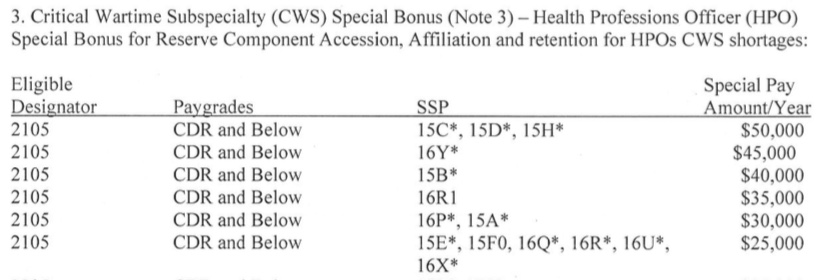
So what do those mysterious codes mean? They are defined in the Promo Prep, but since I’m such a nice guy here is the translation. The CWS include:
- General Surgery (15C)
- Neurosurgery (15D)
- Orthopedics (15H)
- Radiology (16Y)
- Anesthesia (15B)
- Internal Medicine Subspecialties (16R1)
- Emergency Medicine (16P)
- Flight Surgery (15A)
- OB/GYN (15E)
- GMO (15F)
- Family Medicine (16Q)
- General Internal Medicine (16R)
- UMO (16U)
- Psychiatry (16X)
Update just prior to publication – My wife (a Reservist) was sent this chart in the Health Professions Officer Special and Incentive Pay Plan, and the specialties under “USNR” match the list above:
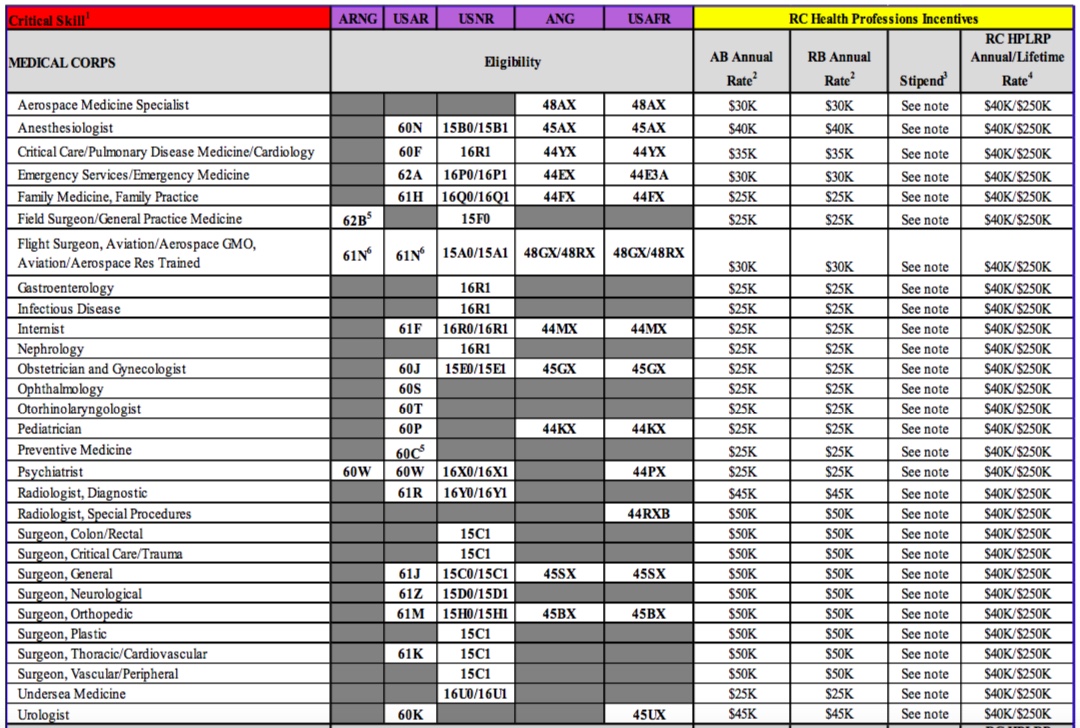
If you are in one of these specialties, you can get retirement credit for your time in HPSP (or at least 3 years of the 4). In addition to the info above, here is what else I could find about this program:
Army Policy – Guidance on Reserve Service Credit for Participation in DOD HPSP and FAP
Recruiting and Retention Incentives for Reserve Component Health Professions Officers
Retirement and Separation/Resignation Requests Now Requested in NSIPS
I announced this change back in November, but it has officially gone live. Anyone with access to NSIPS is required to use it for retirement and resignation requests effective 1 January, 2018.
The new system allows members to initiate retirement and separation requests electronically via NSIPS self service, route them through their chain of command for review and recommendation, and then electronically route the request to Navy Personnel Command (NPC) for a decision. This improvement provides transparency for service members as to the status of their request, provides an integrated waiver process when needed, and provides an electronic notification of the final disposition of the request for both the member and the command.
Also of note, statutory retirement notifications are now being generated through NSIPS to eliminate printing and distributing business letters via the postal service. A statutory retirement occurs when a LCDR hits 20 years of commissioned service (not counting enlisted time), a CDR 28 years, and a CAPT 30 years.
Early Separation Policy NAVADMIN Cancellations
The NAVADMIN is below and here if you want to read it, but what is the short story? The Navy is growing, and they’re not going to let you out early anymore. In other words, if you want to RETIRE (not resign) as a CDR or CAPT, you are going to have to serve your full 3 years in that rank before they’ll let you out. You can read more details in this post.
UNCLASSIFIED
ROUTINE
R 131504Z DEC 17
FM CNO WASHINGTON DC
TO NAVADMIN
INFO CNO WASHINGTON DC
BT
UNCLAS
PASS TO OFFICE CODES:
FM CNO WASHINGTON DC//N1//
INFO CNO WASHINGTON DC//N1//

NAVADMIN 288/17

MSGID/GENADMIN/CNO WASHINGTON DC/N1/DEC//

SUBJ/EARLY SEPARATION POLICY NAVADMIN CANCELLATIONS//

REF/A/MSG/CNO WASHINGTON DC/N1/081628ZMAY14//
REF/B/MSG/CNO WASHINGTON DC/N1/171732ZAUG16//
REF/C/DOC/COMNAVPERSCOM/23AUG06//
NARR/REF A IS NAVADMIN 103/14, ENLISTED EARLY TRANSITION PROGRAM.
REF B IS NAVADMIN 182/16, TIME-IN-GRADE AND NEXT-LOWER-GRADE WAIVERS.
REF C IS MILPERSMAN 1300-500, REASSIGNMENT FOR HUMANITARIAN REASONS (HUMS).//

RMKS/1.  References (a) and (b) are cancelled.

2.  We are in a growing Navy.  This requires more people, at a time when we
are still working our way back to desired sea duty manning levels, and when
the competition for talent is especially keen.  We will certainly recruit and
train many more Sailors to help meet these demands, but that will not be
enough.

3.  Retention of every capable Sailor will be critical to the operational
readiness of the Navy.  Therefore all early out programs and minimum service
requirement waiver programs are cancelled.  Service commitments such as
enlistment contracts, service obligations for accepting promotions, bonuses,
education, etc., are expected to be fulfilled.

4.  Service members experiencing difficulty in fulfilling obligated service
requirements are encouraged to work with their chains of command and
detailers to examine available alternatives to complete their obligation, to
include reassignments to other duties for humanitarian reasons, in line with
reference (c).

5.  It has been decades since the last period of major personnel growth in
our Navy.  You will see many additional policy changes in the coming weeks
and months to set us on the right course.  However, the most important tool
we have is deckplate leadership and its ability to influence retention.  The
Navy is counting on each of you.

6.  Released by VADM R. P. Burke, N1.//

BT
#0001
NNNN
UNCLASSIFIED//
Retirement and Resignation Requests Will Be Submitted on NSIPS as of 1 JAN 2018
Here is a NAVADMIN that was just released about retirement and resignation requests being submitted on NSIPS. Since many Medical Officers are allergic to NAVADMINs, here are the highlights:
- This functionality allows members to initiate requests electronically via NSIPS self-service, route them through their chain of command for review and recommendation, and then electronically route the request to Navy Personnel Command for a decision.
- This improvement provides transparency for our service members on the status of their requests, an integrated waiver process when needed, and electronic notification of the final disposition of requests for both the member and the command.
- All officers submitting their voluntary resignation or retirement must utilize NSIPS for requests initiated on or after 1 January 2018.
- Service members must ensure their email addresses in NSIPS are correct to ensure timely delivery.
PoF Blog Post – Financial Implications of Leaving a Military Medicine Position
One of my readers pointed me to this blog post on Physician on Fire, which many of you will find interesting:
Financial Implications of Leaving a Military Medicine Position
If you’d like my own thoughts on the value of a military pension, you can read them here:
Blended Retirement System: 6 Major Considerations Before You Choose
Here is a nice article for those debating between the current retirement system and the new Blended Retirement System or BRS:
Blended Retirement System: What Will You Do? 6 Major Considerations Before You Choose
 Joel Schofer's Career Planning Blog