PCS
You Shouldn’t Need a PCS Order Waiver for Orders to GME
It has been determined that no PCS waivers are needed for orders to “in-resident graduate education including in-resident Joint Professional Military Education.” This should include all GME and War College.
I’m sure, though, that people will hit road bumps with PSDs or when trying to set up a move, at which point your Detailer is your POC to try and resolve them.
Assignment Incentive Pay Approved for Extensions
WASHINGTON (NNS) — The Navy has authorized Assignment Incentive Pay (AIP) for Sailors extended at certain commands due to COVID-19 transfer delays.
On June 12, the Navy announced the conditions-based, phased plan for Permanent Change of Station (PCS) moves. A vital part of the plan is prioritizing sea duty and critical shore billets, such as Recruit Division Commanders duty at Recruit Training Command in Great Lakes. As a result, Sailors at these types of duty may be involuntarily extended.
“Shipmates, I honor your continued dedication to the mission in these tough times,” said Vice Adm. John B. Nowell Jr., the Navy’s top uniformed personnel official. “We will only keep you in your current billet if it is absolutely necessary for mission readiness, however, if you are affected by these moves beyond our normal limits, we now have taken steps to compensate you for your time.”
Involuntary extensions beyond six months will only occur under the most unusual circumstances. The Navy’s standard rotation window allows for Sailors to be transferred up to six-months before their scheduled rotation date as well as to be held in place for an additional six months, if necessary.
According to two separate Department of the Navy memos, Recruit Division Commanders and Sailors on sea duty are eligible to be paid AIP at the rate of $500 per month for each month they are held at their current command beyond the six-month threshold. Sailors should work with their chain of command as well as their detailer to determine if this program will apply to them.
Assignment Incentive Pay is just one tool available to the Navy to keep key billets filled. Still in effect is NAVADMIN 132/20 released on May 5, which offers both high-year tenure waivers as well as Sea Duty Incentive pay to Sailors in specific skills willing to extend at sea or return to sea early. The deadline to apply for these programs is Sept. 30.
Volunteering to extend could net Sailors a lump-sum payment in return for their extension or curtailment, the amount can vary based on rating and paygrade. Those Sailors interested in volunteering for SDIP should contact their detailer. This includes those in SDIP-eligible skills currently scheduled to separate or retire who are willing to delay their departure by 6-12 months are eligible for SDIP as well.
Ordinarily, such requests require applying 14-16 months before their projected rotation date; however, this timeline may be waived on a case-by-case basis. The latest list of eligible ratings and paygrades, updated May 5, can be found at https://www.mnp.navy.mil/group/pay-and-benefits.
More information on the AIP program is available at https://www.mnp.navy.mil/group/assignment-leave-travel/resources-and-links. Those interested in the high-year tenure wavers and Sea Duty Incentive Pay can get details from NAVADMIN 132/20.
The latest DoD policies are at https://www.defense.gov/explore/spotlight/coronavirus.
For more news from Chief of Naval Personnel, follow us on Facebook at https://www.facebook.com/mynavyhr, Twitter at https://twitter.com/mynavyhr or visit https://www.navy.mil/cnp.
Get more information about the Navy from US Navy facebook or twitter.
For more news from Chief of Naval Personnel, visit www.navy.mil/local/cnp/.
Throwback Thursday Classic Post – NOB Fitrep vs New Guy/Gal Promotable (P) Fitrep – Which is Better?
Reader Question
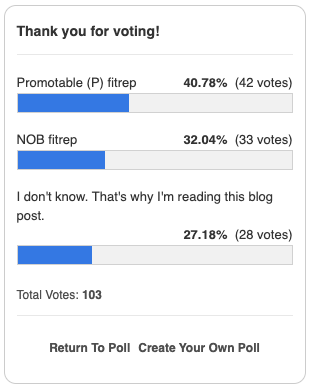
I’m a LCDR MC officer. I’m new at my command and was passed over during my in-zone promotion board for CDR. My command is considering a NOB fitrep vs. a Promotable (P) fitrep. Do you have a recommendation on which fitrep will be more helpful for my promotion board?
Reader Poll
Here’s an image of the poll results:
My Answer
In my experience, most physicians seem to prefer the NOB, but that’s not what the poll above says.
Personally, I don’t think it really matters very much. At the promotion board, both are easily explained and a getting a P as the new officer is expected, so it wouldn’t be a negative.
I would say that if you get a P you have already started the march to an MP and then (hopefully) an EP. If you take the NOB, then your next fitrep could be seen as your “new guy/gal P.”
This last point is why I’d prefer the P if it was me, but I don’t feel that strongly about it.
Travel Restrictions: Green Locations, June 29, 2020
Here’s a link to the locations:
It’s a PCS Season Like None Other. Here’s What You Need to Know
Here’s a link to this article:
It’s a PCS Season Like None Other. Here’s What You Need to Know
Navy Expands Government Travel Card Use for PCS Moves
MILLINGTON, Tenn. (NNS) — Sailors are now authorized to use the Government Travel Charge Card (GTCC) for permanent change of station (PCS) moves. This announcement comes in advance of the conditions based restart to the PCS move process, and provides a proven and reliable option to Sailors to support their financial travel needs during a PCS move.
“Over the past year, the Navy has piloted the use of the GTCC for PCS travel expenses and the feedback we have received and our assessment give us confidence that this provides a great option for Sailors during the PCS move process,” said Capt. Chris Harris, Navy Personnel Command (NPC) Assignment, Leave and Travel business design owner.
“The ease of use combined with our new GTCC PCS Support Cell for immediate support during a PCS move really gives our Sailors a great resource to make the moving experience better.”
NAVADMIN 176/20 announced the final rollout of GTCC use for PCS travel and expands the program so that active-duty Sailors moving within or outside the continental U.S. can use the GTCC for PCS-related travel expenses in lieu of a traditional travel advance for PCS moves.
To provide enhanced customer support, NPC has established a GTCC PCS Support Cell within the MyNavy Career Center (MNCC) Contact Center to assist Sailors who have questions or are experiencing difficulties using their GTCC during PCS. This cell builds on the previous MNCC success with the Command Pay and Personal Administrator (CPPA) Pro-to-Pro cell stood up last year to provide direct support to CPPAs.
This cell is easily reached through the MNCC Contact Center and is staffed with subject matter experts including CPPAs and GTCC Agency Program Coordinators (APC) to quickly solve problems Sailors might experience while using their GTCC for PCS purposes after detaching from their previous command.
Additionally, Sailors in extremis can contact Citibank directly (number on the back of the card) for help requesting a temporary credit limit increase for up to five days under their “No Strand” policy.
Adding to the MNCC vast arsenal of tools to help Sailors, these GTCC PCS Support Cell agents are able to provide services such as placing a Sailor into a mission critical status during a PCS move in the event there is an issue. Upon normal check-out, APCs at the losing command should place cards in a mission critical status before the Sailor departs.
GTCC holders who elect not to use the card prior to travel may still activate it during the PCS process. The GTCC PCS Support Cell can be contacted by calling the 24/7 MNCC call center regarding issues related to the GTCC at 1-833-330-MNCC (1-833-330-6622) or by email at askmncc@navy.mil. Sailors will then be directed to a GTCC PCS Support Cell agent.
The option to use the GTCC for PCS travel is for active duty Sailors. Expenses covered include Temporary Lodging Expenses or Temporary Lodging Allowance at the old or new permanent duty station, fuel for a privately owned vehicle when authorized as the mode of transportation, rental cars and fuel (if authorized), lodging and meals in route, dislocation allowance expenses normally used to establish a household, and ATM withdrawals.
The use of the GTCC cannot be combined with a travel advance, used for personally procured moves (formerly known as do-it-yourself or DITY moves), used for commercial airfare for PCS travel (all commercial airfare for PCS travel will continue to be booked through the Navy Passenger Transportation Office), used for personal travel arrangements during leave in conjunction with orders, or used for medical expenses.
The GTCC option for PCS is another service provided by the MyNavy HR team to modernize the pay and personnel process and improve the customer experience for Sailors and their families. It adds to the number of recently released products to support Sailors during a PCS move that include numerous offerings available via the MyPCS Mobile web enabled site.
On MyPCS Mobile you can view a streamlined, plain language set of orders, complete an interactive PCS checklist tailored to your move plan, use a PCS Entitlements Calculator, and complete an easy to use electronic travel claim. MyPCS Mobile can be downloaded from the Navy App Locker at https://www.applocker.navy.mil.
For more news from Chief of Naval Personnel, follow us on Facebook at https://www.facebook.com/mynavyhr, Twitter at https://twitter.com/mynavyhr or visit https://www.navy.mil/cnp.
Get more information about the Navy from US Navy facebook or twitter.
For more news from Chief of Naval Personnel, visit www.navy.mil/local/cnp/.
Travel Restrictions: Green Locations, June 19, 2020
Here’s a link to see the updated list that is driving all of our travel and PCS moves:
Military Times – As Military Moves Restart, It’s Still a PCS Season Like None Other – Here’s What Families Need to Know
Here’s a pretty good article for those PCSing:
 Joel Schofer's Career Planning Blog