A conversation with TSP Executive Director Ravi Deo
Dear Participant,
This year, I decided to do something a little different with my annual letter to you. I sat down with a member of our editorial staff for an interview in which we talked about the TSP’s mission, our achievements over the past year, and best practices for keeping your TSP account productive and up to date. I hope you enjoy the results.
—-
Q: What is the TSP’s mission and how does the FRTIB carry it out?
Our mission is to run the TSP solely in the best interest of our participants. And that’s a great mission because it means we’re focused on one thing—participants’ financial well-being. It is unique within the federal government that we have one mission, one purpose, for a narrowly defined group of people. And that makes us really efficient, really effective.
—-
Q: What improvements has the TSP made over the past year?
In July 2024, we added a new L Fund, the L 2070, for participants who were born after 2004 or plan to begin withdrawing from their TSP account in 2068 or later. Each of the eleven L Funds is tailored to when you think you’ll need your money and reduces your exposure to investment risk as your expected retirement date approaches.
In August, we transitioned to a new I Fund benchmark index to further diversify I Fund investments and give participants access to more markets and companies. The new index includes more than 5,000 large, medium, and small companies from more than 40 developed and emerging market countries. Based on a thorough analysis, we expect the new index to offer opportunities for higher returns without a significant increase in risk, as compared to the old I Fund index.
In the fall, we launched our “Grow with the TSP” campaign to highlight how time is your greatest ally when investing. The earlier you invest, the more your money can grow. You can visit our webpage to see how $1 can increase over different time periods. Plus, we’ve included six key points for early-career participants to keep in mind.
L 2070 Fund
>>> https://www.tsp.gov/funds-lifecycle/l-2070
I Fund tracking new benchmark index
>>> https://www.tsp.gov/plan-news/2024-09-03-I-Fund-tracking-new-benchmark-index
Grow with the TSP
>>> https://www.tsp.gov/grow
—-
Q: What do you think people get wrong about the TSP?
There are three things. First, when you retire, you don’t have to leave the TSP. The TSP has advantages that an IRA does not have, and not everybody is aware of that. You can leave your money in the TSP after you leave federal service, and that means your savings can keep earning interest and gaining value while you continue to benefit from the TSP’s low expenses. As of July 2024, the TSP’s expenses are lower than 99% of investment options.
Second, many participants may not know how much they can do online with their TSP account, especially once securely logged in to My Account on the TSP website. For example, with My Account access, you can complete and submit many forms online with your electronic signature, view and manage your investments, and add your bank information for direct deposit to help you get your money faster and more safely. You can also use the TSP Mobile App, which offers the same functionality as logging in to My Account online.
Third, it’s best to avoid borrowing from your TSP account to cover unexpected expenses. While it may seem convenient to borrow from yourself, taking money out of your account means those funds can’t benefit from compounding interest until they’re paid back. It’s better to build up an emergency fund separate from the TSP and draw on that to weather life’s unexpected bumps. Saving starts with retirement, but it shouldn’t end there.
Expenses and fees
>>> https://www.tsp.gov/tsp-basics/expenses-and-fees
—-
Q: What message would you give people just starting to save for retirement?
Start now. That’s the most powerful thing you can do. It doesn’t have to be a lot; as long as it’s at least 5% of your basic pay, you’ll get the full matching contribution from your agency or service. You can always contribute more, but if you contribute less than 5%, you miss out on the free money available to you. That could mean losing out on thousands of dollars by the time you retire.
Investing strategies
>>> https://www.tsp.gov/investing-strategies
—-
Q: What would you say to participants getting ready to retire?
In addition to reminding participants they can keep their money in the TSP when they leave, I would also say they could consider lower-risk investments. You can change your investment mix yourself, or one of the Lifecycle Funds can do it for you. When you’re first starting out with your TSP account, choosing riskier investments—which offer the opportunity for higher gains—can be OK because you have time to recover from losses before you retire. But if you’re at retirement or close to it, you don’t have 20 or 30 years to recoup your losses because you are going to start spending that money soon. And stocks don’t always go up. Risk is real.
Lifecycle Funds
>>> https://www.tsp.gov/funds-lifecycle
—-
Q: And what hopes do you have for your own retirement?
I hope I can use my TSP to enjoy time with my kids, and to do the things that my wife and I hope to do when we have lots and lots of time, with no need to get up in the morning and come to work.
—-
Q: Any final thoughts?
Yes. It’s good to do a wellness check on your TSP account at least once a year. There are a few housekeeping issues you can take care of to ensure your TSP account is up to date.
If you haven’t logged in to My Account since June 2022, you need to set up a new login on tsp.gov. It takes less than 10 minutes to get online access to your TSP investments, verify your contact information, and help protect your account from fraud.
Add your bank account information to your My Account now so that when you need money later, you can get it quickly and safely through direct deposit.
Lastly, always make sure your contact information is up to date so we can notify you of important information about your account. Being able to reach you helps us carry out our mission: helping you fulfill your financial goals and live the best possible version of the life you want in retirement.
And reach out to us anytime. If you have general questions or concerns, you can use AVA, the TSP virtual assistant on tsp.gov, to get answers. To ask AVA account-specific questions and connect with a ThriftLine representative during business hours for a live chat session, log in to My Account and select the icon found on the bottom right of the page. To speak with one of our representatives by phone, call the ThriftLine at 1-877-968-3778.
We’re here to help
>>> https://www.tsp.gov/contact
—-
Wishing you a happy and prosperous 2025,
Ravi Deo, Executive Director
Federal Retirement Thrift Investment Board
—-
~~~~~~~~~~~~~~~~~~~~~~~~~
Important TSP information
~~~~~~~~~~~~~~~~~~~~~~~~~
* Rates of Return: https://www.tsp.gov/fund-performance
* TSP Expenses: https://www.tsp.gov/tsp-basics/expenses-and-fees
* TSP Funds: https://www.tsp.gov/investment-options
~~~~~~~~~~~~~~
Stay connected
~~~~~~~~~~~~~~
* Twitter/X: https://x.com/tsp4gov
* YouTube: https://www.youtube.com/user/tsp4gov
* TSP webinars: https://www.tsp.gov/webinars
* Contact us: https://www.tsp.gov/contact
* Privacy: https://www.tsp.gov/privacy-policy/participant-outreach-emails
* TSP website: https://www.tsp.gov
ThriftLine Service Center
C/O Broadridge Processing
P.O. Box 1600
Newark, NJ 07101-1600
Announcing the USU Packard Lecture for 2025
Greetings.
We are thrilled to be welcoming Mr. Larry Ellison to the Uniformed Services University of the Health Sciences for the annual Packard Lecture on Wednesday April 23, 2025 at 2PM Eastern time.
Larry Ellison is chairman of Oracle Corporation and chief technology officer. He founded Oracle in 1977.
Please see the official flyer (attached). For those wanting to attend this event in person, advanced registration is required, as seating will be limited compared to what we anticipate will be great interest amongst people both within USU and other agencies and partners.
There will be a virtual option but we will send that link/info as we get closer to the event.
To register for in-person attendance, please use the QR code on the attached flyer.
Most sincerely,
Geeta Upadhyay PhD and Craig Shriver, MD
New Benefit Alert! Health Care FSA for Service Members
Eligible Service members can enroll for a Health Care Flexible Spending Account (HCFSA) for the first time through a Special Enrollment Period (SEP) from March 3, 2025 – March 31, 2025.
A Health Care Flexible Spending Account allows Service members to set aside between $100 – $3,300 per individual in pre-tax earnings each year to pay for expenses such as
– Over-the-counter medicines and drugstore items such as sunscreen, Band-Aids, and menstrual products
– Co-pays and cost-shares
– Eye exams, glasses, and contact lenses
– Dental and orthodontia
There are more than 300+ HCFSA eligible expenses. Search whether the expenses you pay for are HCFSA-eligible here: https://www.fsafeds.gov/explore/hcfsa/expenses
Service members and their families sometimes must pay out-of-pocket for certain healthcare expenses to supplement the coverage offered through TRICARE. HCFSAs can be used for you and your dependents health expenses, allowing Service members to save while paying for those costs.
___________________________________________________
Delivered by Defense Finance and Accounting Service
FY26 O6 Staff Corps Promotion Opportunities
On page 2 of the just released convening order, you can find the promotion opportunities for O6 in FY26:
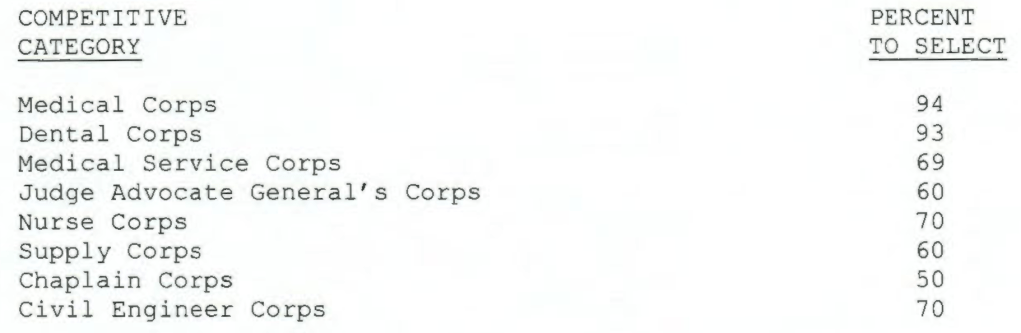
Here’s the full convening order:
Message from the New Medical Corps Chief and Detailing Update
Medical Corps Officers,
Good morning and happy Friday! Below is a message from our new Medical Corps Chief RDML Kevin Brown. RDML Brown’s bio is available at https://www.navy.mil/Leadership/Flag-Officer-Biographies/BioDisplay/Article/3848460/rear-admiral-kevin-j-brown/
I’m honored to serve as your 15th Medical Corps Chief. I thank RDML Valdes for his 3 years of leadership as our Chief, and his dedication to the professional health and well-being of our Navy physicians. My priority is to build on the foundation and successes RDML Valdes established as we continue to improve the health of our Corps. Having just returned from the Surgeon General’s quarterly FOSESFOR (Flag Officer / Senior Executive Service / Force Master Chief) symposium, I am confident that the considerable investment in the Medical Corps is beginning to pay dividends, but we still have much work to do.
Recruit – We will continue to identify and prioritize successful recruitment initiatives to attract the most talented physicians to the Navy. Rebounding from two lean years, FY24 saw a return to historic norms for medical student recruiting. In partnership with RADM Waters at Navy Recruiting Command, we’ve increased our medical student goals for FY25 and added aggressive direct accessions goals to accelerate the Medical Corps recovery. The best recruiters of future Navy doctors are current Navy doctors. We must leverage our physicians’ vast expertise and experience to energize the next generation of leaders and ensure the continuous preservation of the Navy Medical Corps pipeline.
Train – Graduate Medical Education and Force Development remain a priority. We will continue to increase training opportunities for developing initial competency while exploring effective and alternative models for currency and skill sustainment. Just as our operations doctrine has adjusted to the pacing threat, our medical force development must evolve to ensure Navy physicians’ ability to render care in any situation, under all operational conditions, is never compromised.
Retain – The health of our Medical Corps, and Navy Medicine’s ability to meet its mission, hinges on keeping physicians in the Navy. The foundation of any successful team is trust. Frankly, decisions made after the end of the Global War on Terror eroded physician trust within our team. We must re-establish that trust. By enhancing career progression, promotion opportunities, clinical and operational experiences, and initiatives designed to improve our Quality of Service, Navy physician professional gratification will improve. Starting with addressing civilian-military pay gaps, we will systematically remove doubt that the Navy is the premier physician employer in the United States.
Consider this a call to action. Get involved. Be part of the solution. I’m excited by our initiatives to improve the experience of naval service for our physicians and unequivocally demonstrate the value of continued service, but success requires effort from each of you. Working together, I have no doubt we will establish and sustain the prominence of our Medical Corps
Kevin
We also want to take this opportunity to address potential changes in how our officers experience the detailing process.
Changes in PERS-4415 engagement with Medical Corps Officers – This is not a policy change. The detailing process and the specialty leader-detailer relationship is unchanged. Specialty leaders make recommendations; detailers issue orders. Our detailers (PERS-4415) have always had the final say in MC officer assignments. Because physician careers are different than line officers, the Medical Corps has specialty leaders assigned to each specialty to ensure specialty-specific considerations are incorporated into physician detailing decisions. The line does not have specialty leaders. MC specialty leaders have traditionally been the ones who have in-depth conversations with individual MC officers within their communities IRT career progression and next assignments. This will still occur. However, BUPERS has instructed our MC detailers to play a larger role in these discussions similar to the way line communities (and the other health services support officer Corps) are handled. The net result is MC officers will likely have these detailed conversations with both our specialty leaders and our detailers before they meet to make final assignment determinations.
v/r,
John J. Devlin, MD, FAACT, FACEP
CAPT / MC / USN
Deputy Chief, Navy Medical Corps
Office of the Corps Chiefs (N01C),
Bureau of Medicine & Surgery (BUMED)
NMCP Association Director of Surgical Services – Due 7 MAR 2025
The Associate Director, Surgical Services (ADSS) assists the Director with implementing his/her vision for the future, executing the administrative workload and providing oversight of clinic and surgical operations. The ADSS cultivates a collaborative work environment among the ten Department Heads (Anesthesia, Brain & Spine, Cancer Coordination Center, Eyes Ears Nose and Throat, General Surgery Oral Maxillofacial surgery, Operative Support Services, Orthopedics, Urology, and Gynecological Services, and Obstetrics). The incumbent is responsible in assisting the director in using available resources to provide the best possible patient care. The incumbent also provides guidance and direction to leaders within the directorate regarding administrative matters, management of personnel, budgetary issues and clinic management.
The position is open to Navy Medical Department officers of all Corps at the O-4 to O-6 level with a professional clinical background. All applicants must have the approval of their Detailer to apply.
The preferred candidate will have the following attributes:
1) A track record of broad superior performance in both clinical and leadership positions;
2) Effective interpersonal, communicative, and collaborative skills;
3) Proven ability to function in operational and academic settings and to understand operational and academic imperatives;
4) Superior military bearing.
Interested candidates should submit (preferably via e-mail) a letter of interest, a short bio, copies of the 3 most recent FITREPs, and a CV by 07 MAR 2025 to:
Tresa R. James
Administrative Assistant, Director of Surgical Services
Naval Medical Readiness Training Center
620 John Paul Jones Circle
Portsmouth VA 23708
Office: 757-953-3051
Pentagon Prioritizes Homeland Defense, Warfighting, Slashing Wasteful Spending
During a media interview today, Defense Secretary Pete Hegseth said efforts at the Defense Department include modernizing the nuclear triad and building an iron dome for the U.S., referring to the iron dome that defends Israel against aerial threats.
These and other homeland priorities will be reflected in the fiscal year 2026 defense budget and future defense budgets, he added.
The secretary also addressed defense spending. He said DOD is committed to passing a clean audit across the department, as the Marine Corps has done for the last two years.
“American taxpayers deserve to know exactly how and where their money is spent,” he said. “We need to know when we spend dollars; we need to know where they’re going and why.”
He said the department welcomes Elon Musk’s Department of Government Efficiency, which will help identify ways to streamline this process, fast-track acquisitions and cut waste.
The secretary will be traveling to Brussels, Belgium, this week to attend the NATO ministerial meeting. He also will be traveling to Poland and Germany to meet with his counterparts and U.S. service members stationed there.
Hegseth said he especially looks forward to meeting the troops and hopes to do some physical training with them.
“I want to make sure our troops understand how focused we are on their warfighting capabilities,” he said.
But the focus is not just on Europe. It’s also the Indo-Pacific region, he said, mentioning recent phone calls and meetings he’s had with leaders in Australia, South Korea, the Philippines and Japan.
He said the focus there is maintaining a strategic advantage over China. “We want the future of the world to be free.”
“We’re confronting threats in real time, restoring the warrior ethos, rebuilding the military, reestablishing deterrence,” he said.
“I’m proud to come alongside the 1.3 million uniformed members of the department who execute America’s national security approach and do so with fidelity only to the Constitution and the rule of law, and that’s all you can ask for,” he said.
 Joel Schofer's Career Planning Blog