COVID-19 Travel Restrictions Installation Status Update, July 2, 2020
Here’s a link to this DoD press release:
COVID-19 Travel Restrictions Installation Status Update, July 2, 2020
COVID-19 Life Support Training Update
BLUF – The purpose of this memorandum is to update policy guidance within the Military Health System for American Red Cross life support training (First Aid/cardiopulmonary resuscitation (CPR)/automated external defibrillator (AED), Basic Life Support (BLS), Advanced Life Support (ALS), and Pediatric Advanced Life Support (PALS)). As military medical treatment facilities (MTFs) transition to normal operations, no further extensions for the above life support certifications will be granted after June 30, 2020. Personnel whose certifications expired between March and June 2020 have up to 120 days to get recertified. This also applies to providers who have American Heart Association cards.
Here’s the full memo.
Assignment Incentive Pay Approved for Extensions
WASHINGTON (NNS) — The Navy has authorized Assignment Incentive Pay (AIP) for Sailors extended at certain commands due to COVID-19 transfer delays.
On June 12, the Navy announced the conditions-based, phased plan for Permanent Change of Station (PCS) moves. A vital part of the plan is prioritizing sea duty and critical shore billets, such as Recruit Division Commanders duty at Recruit Training Command in Great Lakes. As a result, Sailors at these types of duty may be involuntarily extended.
“Shipmates, I honor your continued dedication to the mission in these tough times,” said Vice Adm. John B. Nowell Jr., the Navy’s top uniformed personnel official. “We will only keep you in your current billet if it is absolutely necessary for mission readiness, however, if you are affected by these moves beyond our normal limits, we now have taken steps to compensate you for your time.”
Involuntary extensions beyond six months will only occur under the most unusual circumstances. The Navy’s standard rotation window allows for Sailors to be transferred up to six-months before their scheduled rotation date as well as to be held in place for an additional six months, if necessary.
According to two separate Department of the Navy memos, Recruit Division Commanders and Sailors on sea duty are eligible to be paid AIP at the rate of $500 per month for each month they are held at their current command beyond the six-month threshold. Sailors should work with their chain of command as well as their detailer to determine if this program will apply to them.
Assignment Incentive Pay is just one tool available to the Navy to keep key billets filled. Still in effect is NAVADMIN 132/20 released on May 5, which offers both high-year tenure waivers as well as Sea Duty Incentive pay to Sailors in specific skills willing to extend at sea or return to sea early. The deadline to apply for these programs is Sept. 30.
Volunteering to extend could net Sailors a lump-sum payment in return for their extension or curtailment, the amount can vary based on rating and paygrade. Those Sailors interested in volunteering for SDIP should contact their detailer. This includes those in SDIP-eligible skills currently scheduled to separate or retire who are willing to delay their departure by 6-12 months are eligible for SDIP as well.
Ordinarily, such requests require applying 14-16 months before their projected rotation date; however, this timeline may be waived on a case-by-case basis. The latest list of eligible ratings and paygrades, updated May 5, can be found at https://www.mnp.navy.mil/group/pay-and-benefits.
More information on the AIP program is available at https://www.mnp.navy.mil/group/assignment-leave-travel/resources-and-links. Those interested in the high-year tenure wavers and Sea Duty Incentive Pay can get details from NAVADMIN 132/20.
The latest DoD policies are at https://www.defense.gov/explore/spotlight/coronavirus.
For more news from Chief of Naval Personnel, follow us on Facebook at https://www.facebook.com/mynavyhr, Twitter at https://twitter.com/mynavyhr or visit https://www.navy.mil/cnp.
Get more information about the Navy from US Navy facebook or twitter.
For more news from Chief of Naval Personnel, visit www.navy.mil/local/cnp/.
Finance Friday Articles
Here are my favorites this week:
Free Beer Plus Profits! A Craft Brewery Investment Goes Full Circle
How Often Do Long-Term Bonds Beat Stocks?
Roth 401(k) vs. 401(k): Which is the Better Option?
The Best Side Gig Is Spending Less
Here are the rest of the articles:
3 keys to building an emergency fund
5 Ways Financial Freedom Beats Burnout
10 Reasons to Consider a Nonclinical Job to Defeat Burnout
Achieving Financial Freedom as a Physician is Simple, but Not Easy
Breaking the Traditional Financial Rules
Consumer Addiction and 5 Ways to Beat It
Consumption Smoothing is Stupid
How a Career Transition Can Help You Reach Financial Independence
Indexed Annuities – No Down Less Up
Investing legend Burton Malkiel on day-trading millennials, the end of the 60/40 portfolio and more
IRS Adds New Criteria for COVID-Related Loans, Withdrawals From Retirement Plans
IRS expands criteria to withdraw money from retirement plans for those affected by coronavirus
Report of Retirees Fleeing Market Due to Coronavirus Was Greatly Exaggerated
Should spouses get to contribute to troops’ retirement savings accounts? Debate set to begin.
States Without Income Tax: Is There a Benefit to Moving?
The Best and Worst Quarters in Stock Market History
The Economy is Not the Stock Market
The Key to Successful Investing? Your Mindset
When It Comes to Social Security Retirement Benefits, Timing Matters
Leave and Liberty now Exempt from COVID Travel Restrictions
WASHINGTON (NNS) — Effective immediately, leave and liberty outside the local area of your command is exempt from ongoing COVID-19 travel restrictions.
Secretary of Defense Mark Esper approved the leave exemption for all military on June 29. The Navy’s rules for implementation came in NAVADMIN 189/20 on July 2.
Approval authority for leave outside of the local area will be determined by the echelon 2 commander. Delegation of that authority can not be lower than the unit commanding officer, officer-in-charge or equivalent — Branch Head, Division Director, etc.
All other guidance for transitioning from a stop movement to a conditions-based phased approach to personnel movement and travel, remains in place.
“Commanders and supervisors will conduct a risk assessment of the health status and travel itinerary for personnel requesting leave or liberty outside the local area,” wrote Vice Adm. John B. Nowell, Jr., the Navy’s top uniformed official in the message.
Commands also have the responsibility of reviewing a Sailor’s travel plans to verify they have a plan to both keep themselves safe, as well as ensure they don’t become a vector of infection when they return.
Sailors should not go on leave or liberty out of the local area if they have a fever or display any other symptoms that could indicate COVID-19 infection. In addition, Sailors should not travel if they have had close contact with someone who has tested positive for the virus within the past 14 days.
Before departure, commands must establish with their travelers a means of reliable communication. This allows for quick access for reacting to any circumstances that arise during leave or liberty.
While traveling away from their home area, Navy Service members must comply with any Department of Defense, federal, state, or local restrictions in place due to COVID-19.
The latest DoD policies are at https://www.defense.gov/explore/spotlight/coronavirus.
Navy Publishes Leaders’ Handbook for COVID Guidance
WASHINGTON (NNS) — Navy leadership published a COVID-19 Leaders’ Handbook containing current Navy guidance on COVID mitigation measures and procedures 30 June as a reference for leaders throughout the fleet.
The handbook will act as a quick guide for leaders both ashore and at sea to educate their teams on the threat COVID poses to the Navy and give them key information on prevention and mitigation procedures.
As new information and research about the coronavirus comes available, the Navy updates and publishes guiding documents to inform and assist the fleets in their decision making processes. This handbook distills and collates key high-level guidance into one place to more easily allow leaders to make informed decisions and thrive within the COVID-19 environment.
The handbook will assist commands in the completion of their missions both at sea and ashore as they become accustomed to the “new normal” of operating in a COVID-19 environment. Guidelines require commands to establish and maintain COVID-free bubbles, adhere to the established prevention protocols, and be ready to fight through COVID outbreaks while continuing to provide mission assurance.
The handbook includes information on how COVID spreads, and promotes Public Health Mitigation Measures like self-monitoring and reporting, physical distancing, washing hands frequently, and wearing masks to prevent the spread of the disease that have been proven as effective tools in fighting the virus.
The handbook also covers protocols for containment in the event that there is an outbreak in addition to outlining the process of conducting methodical contact tracing to identify service members who may have been in close proximity to a COVID-positive Sailor.
“The handbook is designed to provide Leaders at all levels with a common understanding of the latest science, show them that current USN guidance is grounded in that science, provide them tools to prevent, and when necessary, contain COVID-19.” said Rear Adm. Will Pennington, Special Assistant to the Deputy Chief of Naval Operations for Operations and Plans.
Newly established sentinel surveillance testing protocols are also outlined as a key resource for unit commanders to potentially identify asymptomatic COVID-positive individuals. The handbook stressed that scientific data informs operational guidance and frequent updates will be made.
“This handbook reinforces how individual responsibility and simple public health mitigation measures are critical to protecting the team, and is written to allow young leaders to distill and then disseminate the most pertinent guidance so we can successfully operate through this pandemic,” explained Rear Adm. Karl Thomas, Assistant Deputy Chief of Naval Operations for Operations, Plans, and Strategy.
The Navy will continue to protect the health of the force and proactively fight complacency within the ranks. The Navy is prepared to fight and overcome the challenge of operating in a COVID-19 environment while delivering decisive sea power on, above, and under the sea.
To view and download the US Navy COVID-19 Leaders’ Handbook click here https://allhands.navy.mil/The-Way-Forward/US-Navy-COVID-19-Leaders-Handbook
BUMED GME Note Delayed
As with many other things this year, COVID has impacted the timing of the release of the BUMEDNOTE 1524 – 2020 Joint Service GME Selection Board Application Procedures. We realize many in the Medical Corps are looking forward to its publication and we will get it distributed as soon as possible. We apologize for the delay and will get it out ASAP.
Throwback Thursday Classic Post – NOB Fitrep vs New Guy/Gal Promotable (P) Fitrep – Which is Better?
Reader Question
I’m a LCDR MC officer. I’m new at my command and was passed over during my in-zone promotion board for CDR. My command is considering a NOB fitrep vs. a Promotable (P) fitrep. Do you have a recommendation on which fitrep will be more helpful for my promotion board?
Reader Poll
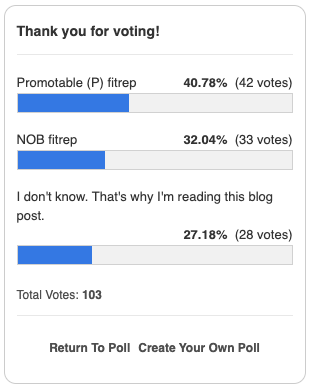
Here’s an image of the poll results:
My Answer
In my experience, most physicians seem to prefer the NOB, but that’s not what the poll above says.
Personally, I don’t think it really matters very much. At the promotion board, both are easily explained and a getting a P as the new officer is expected, so it wouldn’t be a negative.
I would say that if you get a P you have already started the march to an MP and then (hopefully) an EP. If you take the NOB, then your next fitrep could be seen as your “new guy/gal P.”
This last point is why I’d prefer the P if it was me, but I don’t feel that strongly about it.
Lessons in Leadership from Admiral Bill McRaven
Here’s a link to this article:
 Joel Schofer's Career Planning Blog