Career Planning
Throwback Thursday Classic Post – Who’s On Your List?
(It is funny to read this 3 years later, as much of it is true to this day, as you’ll read in my 2019 notes in italics below.)
In my opinion, every Naval physician needs to have a list of people. On this list are the people who you absolutely, positively will not mess with. When you talk to them, you show them the utmost respect. When they ask you for something, you give it to them better and faster than you ever give anyone anything. These are the people who have determined your career path to this point and are likely to continue to steer if for the near future.
Who’s on your list? If you don’t know, you should think about this as soon as you can. You might think it is silly, but I’d actually make a list. Just to show you I’m serious, I’ll share my list (as it was when originally posted on the blog):
- Current Emergency Medicine (EM) Specialty Leader
- Prior Deputy Commander of NMC Portsmouth
- Prior EM Specialty Leader
- Current Director of Medical Services at NMC San Diego
- Prior EM Specialty Leader and Deputy Medical Corps Chief
Why are they on my list? They are Emergency Physicians like me, and they are the most senior and potentially influential people in my career. They are the people who are senior to me, well thought of in my specialty, and get phone calls or in person inquiries when I apply for a leadership position. For example, one of the people on this list thought of me when the Detailer job became available and endorsed me for it. (That same person just made me the incoming Deputy Medical Corps Chief. I show up at BUMED on September 3rd.)
Who’s not on my list? There are no admirals on my list (at least there weren’t at the time – there certainly are now). As a CDR, it is rare that I’m on the radar of an admiral. Some of them know who I am, and some of them could have a major impact on my career path, but it is unlikely that they’ll take a huge interest in my career until I’m a CAPT and qualify for major leadership positions working directly for them (somewhat of a prescient post, I guess). If an admiral wants to know about Joel Schofer, they’ll probably call one of the CAPTs on my list and ask them about me.
Who should be on your list? The people you should consider putting on your list include:
- Your Specialty Leader and prior Specialty Leader
- Your Detailer
- Influential people in your specialty who are 1-2 ranks senior to you
- Whoever is currently in the job(s) you want
Undoubtedly there are other people you should consider, but this list is a good start.
Once you create the list, here are the things you need to keep in mind. Always treat these people with the utmost of respect. You should always treat everyone with respect, but these people get special attention. Never get into an argument with them. I’m not saying you have be a “yes man” (or woman) and agree with everything that they say, but any disagreement needs to be collegial and respectful. You want to prevent them from getting mad at you, if at all possible. When they ask you for something or they give you a task, it immediately rises to the top of your to-do list. In addition, you never give them anything but your best, maximal effort.
The Navy is a large organization that can appear impersonal, but people run it. The people on your list are the ones who are going to determine your future and whether you get want you want or not. If I were you, this is one list I’d put some thought into and actually make.
Medical Corps Career Planner at BUMED – CAPT/CAPT(sel)
Billet Title: Career Planner, Office of the Medical Corps Chief, BUMED
Location: Navy Bureau of Medicine and Surgery, Defense Health Headquarters,
Falls Church, VA
Rank: O6/O6-select
Corps: Medical Corps
Tour Length: 36 months (beginning JAN-FEB 2020)
Mission: Mentor and guide all USN Medical corps officers providing leadership and career development support and guidance. Integral to selecting and maintaining a competent and professional Medical Corps which is valued by the organization and meets the needs of the mission and the strategic goals of readiness, health, and partnerships.
Functions: Mentors and provides leadership development opportunities for Medical Corps Officers. Serve as president of the Professional Review Board, responsible for accessions of MC Officers via FAP/TMS/DA pathways. Responsible for reviewing litigation reports quality assurance reports in determination of NPDB reporting. Plans and coordinates the annual USN MC GME/Operational Intern Road Show. Medical Corps Chief Office liaison to all other Corps Career Planners and Leadership/Career Development Working Groups. Subject matter expert on accession issues pertinent to MC Officers. Serves as member of multiple councils and boards including Medical Education Planning Council and HPSP selection boards. Provides regular AMDOC, ODS, and command-requested briefings relative to the Medical Corps.
Command Relations: Ability to communicate effectively to a 1 or 2 Star Admiral on a regular basis.
Experience Required: Highly recommended to have: Knowledge of Department of Defense, Navy, Navy Medical Corps policies and instructions and policies of other Federal entities as needed; Experience with recruitment, retention, promotion, and sustainment of Medical Corps Officers; Proficient networking, written and oral communication, and public speaking skills.
Other: Time available to perform clinical work at multiple MTFs in the National Capital Region. Time available to travel for CME. TAD travel possible throughout the year for Medical Corps Chief related events.
POC: CAPT Chris Quarles (contact info is in the global) by 29 JUL 2019 with Specialty
Leader and Detailer concurrence. All candidates must be eligible for PCS orders. Preferred report date is JAN 2020.
Career Planner Position Description
NOTE: CV, BIO, and Letter of Intent needed for application. All candidates must be eligible for PCS orders.
MCCareer.org The Book – Chapter 3 – Career Progression and Promotion Board Math
Introduction
When you start your Naval career, the future is largely a mystery. As you progress is your career, things will crystalize, you’ll become wiser, and you’ll think, “It would have been nice to know all of this in the beginning.”
I’m going to try and tell you what you should have known about career progression and promotion board math from the beginning.
Career Progression
This diagram below demonstrates the typical career progression of a Medical Corps officer who has no prior service. Assuming you are not picked early for promotion, you typically promote every six years. You will become a Lieutenant Commander (LCDR) at approximately 6 years, a Commander (CDR) at 12 years, and a Captain (CAPT) at 18 years. I had no prior service, I have never been promoted early, and this is exactly the timing I experienced in my career.

Along the left are the ranges of promotion opportunity for each rank from fiscal year 2013-2020. In each year, the promotion opportunity for LCDR has been 100%. In theory, if all the Lieutenants are suitable for promotion they can all be promoted to LCDR. When it comes to the promotion opportunities for CDR or CAPT, interpreting them is a touch more difficult because we have to talk about promotion board math.
Promotion Board Math
In Fiscal Year 2019 (FY19), people were very excited about a 90% promotion opportunity for the FY19 Staff Corps O6 promotion board. But it was easy to misinterpret this opportunity. It did not mean that 90% of CDRs were selected for CAPT.
Where Does the Promotion Opportunity Come From?
The short answer is from manpower projections. How many physicians are getting out or retiring? What is the current Medical Corps manning level for that rank? What are future needs anticipated to be? What is the size of the promotion zone? The answers to all of these questions determines the promotion opportunity and guide Navy Personnel Command (NPC) and the Bureau of Medicine and Surgery (BUMED) when they are making their decision.
As you can see here, the promotion opportunity varies from year-to-year:
| FY13 | FY14 | FY15 | FY16 | FY17 | FY18 | FY19 | FY20 | |
| LCDR | 100% | 100% | 100% | 100% | 100% | 100% | 100% | Pending |
| CDR | 80% | 80% | 70% | 70% | 65% | 75% | 85% | 77% |
| CAPT | 60% | 60% | 60% | 50% | 70% | 80% | 90% | 81% |
Historical promotion opportunities for FY13-20.
But as you can see here, the percentage who are promoted from the in zone group is substantially lower:
| FY13 | FY14 | FY15 | FY16 | FY17 | FY18 | FY19 | FY20 | |
| LCDR | 97% | 89% | 90% | 93% | 88% | 85% | 87% | Pending |
| CDR | 58% | 66% | 49% | 53% | 44% | 40% | 52% | 53% |
| CAPT | 55% | 43% | 47% | 39% | 34% | 37% | 41% | 51% |
Historical percentage of in-zone candidates selected for promotion for FY13-20.
Promotion Board Zones
There are three “zones” for promotion – below zone, in zone, and above zone. Medical Corps officers are below zone for two years, in zone for one year, and above zone until they are either selected for promotion or get out of the Navy. A few people are usually picked early or below zone, but most people will not get picked until they are in or above zone.
FY19 O6 Promotion Board Math
In FY19, there were 74 CDRs in zone for promotion. To figure out how many officers can be selected for promotion, you have to multiple the zone size by the promotion opportunity. For example, if you take the 90% promotion opportunity everyone was excited about and multiply it by the zone size of 74, you’ll see that they could have promoted 67 CDRs to CAPT during the board:
90% opportunity X 74 people in zone = 66.6 (rounded up to 67) people they can pick for O6
These 67, though, were picked from CDRs who were below zone, in zone, or above zone. Usually, there is a small number picked from below zone, and a much larger number from the in zone and above zone categories. Here were the results:
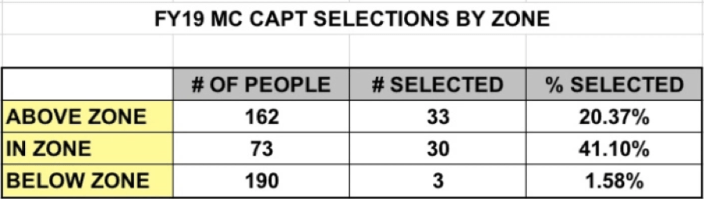
As you can see, the 90% promotion opportunity only led to a 41% selection rate for those who were in zone. The remainder came from the below and above zone CDRs.
The Bottom Line on Career Progression
The typical career progression occurs with a promotion every six years, as detailed in the diagram below. The promotion opportunities listed, though, result in a much lower chance of getting picked when you are in zone because the selections come from those below, in, and above zone.
Navy Times – Here’s How the Navy is Revolutionizing Officer Career Paths
Here’s a link to the article:
Navy Times Article – Navy Looking at Radical New Career Paths
Here’s the link:
Updated Medical Corps Career Progression Slide
Here is the updated BUMED Medical Corps Career Progression slide, which nicely summarizes the typical career path as well as spells out the educational opportunities you should try to obtain:
Summary of Specialty Leader Business Meeting
Here is a brief summary of last week’s Specialty Leader Business Meeting that is always held in conjunction with the Graduate Medical Education Selection Board:
- Current interim Chief Medical Officers (CMOs) need to formally apply to the next screening board in summer 2017. I would STRONGLY encourage other people to apply as well because it is a screened/appointed leadership position that allows you to remain clinically active and that I also think will lead to promotion to O6 if done successfully.
- Announcements for nominative positions often come out with very little time until the nominations are due. They all require your CV, BIO, Letter of Intent (LOI), Officer Summary Record (OSR), and Performance Summary Record (PSR). It is best if you have these ready to go due to the often short timeline. I will tell you that I update my CV and military biography monthly and have multiple LOI templates at the ready at all times, so I practice what I preach. Your OSR/PSR can downloaded from BUPERS On-Line anytime, so that requires no prep (assuming BOL is working).
- Current overall Medical Corps manning is 103.4%. This is of no real use to you but is simply an interesting fact/statistic. It does, perhaps, limit our promotion opportunity a lit bit, but…
- The Medical Corps promotion opportunities for FY18 are expected to be higher than they have been in recent years. You never know the actual percentage until the board has concluded, but this is certainly good news.
- As of now, there is no change in the conference approval process. Sorry.
- The Career Intermission Program (CIP) has been extended until 2019. This program allows you to take up to 3 years off from the Navy to do something else, hit the pause button on progression toward promotion, and then return afterward. You have a 2:1 additional commitment for any time off. In other words, if you take 2 years off you’ll owe 4 years when you return. Some people have tried to use the CIP to do fellowships on their own, but that is not the intent of the program and requests for CIP to do a fellowship will be closely scrutinized by BUMED before approval. Info on the program can be found here or you can contact your Detailer.
- There is no special pays update. They are still awaiting the NAVADMIN. The latest can always be found here:
http://www.med.navy.mil/bumed/Special_Pay/Pages/default.aspx
Updated Career Intermission Program NAVADMIN
Here are a PDF and link to the updated NAVADMIN that governs the Career Intermission Program (CIP):
The CIP allows you to take 1-3 years off from your Naval career, maintain a small basic pay and TRICARE benefits, and then return. If you are interested, you can also check out OPNAV 1330.2B – Navy Career Intermission Program Guidelines.
You Made CDR! Now What?
If you are one of the lucky people who made CDR, I have some things for you to consider:
- The next 2-3 years of fitreps may mean very little to your overall career. First, you are soon going to be in the most competitive group in the Medical Corps, Commanders scratching and clawing to make Captain. If you are at a medium to large command, no matter what you do as a junior Commander, you are likely to get promotable on your fitreps. That is just how it works for most commands.
- This first bullet means that now is the PERFECT time to do something “alternative” (off the usual career path for a physician) or take a position that you know will get you 1/1 fitreps or be part of a very small competitive group. Go to the War College. Take a senior operational job where you’ll get a 1/1 fitrep. Become a Detailer. Apply for fellowship because the NOB fitreps won’t hurt you as a junior Commander or Commander Select. Now is the time to do these type of things. You don’t want to wait until you are a few years below zone for Captain. When you reach this stage you’ll need competitive EP fitreps.
- After you are selected for your next rank is also a great time to move/PCS. Have you ever been OCONUS? If not, now would be a great time to go. You can PCS somewhere for 2-3 years and then PCS to the command where you are going to set up shop and try to make Captain. At OCONUS commands there is more turnover of staff, so major leadership jobs like MEC President, Department Head, and director positions open up more frequently, setting you up to get a senior position when you return to CONUS.
- You may think I’m crazy, but it is time to start thinking about how you are going to make Captain. As I mentioned in the first bullet, getting a job that will make you a Captain is tough and competitive. Now is the time to do the things that will make you an excellent candidate for one of those jobs. Want to be a residency director? Maybe you should get a degree in adult or medical education. Want to be a director? Maybe you should get a management degree like a Masters in Medical Management or an MBA. Want to be a senior operational leader? Now is the time to do Joint Professional Military Education I and/or II.
- Here is a list of the jobs that I think will make you a Captain. Read the list…figure out which of these jobs you are going to use to make Captain…and get busy preparing yourself to get them:
- Residency Director
- Department Head in a large MTF
- Associate Professor at USUHS
- Director
- Officer-in-Charge
- Major committee chair
- Medical Executive Committee President
- BUMED staff
- Specialty Leader
- Deployment requiring an O-5
- Detailer
- Senior operational leader
- Division/Group/Wing Surgeon
- CATF Surgeon
- Amphib or CVN Senior Medical Officer
Optimally you’ll have the time when you are an O5 to do multiple jobs on the preceding list. For example, as an O5 I have been a Detailer, a Specialty Leader, and CO of a deployed unit. My next step is to become a director at a major MTF, and while I was a senior LCDR and CDR I obtained a Naval Postgraduate School MBA as well as achieved certification as a Certified Physician Executive to try and make myself a competitive candidate for a director position.
Congratulations on making Commander…take a deep breath…and start thinking about some of the things I mentioned in this post. Before you know it you’ll be in zone for Captain.
House & Senate Defense Bills – How They Could Affect You
Here is the full article from the Military Officers Association of America:
House and Senate Divide on Defense Bill
Here are the issues mentioned that would affect Navy physicians:
- For new entrants after 1 JAN 2018, and upon the first PCS after that date for those already serving, basic allowance for housing (BAH) would be calculated using the servicemember’s actual housing cost or the BAH rate, whichever is less.
- The bill proposes dividing the normal BAH rate by the number of BAH-eligible occupants, meaning dual military couples or roommates could receive a significantly smaller allowance.
- The committee also included proposals to change family leave policies. Servicemembers that are primary caregivers would receive six weeks of leave. Secondary caregivers would receive three weeks. This parental leave would be in addition to six weeks of convalescent leave allowed for a servicemember who gives birth.
- Establishing TRICARE Prime only in areas with Military Treatment Facilities (MTFs).
- Changing the name of TRICARE Standard to TRICARE Choice.
- Authorizing the treatment of veterans and civilians in MTFs as needed to maintain operational skills.
- Directing DoD to create a program to improve quality of care in MTFs.
- Promotion boards would be able to identify up to 20 percent of selectees as “top performers” to go to the top of promotion lists.
- The services will be authorized to give continuation pay to eligible servicemembers with eight to 12 years of service.
- The service secretaries will be able to designate specialties to allow officers to serve up to 40 years.
- ← Previous
- 1
- 2
- 3
- 4
- Next →
 Joel Schofer's Career Planning Blog