Author: Joel Schofer, MD, MBA, CPE
Throwback Thursday Classic Post – What Should You Do If You Didn’t Promote?
If you are particularly interested in this post, I’m sorry. You or someone you care about probably failed to promote. In reality, nowadays it is normal and expected to fail to promote to O5 and O6, so you have company. Here are my suggestions for those that fail to promote.
Try to Figure Out Why You Didn’t Promote
First, try to figure out why you didn’t promote. Because the promotion board members are not allowed to speak about your board, you’ll never actually find out why you failed to promote, but you can usually take a pretty educated guess if you talk to the right people (like me).
If any of these things happened to you, they are likely a main reason you didn’t promote:
- Any PFA/BCA failures.
- Legal issues, such as a DUI or any other legal trouble.
- Failure to become board certified.
There are other things that could happen to you that make it difficult but not impossible to promote. They include:
- You have not been operational or deployed at all, or you have done so much less than your peers. The FY21 O6 convening order emphasized that everyone needs to be operational.
- Coming into zone while in you were in GME.
- Having non-observed (NOB) fitreps before the board, such as those in full-time outservice training.
- Spending too much time in the fleet as a GMO, Flight Surgeon, or UMO. This is mostly because it causes you to come into zone for O5 while you are still in GME or not board certified yet, and is more of a problem if your residency is long.
- Never getting a competitive early promote (EP) fitrep. Many officers who fail to select have never had a competitive EP fitrep in their current rank. This can be because they were stationed places without competitive groups and they get 1/1 fitreps, or it can be because they were in a competitive group and did not break out and get an EP. To me this is the #1 ingredient to promote…competitive EP fitreps. If you don’t have them, you are really up against it.
- Receiving potentially adverse fitreps. This most commonly happens when you are at an operational command and your reporting senior is not someone who is used to ranking Medical Corps officers, although it could happen for other reasons (like your reporting senior felt you deserved this type of fitrep). The most common situation would be if there is a competitive group of 2 officers but both are given must promote (MP) fitreps instead of 1 getting an EP and the other the MP. When both get an MP, it reflects poorly on both officers unless the reason for this is CLEARLY explained in the fitrep narrative, which it often is not. The other thing that happens is that a reporting senior gives you a 1/1 MP instead of a 1/1 EP. If you are ever getting a 1/1 fitrep, make sure you get an EP. You should consider getting a 1/1 MP an adverse fitrep. If there is no way around this, often because the reporting senior has a policy that they don’t give newly promoted officers an EP, make sure that this policy is clear in the fitrep narrative.
- Having a declining fitrep. Mostly this happens when you go from getting an EP to an MP on your fitrep under the same reporting senior. If it is because you changed competitive groups, like you went from being a resident to a staff physician, that is understandable and not a negative. If you didn’t change competitive groups, though, make sure the reason you declined is explained.
- Making it obvious to the promotion board that you didn’t update your record. The most obvious ways a promotion board will know you didn’t update your record is if your Officer Summary Record (OSR) is missing degrees that you obviously have (like your MD or DO) or if many of the sections of your OSR are either completely blank or required updating by the board recorders. Remember that although promotion board recorders will correct your record for you, anything they do and any corrections they make are annotated to the board. While a few corrections are OK, you don’t want a blank record that the recorders had to fill in. It demonstrates that you didn’t update your record.
Who Actually Promotes?
So who actually promotes to O5 and O6? In general, the officer who promotes has:
- Achieved board certification.
- Spent time in both a military treatment facility and in the operational setting.
- A demonstrated history of excellence as an officer. In other words, whenever they are in a competitive group, they successfully break out and get an EP fitrep. Being average is just not good enough anymore.
- No PFA failures, legal problems, declining fitreps, or potentially adverse fitreps.
- Updated their record, and if they previously failed to select they reviewed their record with their Detailer and actively worked to improve it.
What Do You Do If You Failed to Promote?
Realize that it is not the end of the world. Based on the recent promotion board statistics (which you can get in the Promo Prep), most officers were passed over for O5 or O6, but a large number of the officers selected were from the above zone group.
If you do nothing, you will continue to get looked at by promotion boards until you retire, resign, or are forced out of the Navy. There is no limit to the number of chances you get to promote and your record will be evaluated for promotion every year. That said…
You need to try to promote. Consider sending a letter to the promotion board. What do you say in this letter? First, briefly state that you want to be promoted and to continue your career in the Navy. Second, explain what a promotion would allow you to do that you can’t do at your current rank. Answer the question, “Why should they promote you?”
For example, if you want to be a Department Head at a large military treatment facility (MTF), a senior operational leader, or a Residency Director (or whatever you want to do), tell them that you need to be promoted to be competitive for these jobs. The Navy wants to promote leaders. Make it clear to them that you are a motivated future leader.
Try and get letters of support to attach to your letter. These letters should be from the most senior officers who can personally attest to your value to the Navy. In other words, it is probably better to get a letter from an O6 who knows you well than a 3 star who doesn’t. If you are not sure who to ask for letters, ask those more senior to you or your Detailer for advice. Your Specialty Leader is always someone to consider if he/she knows you well and can speak to your contributions to the specialty and Navy.
Have your record reviewed by your Detailer, Specialty Leader, other trusted senior advisor, or by me. Because of promotion board confidentiality, you will never know the reason(s) you did not promote, but most of the time experienced reviewers can come up with an educated guess. They’ll often find things that you were not even aware of, like potentially adverse fitreps, or information missing from your record. My promo prep document will help you as well.
Do everything you can to get “early promote” or “EP” fitreps. This is largely accomplished by continually striving for positions of increased leadership. You need to get a job that has historically led to a promotion while keeping in mind that the new MC career path emphasizes that all need to be operational.
As a LCDR who got passed over for CDR, try to get one of these jobs and excel at it (this list is not exhaustive and these positions are not the only path to CDR, but they are a good start):
- Assistant Program Director
- Division/Department Head
- Fleet Surgical Team (FST) Specialty Staff
- Global Health Engagement (GHE) Staff Officer
- Group/Senior Flight Surgeon (FS)
- Medical Battalion Specialty Staff
- Medical Executive Committee (MEC) Member
- Regimental Surgeon
- Senior Undersea Medical Officer (UMO)
- Ship or Group Senior Medical Officer (SMO)
- SMO/Medical Director
If you are a CDR who got passed over for CAPT, try to get one of these jobs and excel at it:
- Assistant Specialty Leader or Specialty Leader
- Chief Medical Officer (CMO)
- Director/Large Department Head at a NMRTC/MTF
- Division/Group/Wing Surgeon
- FST Officer-in-Charge (OIC) / CATF Surgeon
- GHE, Headquarters, or Navy Personnel Command (PERS) Staff
- Group UMO
- LHA/LHD/CVN SMO
- MEC Chair
- Program Director
- Senior GHE Billet
Meet with your chain-of-command. After you’ve been passed over is not the time to be passive. You need to sit down with your leadership and get an honest assessment from them of how you’re doing and what they would recommend continuing to advance your career. You may not like what you hear, but it is better to find out early if they don’t think you’re doing a good job or that you are unlikely to break out on your fitreps. That way you can try and put yourself in a better situation by changing commands.
Things You Should Not Do
In addition to the above list of things you should do, there are a few things you should not do:
- Do not lie in your letter to the board. In other words, don’t tell them you want to do Executive Medicine if you don’t really want to. Your record reads like a book, and if it tells a story that is contrary to what your letter says, this is unlikely to help you and may hurt you.
- Do not send long correspondence. Promotion boards have to read everything sent to them, and a long letter may not be appreciated. Keep it brief and to the point.
- Do not ask your current CO to write you a letter to the board if they’ve done an observed fitrep on you. His or her opinion about you should be reflected on that fitrep, so they don’t need to write you a letter. If they’ve never given you an observed fitrep or there is some new information not reflected on prior fitreps, they could either write you a letter or give you a special fitrep. Ultimately it is up to them whether they do either of these or none.
- Do not discuss anything adverse unless you want the board to notice and discuss it. This issue comes up frequently and people will ask me for advice, but ultimately it is up to the individual officer. The one thing I can guarantee is that if you send a letter to the board and discuss something adverse, they will notice it because they will read your letter! If you think there is a chance the adverse matter will get overlooked, it is probably better not to mention it and keep your fingers crossed.
Never Stop Trying
Those are my tips for those who find themselves above zone. Most importantly, if you want to promote, NEVER STOP TRYING. You can usually stay in as a LCDR for 20 years, and I personally know of people who got promoted their 9th look!
Overconfidence in Investing
Jonathan Clements was a longtime personal finance columnist for The Wall Street Journal, and he offers great advice at the best price you can get (free) on his blog Humble Dollar. Here is one piece of advice from his site:
“OVERCONFIDENCE. Most of us believe we’re above-average drivers, smarter than most and better looking. This overconfidence is often a good thing—it can boost happiness and help us in our career—but it’s terrible for investment results. As they seek market-beating gains, overconfident investors trade too much, take unnecessary risk and buy costly investments.”
I’m smarter than most but probably an average driver. When it comes to my looks, my crowning achievement is that I was once told by a patient that I was “extremely handsome.” A few minutes later she told me that one of her medical problems was that she was legally blind. You can’t make this stuff up…
If there was a common fault among military members, overconfidence is probably it. It has boosted my happiness and helped me in my career, but it has caused me to take unnecessary risk. I don’t think I trade too much because I never sell anything. I simply rebalance to my desired asset allocation with my end-of-the-month investments.
Avoiding the pitfalls associated with overconfidence is one of the reasons I use a financial advisor despite my obvious interest in personal finance. While I execute the financial plan myself and don’t pay any ongoing fees to a financial advisor, getting the plan from Vanguard’s Certified Financial Planners was eye opening. While I had a 100% stock portfolio, they recommended an 80% stock and 20% bond portfolio with a gradual transition to 60% stock and 40% bond when I retire in 5-11 years, depending on how long I stay in the Navy.
Probably more than 90% of my readers could benefit from a financial second opinion from a trusted advisor. If it was me, I’d get that opinion from Vanguard.
Federal News Network – COVID-19 Throwing a Wrench in DHA Transition Plans
Here’s a link to this article:

2 Quick TSP Investing Tips for Beginners (and Maybe Not-So-Beginners)
Here are two tips for investing in the Thrift Savings Plan (TSP) that frequently trip up beginners and not-so-beginners:
- Strive to always base your TSP contribution off of your basic pay because it is the most stable and predictable pay you have. If you prefer to contribute from bonuses (or some other type of pay) you can, but realize that they tend to be less predictable. During my career I’ve seen the Navy’s pay structure changed and my special pays get hosed up due to the variable timing of the special pay NAVADMIN release. If I would have been contributing to the TSP from my bonuses, my TSP contributions would have been screwed up. TSP contributions from base pay, though, wouldn’t have missed a beat because my basic pay stayed the same.
- If you are in the Blended Retirement System (BRS), make sure you don’t fill your TSP early. If you fill it in September, you won’t get a match for the rest of the year. You have to contribute each month to get the monthly match.
Director, Virtual Medical Center Hub Site – O5/O6
The Director for Medical Services at Naval Medical Center San Diego is currently seeking applicants for the position of Director, Virtual Medical Center Hub Site for INDOPACOM located at NMCSD. The successful candidate will be an O5 to O6 Officer of the Medical Corps with active board certification. They will be an articulate, intelligent, and team-oriented individual ready for the challenge of leadership and management of a dynamic and growing department consisting of 30+ enlisted and civilian employees that supports virtual care within the INDOPACOM region. Prior experience with Virtual Health is preferred, but not required. The incumbent will work with both the Defense Health Agency (DHA) and sister Services in the performance of their daily routine. As virtual health is the fastest growing area within the MHS, the incumbent must be capable of finding innovative solutions, and conveying recommended courses of actions to senior leaders in both Navy Medicine and the DHA.
To apply, please submit a letter of intent and current CV via your Chain of Command by close of business on Friday, 16 October 2020, to Mr. Brian Howard (Deputy Director, VMC-IP, contact info in the global). For additional information, please contact CAPT Konrad L. Davis (contact in the global).
Finance Friday Articles
Here are my favorites this week:
- Some Money & Investing Stuff I’ve Changed My Mind About
- Stock picking has a terrible track record, and it’s getting worse
- The 7 Things That Matter For Markets Going Forward
- What Backtests Hide
Here are the rest of the articles:
- Accredited Investor vs Qualified Client vs Qualified Purchaser
- A skeptic takes a second look at SPIAs
- Bill Bengen Revisits The 4% Rule Using Shiller’s CAPE Ratio, Michael Kitces’s Research
- Covering Kids
- Don’t Play Politics
- How Comfortable Are You Holding Stocks For 30 Years?
- How to Build Wealth on a $150,000 Salary
- How To Make Your Financial DESIRES Come True
- How to Protect Your Investments During Bad Times
- Most Stocks Suck
- Pay It Forward
- Pros and Cons of Target Date Funds
- Rebalancing
- Relocate Out of California to Escape High Taxes After Retirement?
- Student Loan Repayment During Uncertain Times
- The 3 Ways Tax Loss Harvesting Can Save You Money
- The Biden Tax Plan: Proposed Changes And Year-End Planning Opportunities
- The Reach For Yield: Is It Really Worth It?
- The U.S. Real Estate Market in Charts
- What We’ve Learned from 200 Millionaire Interviews
- Why Now is the Perfect Time to Start A Side Hustle
Basic FY21 O5 Medical Corps Promotion Stats
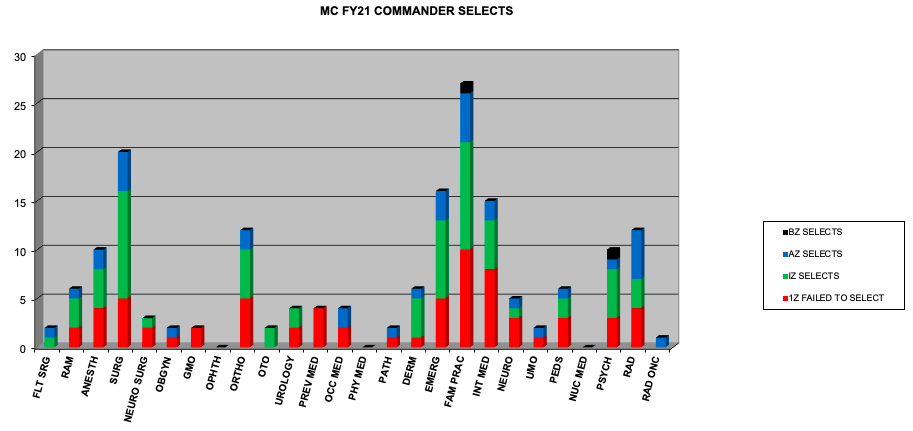
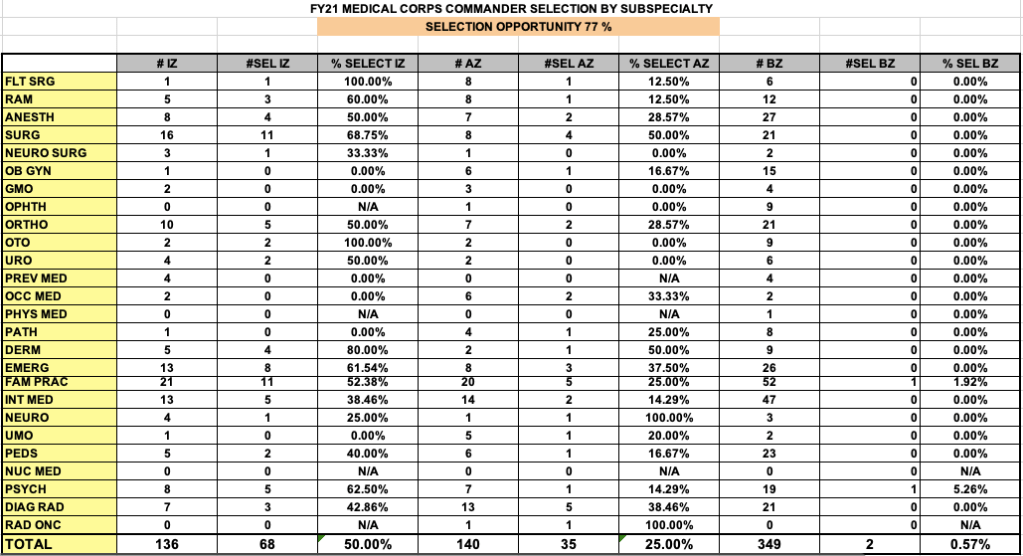
Here are the basic MC stats from the O5 board:
- Below Zone – 2/349 – 0.57%
- In Zone – 68/136 – 50%
- Above Zone – 35/140 – 25%
Other Corps and board Presidents can be seen in this file:
I’ll probably have the by specialty breakdown next week.
FY21 Active Duty CDR Staff Corps Selections
UNCLASSIFIED//
ROUTINE
R 081239Z OCT 20 MID200000213976U
FM SECNAV WASHINGTON DC
TO ALNAV
INFO SECNAV WASHINGTON DC
CNO WASHINGTON DC
CMC WASHINGTON DC
BT
UNCLAS
ALNAV 087/20
MSGID/GENADMIN/SECNAV WASHINGTON DC/-/OCT//
SUBJ/FY-21 ACTIVE-DUTY NAVY COMMANDER STAFF CORPS SELECTIONS//
REF/A/DOC/SECNAV/09MAR20//
AMPN/REF A IS THE FY-21 ACTIVE-DUTY NAVY COMMANDER STAFF CORPS PROMOTION
SELECTION BOARD CONVENING ORDER.//
RMKS/1. I am pleased to announce the following Staff Corps Officers on the
Active-Duty list for promotion to the permanent grade of Commander.
2. This message is not authority to deliver appointments. Authority to
effect promotion will normally be issued by future NAVADMINs requiring
NAVPERS 1421/7 preparation and forwarding of document to PERS-806.
3. Frocking is not authorized for any officer listed below until specific
authorization is received per SECNAVINST 1420.2B.
4. For proper alphabetical order read from left to right on each line. The
numbers following each name to the right indicate the relative seniority
among selectees within each competitive category. Note: An (*) by the name
indicates the selectee was merit reordered to the top of the promotion list
in accordance with reference (a). Members are directed to verify their
select status via BUPERS Online.
Medical Corps
Ajao Michael A 0021 Ambrosio Art A 0066
Andrews Shalimar J 0100 Annen Michael J 0083
Armstrong Damon M 0015 Barnes Danielle Marie 0101
Bartle Ryan C 0038 Bernstein Kevin M 0095
Bhatt Nikunj A 0078 Biscotti Mauer III 0062
Brill Jason Bradley 0098 Burger John Mcclure 0096
Camarata Andrew S 0016 Carroll Eric Timothy 0084
Clayton Suzanne Dawn * 0003 Cochran Christopher A 0044
Cook Glen A 0058 Cronin William Andrew 0092
Daughtry Mohenish K 0028 Deforest Christine Ann 0088
Dettmer Jonathan R 0069 Dorsam Jillian Marie 0086
Dye Cicely Anne 0070 Ellis Rachel Michal 0059
Esquivel Christian E 0094 Feist Matthew Philip 0050
Finne Huckelberry A 0053 Ford Gavin W 0073
Gizaw Gabriel T 0054 Glerum Steven Michael 0033
Gomez Reynaldo 0039 Gonzalez Aaron Josue 0022
Guggenbiller Mathew R 0099 Halbach Jonathan Leo 0077
Hanrahan David M 0060 Hanson Robert S * 0006
Hardy Curtis Lamar 0093 Hart Kevin Scott 0012
Hartwell James Andrew * 0001 Harvey Amie Luann 0040
Hodges Sarah D 0030 Hopkins Scott Patrick 0036
Horn Adam Robert 0026 Hwang Daniel Sun 0087
Ismawan Johanes M 0061 Jackson Michael L 0089
Johannsen Marc T 0014 Kaviratne Summanther A 0056
Kehoe John Edward 0048 Keith Kevin Dewayne 0019
Keleher Eamon Carrigan 0091 Kemp Tamara Leigh 0080
Knaus Christopher M 0027 Kohan Matthew William 0103
Lee Michael A * 0007 Lewandowski Louis R 0076
Lizardo Radhames E 0082 Lucas Donald Jay Jr * 0004
Macclary Margaret E 0079 Madsen Clifford Marc 0090
Manley Edwin Jr 0023 Markham Gordon T * 0005
Marvin Blake A 0097 Mccluney Brendan J 0072
Mcdonald Victoria S D 0065 Mcgill April Lynn 0042
Mclendon Anne E 0081 Moore Margrette M 0013
Mukherjee Samir T 0032 Needham Kenneth Eugene * 0008
Oconnor Kristina W * 0009 Oldt Robert James III * 0010
Patton Jared Michael 0052 Penn Ashley B 0064
Prescher Lindsey Miche 0085 Robbins Langan Phelps 0025
Roxo Keith Michael 0057 Ruth Nadine Henley 0041
Rutter Robert P Jr 0049 Sakai Brandi Lyon 0068
Sapida Steven Benjamin 0024 Schuett Dustin Jon 0037
Scully Stephenie A 0104 Shrivastava Vikas 0074
Slotto James Gregory 0034 Smark Charles Thomas 0063
Soderlund Karl Anton 0043 Spinelli Joseph 0051
Stickels Paul A 0071 Sturgill Sarah B 0035
Sulaver Randy K 0102 Tarman Daniel Drew 0045
Tillman Brendon G 0067 Torbert Denise Renee * 0011
Tring Visong 0046 Twerdahl Eric H Jr 0031
Vicente Diego A 0075 Vincent Brian Roy 0018
Vo Joseph Van Jr 0029 Whiting Judd Atwood 0020
Willett Matthew C 0055 Williams Lawrence L Jr 0047
Williams Raquel T 0017 Wooldridge Bryan E Jr 0105
Dental Corps
Bakan Natalie Ranee 0005 Beck Jared Cameron 0018
Bischoff Eric L 0019 Boice Joseph Glenn Rob 0025
Bradley Christopher D 0010 Carey Joseph Francis 0008
Chilcutt Sara Ann 0014 Cooper Thomas Gene 0017
Dantonio Tracy Ann 0023 Darcey Caitlin Dora 0028
Dave Rohit Kumar 0022 Estrada Kristen Merced 0027
Hanson Christopher M 0012 Hassell Aaron Glen 0013
Hicks Jason Larnce 0016 Hoyle Jeffrey Thomas * 0001
Hutton Stephen Brett * 0003 Jackson Shawna Lee 0015
Lam Doris Kamay 0009 Lish James Carbery M 0024
Moody Evan Paul 0020 Pakchoian Andrew John * 0002
Quintero David G * 0004 Reddout Nicole Marie 0021
Rosacker Blake Mitchel 0026 Russell Paul Michael 0011
Suguitan Julie K 0006 Verzosa Christopher Ed 0007
Medical Service Corps
Adwell James Paul 0030 Aldrich Garth W * 0001
Baugh Joseph A 0017 Bennett David George 0021
Blair William A Jr 0014 Clapper Stephanie C 0027
Coe Kaarin Elizabeth 0011 Defang Gabriel N 0013
English Matthew Rustin 0032 Fraser John Joseph 0010
Fromknecht Joseph M 0024 Gao Hong 0006
Gourdine Jinaki S 0009 Havens Linda Diane 0031
Henry Shani Kay 0022 Hooten Hannah Lynn 0020
Jansen Brittany Jean 0028 Jenkins Kenneth Russel 0016
Kumar Sandeep 0036 Lagger James Arthur * 0003
Locke Jesse David 0025 Nevins Robert Patrick 0029
Norris Jacob Neal J 0035 Olabode Olusegun A 0019
Osborn Eugene Daniel 0007 Owen Michael Dennis 0033
Quebedeaux Luke P 0034 Reini Seth Andrew 0015
Romanowski Dominic J * 0002 Segovia Francine * 0004
Thoemke Chad Michael 0018 Tillman Jone Latice 0026
Veseyolah Kirsten E 0012 Walker Peter B 0008
Weiss Andrew J 0023 Woody Jessica Noelle * 0005
Judge Advocate Generals Corps
Barletto Bryan C * 0002 Bode Natasha T 0018
Caetano Christina Rose 0015 Carlson Erik Anders 0013
Connors Jason William 0004 Ericson Ross Stephen 0025
Fletcher Christopher M 0009 Fralick Kyle 0021
Harp Tracy Lynn 0010 Hoy Cara Addison 0014
Kadlec Nicholas John 0023 Krigbaum Dayton A 0011
Leary Daniel Breen 0024 Manz Gregory William * 0001
Murray Andrew David 0006 Oconnor Elizabeth A 0007
Pike Jennifer Myers 0017 Pitterson Ayana B 0005
Rasmussen Mark Thomas 0012 Reintjes Christopher M 0020
Sonn Matthew Robert 0016 Stampfli Nicholas B 0008
Waldo Aaron D 0022 Walker Kevin Michael * 0003
Warning David William 0019
Nurse Corps
Abuzeid Colleen L * 0001 Boese Martin Lewis 0018
Cavanaugh Edward R 0020 Gelenter Katherine M 0024
Goodridge Jennifer L 0007 Hall Monica Leigh 0023
Hanhila Judy Oliveros 0005 Jolly Rose Cheri 0013
Mckay Sonya Lynette 0004 Morgan Brenda Sue 0016
Newnam Rachel Elaine 0022 Oquin Colby J 0011
Orzechowski Jessica M 0006 Purcellmullins Heather 0017
Ragle Harley R III * 0002 Reaves April L 0008
Ryals Teri Rene 0012 Schaub Julie Michelle 0019
Stats Stacy Marie * 0003 Tobin Eric Tyrone 0010
Vesey Kimberly Ann 0009 Weiss Christopher Ryan 0014
White Lillian Waring 0021 White Robyn Vernye 0015
Supply Corps
Allen Christopher L 0061 Anderson Lindsay Renee 0017
Baker Jacob Thomas 0023 Bastola Jatan 0092
Biby Jennifer Marie 0054 Bick George Michael 0002
Cabana Reynaldo R III 0044 Chou Lupei 0041
Collins Michael Jason 0049 Cooper Vaughn B 0075
Cozart Joseph Marion 0012 Davis Heidi Marie 0089
Davis James Antonio 0084 Devoe Justin Thomas 0038
Dipaolo Ryan Patrick 0057 Diprospero Michael B 0042
Dremann Blake M 0064 Duncan Matthew Elliott 0031
Dziewiatkowski Craig T 0077 Fernandez Jeffgerard C 0022
Flores Heather Marie 0069 Flynn Melissa Shannon 0067
Foster James Leslie 0021 Gillette Casey James 0097
Gonzales Melissa Anne * 0001 Grennan Jeremy Andrew 0083
Gunter Mark Adam 0043 Hamilton Adam Lee 0034
Harding Joshua Ryan 0010 Harnish Jason Eugene 0095
Hartl Richard Patrick 0011 Hays Brian Hunter 0071
Hayward Nathan Taylor 0058 Hockett Michael C Jr 0005
Hodges Luke James 0048 Holch Alejandra 0037
Hughes Ryan Z 0046 Hull Samuel Asa 0027
Key Michael David 0063 Krenz Jonathan Michael 0056
Kundra Suneet 0015 Labbe Michael David 0035
Lanclos Raymond J III 0032 Langhorne Joshua Luke 0091
Lease Quentin Eugene 0045 Lebel Christopher M 0096
Lee Heather Erin K 0020 Lee Sohnhwa 0062
Leung Jonathan Ben 0006 Lewis David Scott 0019
Lovgren Andrew Charles 0007 Marks Jason Polito 0033
Marsh James Rowland 0025 Mazurek Anne Paine 0003
Mccandless Charles E 0094 Mccleery Gregory Thorn 0009
Mikesell Andrew S 0076 Miller Matthew Lewis 0008
Milligan Howard A 0068 Millner Joshua Mackey 0088
Molnar Alexander S 0016 Montano Stephanie C 0072
Monts Jason Aaron 0080 Muniz Benjamin G III 0086
Nelsonwilliams Arthur 0018 Newsome Eric James 0026
Obrien Raymond D 0078 Olabode John Adebayo 0060
Orozco Roel Kalanoc 0081 Ortman Isaac James 0052
Pagnucco Jonathan P 0090 Peters Brady Robert 0029
Poss Matthew Claywell 0055 Prentiss Jacob Matthew 0014
Raigoza Dominic M 0028 Renquist John J 0073
Riester Peter 0098 Riley Leanne Rose 0059
Romps William David M 0065 Rosas Manuel 0087
Sands Christopher M 0051 Schaefer Matthew J 0079
Schotman Jan Douglas 0036 Secrist John Riley 0047
Shaw Jason Andrew 0013 Slaby Gina Marie 0053
Smutz Joseph Anthony 0093 Staines Frederick Mana 0030
Stickel Ryan R 0004 Stone Garrett Daniel 0024
Suarezvillafane Cindy 0085 Sumner John R 0040
Teter Sean Michael 0050 Valle Michael Benjaman 0039
Vargas Julio Antonio 0099 Welday Kurt Alan Jr 0082
Whiteley Jacob T 0074 Williamson Dante E 0070
Windas Edward Patrick 0066
Chaplain Corps
Allen Raynard 0006 Baker Donald A III 0013
Butlersaeger Autumn E 0009 Cain Kimberly 0008
Clark Genevieve M 0010 Constantine Jason M 0016
Deese David Scott 0011 Duprey David Luke 0012
Gardner Calvin B Sr * 0001 Orris Glenn William 0007
Purvis Bryan Edward 0014 Rudd John Clive 0005
Slaughter Robert Atkin 0003 Smith Paul L 0004
Warne Stephen L * 0002 Williams Marlin 0015
Civil Engineer Corps
Angerman James G 0050 Auger Christian J 0032
Augustyn Michael T 0045 Brown Nicholas C 0017
Casilio John Frank 0046 Christner Brian W 0036
Dill Thomas Jonathan 0023 Elles Dane C 0044
Fosson Edward Ashley * 0004 Galloway James Robert * 0003
Gipson Dallas Aaron 0007 Good Crystine Michelle 0009
Gorman Shawn Christoph 0021 Gutierrez Daniel John 0040
Gutierrez Kathryn Anne 0031 Hamrock Phillip Robert 0008
Hansen Carl A * 0006 Hightower Michael Ray 0041
Horner Jonathan Ray 0024 Jackson Brianna E 0022
James Timothy Philip 0015 Kalish Benjamin E 0010
Kvandal John Douglas 0051 Leftwich Robert W 0018
Lenzer Matthew Joseph 0029 Mazur Kimberly Ilene 0030
Mccharen Robert Eugene 0014 Mcguire Seth Thomas 0038
Mckelvie James B 0033 Milkowski Matthew R 0049
Moerbe Sandranell L 0013 Musser Rachael M 0025
Parks Steven Holland 0019 Patton Jeffrey David * 0002
Penrod Ross Averett 0042 Potts Jeremy Rhymes 0012
Rasbach Austin A 0043 Ruggiero John Victor 0048
Sanchez Marcus A * 0001 Sandmel Christopher Ad 0037
Scharar Tyler Robert 0027 Schechter Jason Andrew * 0005
Schwartz Jeremy M 0020 Shambley James Odell 0035
Smith Riley W 0016 Syre Robert Mark 0026
Thrun Ryan Wayne 0034 Turner Joshua Aaron 0047
Woodward Billy Dewayne 0039 Wyckoff Chester John 0028
Zukowsky Joseph Morgan 0011
5. Released by the Honorable Kenneth J. Braithwaite, Secretary of the
Navy.//
BT
#0001
NNNN
CLASSIFICATION: UNCLASSIFIED
 Joel Schofer's Career Planning Blog