Uncategorized
How to Buy Life Insurance When You’re in the Military
Shopping for life insurance can be time consuming and difficult, but I’m going to make it easy for you. Read on to find out how much life insurance you need and figure out the best way to get it.
Do You Need Life Insurance?
The purpose of life insurance is simple. If you die, it protects those who are reliant on your income.
If you have anyone who is financially dependent on you, you need life insurance. If you don’t, you don’t need it. It’s that simple:
- Married with kids – You probably need it unless you have a sizable net worth.
- No kids but your spouse doesn’t work – You probably need it.
- No kids and your spouse works – If their income is enough for them to live on, you don’t need it. If it is not enough to live on, you need it.
- Single with no dependents – You don’t need it.
- Kids do not need life insurance.
This handles most scenarios. If you have some other situation, I’ll go back to the beginning…
If you die, would anyone suffer financially? If the answer is yes, you need life insurance. If the answer is no, you don’t.
What Type of Life Insurance Do You Need?
There are two types – term and permanent/cash-value. Only buy term. Never buy permanent/cash-value. No matter who tries to sell it to you or how convincing they are.
ONLY…BUY…TERM.
If you want to know why, read this article.
How Much Life Insurance Do You Need?
There are a plethora of online calculators set up to answer this question. The best one I’ve found is here. Use the calculator…that’s how much life insurance you need.
If you are averse to complicated calculators, a common rule is to purchase 7-10 times your annual income. Again, that is a rule of thumb that is not taking into account your individual life situation. If you are allergic to online calculators, though, using this rule of thumb will ensure that your family is not destitute if you die.
Where Should You Get Your Life Insurance?
You can shop around on different websites, like Term4Sale.com. But I wouldn’t do that if I was you.
Most companies that sell life insurance do not cater to the military. Their policies will have all sorts of restrictions that you and I just can’t be bothered with, like war clauses that would not pay out in the event of an act of war. (Note that Andy Borgia from DI4MDs.com contacted me after publication and says this is no longer the case. War is covered but there is a 2 year exclusion for suicide.) For this reason, I’d only get my insurance in one of four places:
- AAFMAA
- Navy Mutual Aid Association – You don’t have to be in the Navy to get insurance from them.
- Servicemembers Group Life Insurance (SGLI) – This is the life insurance you can sign up for via your military paycheck.
- USAA
There may be other military-focused insurers, and if you want to share them in the comments feel free, but these are my go-to sources.
What Combination of the Above Options Should I Get?
Getting SGLI isn’t necessarily the cheapest option. The above companies are well-versed in how you can most efficiently combine their products with SGLI to maximize the amount of life insurance you can get for your money.
Contact the three companies above. Spend some time listening to their opinions on how to best address your situation. Only buy term insurance. Then buy what seems best for you.
The Bottom Line
- Decide if you need life insurance.
- Decide how much you need.
- Buy term insurance only.
- Buy only from these sources – AAFMAA, Navy Mutual Aid Association, SGLI, or USAA.
Brief Disability Insurance Update and Finance Friday Articles
Here’s a brief message update from Lawrence Keller, one of the experts of disability insurance for military physicians at Physician Financial Services:
Joel-
Hope all is well.
I wanted to let you know that MassMutual recently announced a 25% discount for Active Duty Military Physicians.
This discount is permanent and also applies to all increases made to one’s coverage in the future.
I’ve also been using a two policy approach for Military Physicians that will ultimately allow them to reach up to $20,000 month, regardless of their health, as their incomes rise. I have received very favorable feedback on this strategy, which even works for Military Residents/Fellows (who are typically limited to only $2,000 month to start).
If you have any questions or require additional information, feel free to call.
Lawrence B. Keller, CFP®, CLU®, ChFC®, RHU®, LUTCF
Phone: (516) 677-6211
Fax: (516) 269-7700
Toll- Free: (800) 481-6447
250 Crossways Park Drive, Woodbury, NY 11797
https://www.physicianfinancialservices.com/
Here are my favorites this week:
6 Tips For Those Who Have Enough
Different Strokes – An Analysis of Vanguard, Schwab, and Fidelity Target Date Funds
TAX PLANNING FOR PHYSICIANS: CONCEPTS YOU NEED TO KNOW
Here are the rest of the articles:
5 Reasons to Not Give Up On Social Security
9 Symptoms of an Unhealthy Relationship with Money
10 Simple Steps to Financial Success
An Investing Road Map for Pre-Retirees
A Retirement Readiness Checklist
Cash panickers: Coronavirus market volatility
Has the Market Changed at All Since the Bottom?
How to Get Rid of Stuff: The Survey Says…
How to Get Started in Telemedicine
How to make economic forecasts personal
Risk and Return in the Stock Market Are Not Evenly Distributed
Socially Responsible Investing: Is It Also More Profitable?
Start Your FIRE: A Modern Guide to Early Retirement
The Right Way to Use Debt in Medical School
Two Ways to Change your TSP Investments
What Happened to the Middle Class?
When All Your Baskets Break At Once: The Black Swan
Weekly GME Application Assistance Calls Starting Today
In an effort to assist with questions members may have regarding the GME application process, the Navy GME office will start holding weekly application assistance open call tel-cons – the dial-in information is below.
Currently we have only been able to reserve 50 ports (maximum available without additional justification) so would ask that only those individuals with questions dial-in. If we find that 50 ports is inadequate we will request additional ports in subsequent weeks. Of course, individuals are always welcome to email any questions to the email address in the BUMEDNOTE 1524 – usn.bethesda.navmedprodevctrmd.mbx.gme-sb@mail.mil.
Date – every Wednesday, starting 26 AUG until JSGMESB on 7 DEC 2020
Time – 1200-1300 (eastern)
Dial-In Numbers:
- Commercial, (210) 249-4234
- DSN, 421-3272, (312) for Overseas DSN
*** The Conference ID and PIN are needed to dial in***
Conference ID: 2477# Pin Code: 145720#
Aerospace Medicine Program Director and NAMI Academics Director
Please see the announcement below from the Flight Surgery Specialty Leader:
Colleagues,
I know a few of you have already talked to me or have asked about both the Program Director for the Aerospace Medicine Residency as well as the NAMI Academics Director for the flight surgeon program. The PD billet typically come with an extended set of orders, although they may be only written for 3 years, 5-6 years is not atypical. The Academics Director job is typically a 3-4 year billet. I lay this out so you know what you are getting yourselves into and understand this is not a 2 years and then retire plan. There is a small number of you that are eligible for these positions and this e-mail is directed at you, but I will be sending the announcement to the Corps Chief’s Office as well. There may be some interest outside of AMS for the Academics Director position, but that individual will need to have been active in flight surgery recently. The PD job obviously requires you to be board certified is Aerospace Medicine, so if you are not currently BC, then you need to sit for your boards in OCT and pass them. Research, leadership positions and the breadth of your experience will also factor into your application.
The application will include your biography, CV and a separate personal statement for each position. For each position, address you’re your motivation to assume that job and what your vision for the program is over a 5 and 10 year period. I know you will not be there for 10 years, but what do you want the program to look like in the future. How will increased UAV usage effect training? What about the gradual conversion of “GMO/OMO”’s to board certified physicians. How would that impact Flight Surgery Training? How would straight through training effect the RAM and what would that internship look like? These are some real questions that may need to be addressed during your time in the seat. Please keep this to 1-2 pages.
We will have a board to review the applications who will then select the next PD and Academics Director. The board will consist of the NAMI OIC, the incumbent, myself .and former TYCOM surgeons.
I know everyone is under different stresses, depending on their current billet, but please send me you applicant packages NLT 18 September. The intent is to have a decision made by October, so turnover plans can begin and the incoming PD and Academics Director can participate in resident selection as well as flight surgeon selection.
Please note this date is different than what I have on the announcement, since I did not get this out yesterday as expected.
Thanks!
V/R,
Rob
Robert J. “Biff” Krause, MD, MPH, CIME
CDR, MC (AMS), USN
Aerosapce Medicine Analyst
Naval Safety Center (Code 14A)
Specialty Leader, Aerospace Medicine and Flight Surgery
What are KSAs?
KSAs are Knowledge, Skills, and Abilities that Naval personnel are supposed to possess in order to do their jobs well. In order to ensure Naval medical personnel meet and exceed their operationally-focused KSAs, Navy Medicine is developing standardized enterprise-wide Naval Medical Readiness Criteria (NMRC), in support of readiness performance metrics. I stole that from slide 2 of this 4 slide PPT deck, which you should read as it provides some background:
As you can see from this portion of slide 3, the NMRCs are a work in progress and are actively in development:
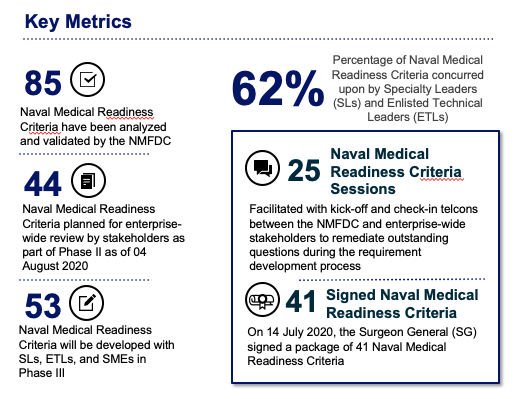
That said, the SG signed this memo on 14 JUL 2020 establishing the NMRCs in these 2 attachments:
Enclosure 1 – Combat Casualty Care Team
Enclosure 2 – Non-Combat Casualty Care Team
You should check out these attachments and see if your specialty has approved NMRCs.
How will people actually monitor and achieve these NMRCs? The Naval Medical Force Development Center (NMFDC), a part of BUMED, is developing dashboards to easily allow individuals and commands to see where they stand on their NMRCs. Once developed, it will be the Navy Medicine Readiness and Training Commands/Units (NMRTC/Us) that work to get their personnel ready and meeting their NMRCs.
If you look at the NMRCs, you’ll notice that they each have 3 categories:
- Category 1 – Core Practice/Clinical Currency – Fundamental training and skills, usually obtained through medical education and maintained through Medical Treatment Facility (MTF) experience and/or partnerships. This category of requirements links to the attainment of core practice, clinical currency, and KSA Threshold for medical personnel. ***Note that this is how KSAs fit into NMRCs, as part of category 1.***
- Category 2 – Expeditionary Skills for Readiness/Readiness Currency – Combat Specialty Knowledge – Individual skills specific to operating in an expeditionary environment. Category 2 Readiness Criteria ensures transference of Category 1 skills to the expeditionary environment, including patient care during combat operations. Category 2 Readiness Criteria also includes general platform training requirements for an individual specialty across the potential operating environment to which the individual would be assigned. This category of requirements links to the attainment of readiness currency.
- Category 3 – Platform Training for Readiness – Readiness Proficiency/Operational Platform – Team/Unit-level training specific to a platform or unit to which a Service member is assigned. This category of requirements links to the attainment of readiness proficiency and, as such, joint interoperability.
In other words, for me it isn’t just about being a competent Emergency Physician who meets his Emergency Medicine KSAs (Category 1) but also about applying that competence to the expeditionary setting (Category 2) and the specific platform I’m assigned to (Category 3).
If after reading this summary you have questions about KSAs, please ask your Specialty Leader. If they don’t know the answer, NMFDC is probably the next stop for answers (contact info is on page 2 of the SG’s memo) but the Corps Chief’s Office can certainly help with anything that is unresolved. CDR Wendy Arnold, Policy & Practice Officer, would be the first stop and her contact info is in the global address book. Lastly, you can always contact me.
 Joel Schofer's Career Planning Blog