Author: Joel Schofer, MD, MBA, CPE
Navy Times – Prognosis Good for Navy Medicine, But Budget Concerns Loom
Here’s a link to this article:
2 Important TSP Changes and Finance Friday Articles
This week I’d like to highlight the 2020 TSP contribution limits, which will be $19,500 for most of us, as well as the instructions for enabling 2-factor login, which will be required as of 1 DEC:
TSP Contribution Limits for 2020
TSP 2-Factor Login Instructions
Here are the rest of the articles:
2020 Tax Brackets, Standard Deduction, and Other Changes
6 Bare Minimum Tasks to Fix Your Finances
Are Real Estate Investments Resistant to Inflation?
Bernstein Says Stop When You Win The Game
Financial Burdens and Physician Burnout
How to manage money for financial success in the U.S. military
How to Think About Money: A Physician on Fire Review
Into a Cloud – Letters from a Downed World War II Pilot
Lessons Driving an $800 Car Can Teach Your Kid
Non-Intuitive Lessons From the Man Who Solved the Market
Student Loan Planner Reviews: Honest Opinions from Three Former Clients
The 3 benefits of charitable giving
The Price of US Stocks and Signal Failure
Trends That Matter in Asset Management
TURNKEY RENTALS DON’T HELP YOU ACHIEVE FAST FIRE
Using Your Estate Plan to Have a Graceful Exit
What does buying a new car really cost over the years?
Why are Doctors Burning Out? Three Ways FIRE Can Save Us
Why Timing the Market is a Fool’s Errand
Throwback Thursday Classic Post – Tips to Improve Your Concurrent FITREP
An officer e-mailed me and asked for tips on improving his concurrent FITREP, which I thought would make a nice blog post.
A concurrent FITREP is most often received when you are deployed. It is “concurrent” because not only are you getting a FITREP from your deployed command/unit, but you are also getting one from your home/parent command. For example, in 2016 I returned from my last deployment after being gone from September 2015 to June 2016. I received both a periodic FITREP from my parent/home command and a concurrent FITREP from my deployed command.
Tips to improve your concurrent FITREP include:
- Realize that operational commanders often know very little about medical/Navy FITREPs, so you want to do everything you can to make sure that none of these critical FITREP mistakes happen to you.
- Try to get a strong soft breakout where the commander compares you to all officers of the same grade under his/her command either now or during his/her entire career. For example, “In the top 10% of over 200 O4 officers I’ve rated in my entire career.”
- Make sure your most important title/duty is in the box in the upper left of block 29. For example, don’t put “PHYSICIAN” but “OIC” or “SMO”. You can often score some titles that sound very important on a deployment, like “MEU SURGEON” or “GROUP SURGEON”. You don’t want to waste them.
Otherwise, general FITREP advice can be found on my FITREP prep page.
Global Health Engagement Position – Health Affairs Attaché, Vietnam – O5/O6
There is a wonderful global health engagement (GHE) opportunity for an O-5/O-6 physician. We will be filling the Health Affairs Attaché position at the embassy in Hanoi, Vietnam. The desired report date is September 2020.
Applications (CV, Bio, Letter of Intent), with Detailer and Specialty Leader concurrence, should be submitted to CDR Melissa Austin (contact is in the global) NLT COB, Friday, November 22nd.
Here are some additional details:
Know Your Bosses
One of the best ways to prepare for interviews when you are trying to score an important position is to be up to date on issues of focus by senior leadership. Here are a few references of interest.
Secretary of Defense
The SecDef recently put out an unclassified message to his commanders. Here it is:
Message to the Force – Warfighting Readiness
Surgeon General
The new Surgeon General focuses on high reliability principles. If you need a primer on them, here is a good open access article from the Joint Commission:
High-Reliability Health Care: Getting There from Here
Here is also an article he wrote:
Fleet Practices Are Driving Better Health Care
I’m Speaking at the Professional Development Committee Discussion on “The Future of Military Medicine” – NMCP – 14 NOV – 1200-1315
Here’s the info sent out about this panel I’ll be speaking at:
We are one week away from our incredible panel brought to you by the Professional Development Committee on the vital topic, “The Future of Military Medicine”. Our panel has adjusted slightly, but we have just an incredible trio that will be present to discuss the important topics on everyone’s mind as we find our course forward in military medicine. Our very own CO, CAPT Lisa Mulligan, will still be on our panel and will be joined by CAPT Guido Valdes, Deputy Commander of Navy Medicine East, as well as CAPT Joel Schofer, Deputy Chief of the Medical Corps from BUMED. This great, high-powered group will be giving us insight into ways forward from the BUMED, NME, and Command level. We look forward to seeing you all there! Tell your friends. VTC info below.
Conference Name: The Future of Military Medicine
Conference Date: Thursday, November 14, 2019
Conference Location: Auditorium, Building 3, NMC Portsmouth
Here’s a PDF announcement as well:
My Investment Portfolio
I write a lot about personal finance. If you are wondering what I’m doing for my own finances, here’s a detailed look at my own portfolio. I’m not going to give you dollar amounts, but percentages. If you want to know the dollar amounts, they can be expressed in one word. I have…enough:
At a party given by a billionaire on Shelter Island, Kurt Vonnegut informs his pal, Joseph Heller, that their host, a hedge fund manager, had made more money in a single day than Heller had earned from his wildly popular novel Catch-22 over its whole history. Heller responds,“Yes, but I have something he will never have . . . enough.”
Assets
My financial assets from largest to smallest include: (all percentages are rounded to the nearest whole percentage)
- 24% – My taxable mutual funds, which is where I put our retirement savings when I fill our retirement accounts. It is currently invested in:
- 56% – Vanguard Total Stock Market Index Fund Admiral Shares (VTSAX)
- 37% – Vanguard Total International Stock Index Fund Admiral Shares (VTIAX)
- 7% – Vanguard Prime Money Market Fund Investor Shares (VMMXX)
- 21% – My Thrift Savings Plan (TSP) – Currently invested in this proportion:
- 91% – US stocks
- 75% – C Fund
- 25% – S Fund
- 1% – International stocks (I Fund)
- 9% – US bonds split evenly between the G Fund and F Fund
- 91% – US stocks
- 15% – My paid off house.
- 12% – My wife’s TSP, which is invested 100% in US bonds with a 50/50 split of the G and F Funds.
- 12% – My wife’s Roth IRA, which is invested in:
- 53% – Vanguard Total International Stock Index Fund Admiral Shares (VTIAX)
- 47% – Vanguard Total International Bond Index Fund Admiral Shares (VTABX)
- 9% – We have two 529 plans with Vanguard invested in their aggressive age-based portfolio.
- 6% – My Roth IRA, which is 100% invested in the Vanguard Total International Stock Index Fund Admiral Shares (VTIAX).
- 1% – My wife’s individual 401k, which is 100% invested in the Vanguard Total International Stock Index Fund Admiral Shares (VTIAX).
- 1% – My wife has a 401k that is invested in the Fidelity® 500 Index Fund (FXAIX).
Liabilities
None. Aside from credit cards we pay off every month, we’re debt free.
Overall Asset Allocation
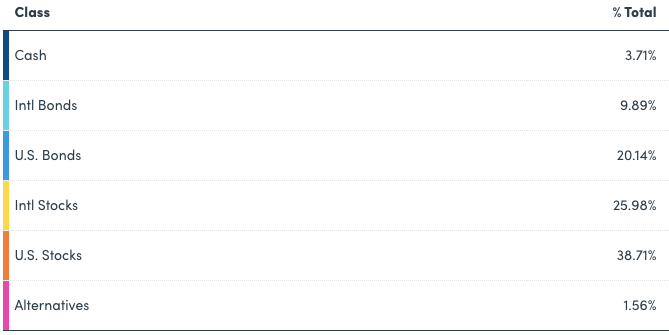
Excluding the pension and my house, here’s my overall asset allocation courtesy of our favorite tool that made all of this easy, Personal Capital:
Finance Friday Articles
Here are my favorite articles from this week:
Financial Planning for Early Career Attending Physicians
Following The Stock Market Is Bad For Your Returns
I followed the path to FIRE — and learned that early retirement is the wrong goal
Here are the rest of this week’s articles:
10 Benefits of Keeping Your Credit Score in Good Health
Achieving Work-Life Balance Through Part-Time Work
A Step by Step Guide to Tax Loss Harvesting
Cap Weighted Versus Fundamental Index Funds
How are the 2000 and 2008 retirees doing?
How to Get a Better Deal From a Real Estate Agent
How to Make a Portfolio Rebalancing Spreadsheet
Refinancing Gains in Real Estate
Save first for the kids’ college or for your own retirement?
Top 5 Money Lessons for Physicians
 Joel Schofer's Career Planning Blog