Retirement
2 Months Into Retirement Prep – What I’ve Learned So Far
I’m about 2 months into my decision to retire. What have I learned so far? Here is a summary:
Retiring is Nearly a Full-Time Job
There is a lot to do. In summary, you’ve got to do all of the items on this timeline:
Here is another very thorough retirement checklist that is the best I’ve found so far.
There are Tons of Civilian Jobs Available
I’m not even sure I want a job, but there is no shortage of opportunity out there, especially if you are not geographically constrained. After setting up job searches on LinkedIn, Glassdoor, Indeed, USAJobs, American Association for Physician Leadership, and HigherEdJobs, I have been deluged by e-mails. Think long and hard about what frequency you want to receive these e-mails when you sign up for them. I’d recommend weekly. Daily is overwhelming.
Almost No One Wants to See Your Full Academic CV
I have a 40 page CV:
The VA recruiter was fine with a full CV and I also uploaded it to HigherEdJobs since those jobs are academically focused, but almost immediately after starting a job hunt I needed a 1-2 page resume, which I didn’t have at the time. Here is what I’m currently using:
I was asked for my “executive portfolio” and I don’t have one of those ready yet, but it came from an unsolicited “recruiter” who wanted me to charge me $800 to develop one. Blocked/Spam!
There are A Lot of People Willing to Help You Out
There are a lot of organizations willing to help out a separating veteran. I’m still working through many of them, but the ones with the most promise so far are here with their missions highlighted. So far I’ve explored using them for resume and LinkedIn profile help and some job searches:
AAPL – The American Association for Physician Leadership (Formerly ACPE) is the only association focused on the personal transformation of all physicians, and through them the organizations they serve. (I’ve used AAPL to become a Certified Physician Executive and could not recommend them more highly. The CME I’ve received from them has been the highest quality I’ve experienced. Plus, unlike the American College of Healthcare Executives, there is no requirement to attend CME/conferences every year once you are certified, which seems like a bit of a pyramid scheme to me.)
Boundless Horizon Coaching – My Sister-In-Law is an executive coach and has helped me out. She could help you out too!
COMMIT Foundation – COMMIT focuses on senior military personnel transitioning out of service. They were able to link me with a free resume coach, and they are searching their alumni for people who work in healthcare in Hampton Roads, which may be helpful.
Military Officers Association of America – MOAA is an independent, nonprofit, nonpartisan association of officers from America’s military services and the commissioned corps of the U.S. Public Health Service and National Oceanographic and Atmospheric Administration, comprising the nation’s uniformed services. They are 350,000 active duty, retired, former, and National Guard and Reserve officers, and surviving spouses, of all ranks and branches who serve or have served, as well as their family members. MOAA advocates with Congress, DoD, the VA, Department of Homeland Security (DHS), and other departments to preserve and protect earned benefits for our uniformed services, veterans, their families, and surviving spouses through advocacy, leadership, education, and service, fulfilling MOAA’s promise to “Never Stop Serving.” (I’m a lifetime member of MOAA and feel like the resources and information they provide are top notch.)
VetJobs – VetJobs expands employment opportunities for service members and veterans through one-on-one employment placement assistance, focused on the use of gap skills training and targeted resume and interview assistance, LinkedIn optimization, and connections to employer partners in order to create a smoother transition process. (They are currently reviewing my LinkedIn profile and resume for free. They also introduced me to this Resume Engine that I thought was a pretty cool tool.)
WendySchoferMD.com – My wife is an Executive Coach like my Sister-In-Law, and a retired Navy Captain in the Reserves. She has helped me out during this process and could help you too!
Just Because Your Retirement Date is Approved Doesn’t Mean You Have Orders Yet
On November 15th I got this e-mail:
From: “noreply@navy.mil” noreply@navy.mil
Date: Saturday, November 15, 2025 at 2:40:53 AM
To: “Schofer, Joel M CAPT USN DHA GUAM NH (USA)”
Subject: NSIPS R&S Request Finalized Notification
Your Retirement/FLTRES/Separation has been finalized. Details are available via NSIPS, Member SelfService. Navigate to Employee Self Service > Retirements and Separations > Request Home.It means that your retirement date is approved. It does not mean you have retirement orders in the system.
I Can’t Comment on the Transition Assistance Program (TAP) Yet
I’m not scheduled to do TAP (there is not “s” on the end anymore) class until January. There will be more to follow once that is done.
Filling Out a Separation Questionnaire
One of my first tasks during my retirement journey is to fill out this separation questionnaire. Note that I couldn’t open with Preview on my Mac, but it worked fine using Adobe for Mac. If the version below gives you trouble, you can find it on this page (it is NPPSC 1900/1):
Largely, it was pretty self-explanatory to fill out. Tips include:
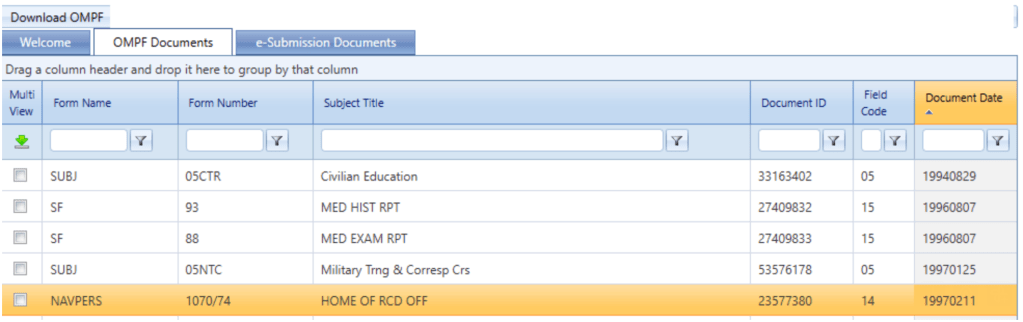
- If you need to find your official home of record, it can be found in your OMPF on BOL. Here is mine highlighted in orange at the bottom:
- For question #15, DD 214-1 is for reservists and is N/A for active duty.
- For question #19, sending your DD 214 directly to your state of residence or the VA can expedite things when you try to access veteran benefits, so I elected to send it.
If anyone else has any tips or tricks for filling this out, please comment below.
I’m Retiring! Let’s Take This Journey Together
I’ve decided to retire on 1 JUN 2026 at the 25 year mark. This may surprise some people. It surprised me, but it is time to do something else.
As this process progresses over the next 9 months, I plan on documenting what I go through to help others who decide to do the same one day.
How to Request Retirement on NSIPS
This is the Google AI overview, which I found to be accurate and made minor edits to:
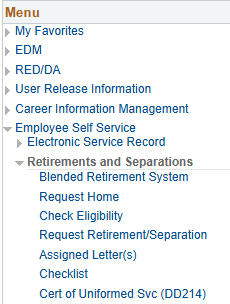
To request retirement on NSIPS, log in and navigate to Main Menu > Employee Self Service > Retirements and Separations > Retirement/Separation Request. Here is a screenshot I took to show you where to go:
Select the appropriate request type and fill out the details, including your desired retirement date. Keep in mind that you must retire on the 1st of the month. After entering your contact information, route the request to your Command Reviewer for processing and attach any required supporting documents.
Overall, I found the process surprisingly simple. I only had one issue I couldn’t figure out, and my Command Career Counselor showed me that I needed to add my “PSA” or “Planned Separation Address”:

Detailed Steps:
- Log In to NSIPS: Access the Navy Standard Integrated Personnel System (NSIPS) and log in to your self-service account.
- Navigate to Retirements and Separations: From the main menu, select Employee Self Service, then Retirements and Separations.
- Initiate Your Request: Select Retirement/Separation Request.
- Choose Request Type: From the dropdown menu, select the appropriate type of retirement or resignation.
- Enter Details: On the “Contact Information” tab, ensure both your current home address and your planned retirement address are accurate.
- Route Your Request: Click the “route” button at the bottom of the page to send your request for review by your command.
- Attach Documentation: After routing, you will proceed to an attachment screen to upload any necessary supporting documents, such as a copy of your DD Form 2648 (Pre-separation Counseling Checklist).
- Submit for Final Decision: Once all steps are complete, submit the request to Navy Personnel Command for a final decision.
Important Considerations:
- Timing: Officers should submit their voluntary retirement requests 9-12 months before their projected rotation date (PRD).
- Check Eligibility: You can check your eligibility for retirement within NSIPS by going to Employee Self Service > Retirements and Separations > Check Eligibility.
- Pre-Separation Counseling: A mandatory prerequisite to attending the Transition Assistance Program (TAP) is completing the Pre-separation Counseling Checklist (DD Form 2648), which must be signed by your Command Career Counselor.
- Contact Support: If your command lacks NSIPS capability, or you need assistance, contact Officer Retirements Branch (PERS-835) for guidance on submitting your request.
Also, here is a checklist I was given by my Career Planner that I plan on working through:
Guest Post – The COLA Trap Review
The COLA Trap Review
Colonel Douglas Fowler graduated the Air War College in June 2020 and wrote The COLA Trap for one of his papers. He has three simple recommendations to optimize your retirement pay based on the first year COLA that influences your annual pension in following years:
Retire at the end of a fiscal quarter: 01MAR, 01JUN, 01SEP, 01DEC
Avoid retiring at the beginning of the fiscal year 01OCT
Maximize your COLA by retiring 01MAR (This means retire in FEB, retirement pay starts 01MAR)
Colonel Fowler explains how the legacy High-3 pension system is calculated using the average of the service member’s highest 36 months of base pay. Active duty pay is determined by the National Defense Authorization Act (NDAA), while the retiree COLA is associated with inflation, and determined by the Consumer Price Index, not the NDAA. Because the COLA is calculated by an automated formula, it is possible to have a pay inversion, a concept where a service member who retires a couple months earlier than a control matched peer can earn a larger pension. This happens because the Consumer Price Index is used to determine inflation. The difference is taken between the base quarter (July-September) of the calendar year you retire and the quarter before retirement. If you retire October-December, you subtract the quarter before retirement (July-September) from your base quarter (July-September) which equals zero months difference in inflation and your COLA is zero. However if you retire January-March, you subtract the quarter before retirement (October-December of the previous year) from your base quarter (July-September of the current year), which has six months of spacing for a larger difference in inflation. This COLA formula applies to both officers and enlisted. Also note service members retiring (not medically) can only retire on the first day of the month. Colonel Fowler’s “The COLA Trap” lays out his three recommendations to optimize your military retirement.
After reading his paper, you can follow the most recent retirement COLAs here:
https://militarypay.defense.gov/Pay/Retirement/cola/
Dr. Jesse Schonau
The views expressed in this blog post are those of the author and do not reflect the official policy of the department of the Navy, Department of Defense, or U.S. Government.
The Most Controversial Post of All Time Resolved? HPSP and FAP Credit in the Reserves
The most controversial post of all time is this post about getting credit for HPSP time in the Reserves. It has over 100 comments, and no other post in 10 years is even close to that many. The issue may have led to an IG complaint and Congressional Inquiry, if not multiple of each!
Yesterday, a reader tipped me off that this may have been resolved. Here is the text from the Navy Personnel Command page:
Physicians, Dentists, Optometrists, Physician Assistants or Clinical Psychologists who participated in the Health Professions Scholarship Program (HPSP) and/or Financial Assistance Program (FAP) and drill in a Critical Wartime Specialty, can earn up to a maximum of 4 years towards retirement and a maximum of 50 points per year. DoDI 1215.07 page 14.
In response to SECNAV memo of 23 Jan 25 and ASSTSECNAV MRA WASHINGTON DC e-mail ltr of 28 Jan 25, member is eligible for issuance up to four years of qualifying service due to completion of the Health Professions Scholarship Program (HPSP) and validation of critical wartime specialty.
HPSP retirement example*: A CDR, who currently serves in a DoD Critical Wartime Specialty, participated in the HPSP program for 4 years and separated from active duty service with 12 years. Upon accession into the Navy Reserves, the CDR is immediately credited with 4 satisfactory years towards Reserve retirement plus 200 points (50 points per year while in HPSP program). The CDR would need to serve in the SELRES for just 4 more years to reach retirement eligibility.
(Note that they don’t tell you want the asterix means after the word “example” in the above paragraph)
Added 20 MAR 2025:
This file has the most recent publicly available list of critical wartime specialties. It is unclear if this is the list they will use for the above policy:
- ← Previous
- 1
- 2
- 3
- …
- 8
- Next →
 Joel Schofer's Career Planning Blog