
TSP I Fund News and Finance Friday Articles
This one is certainly interesting for anyone who invests in the TSP I Fund, its international stock index fund:
Trump orders federal retirement money invested in Chinese equities to be pulled
And then they put out this update:
Board defers action on I Fund transition — (May 13, 2020) Due to a meaningfully different economic environment related in large part to the impact of the global COVID-19 pandemic, as well as the nomination of three new Federal Retirement Thrift Investment Board Members, pending further study, the Board is delaying the implementation of the I Fund benchmark change to the MSCI ACWI ex-U.S. Investible Market index from the MSCI EAFE index.
This is why I try to keep all of my international stock holdings at Vanguard in their total international stock fund, which includes emerging markets like China.
Here are my favorites from this week:
Does Covid-19 Prove the Stock Market is Inefficient?
How Debt-Free Living Helped Us Beat the Coronabear
Here are the rest of the articles:
AMA’s Disability Insurance: You Get What You Pay For
Can Millennials Count on Social Security In Financial Planning?
Charitable Remainder Trusts – A Potential Solution To The SECURE Act
Does Better Virus Response Lead to Better Stock Market Outcomes?
Forced Frugality: Applying Lockdown Life Lessons to Reach FI Faster
How to Thrive with Airbnb Rentals Amid the COVID-19 Pandemic
Nothing Fails Quite Like Success in the Stock Market
Now Is The Best Time In History To Do A Roth IRA Conversion
Partial FIRE: The Solution to Your Problems?
Refinancing with a Physician Home Loan
The 5 Types of Investors In This Market
Thinking Through Financial Decisions
This new site is all about money for military spouses
What Happens to Stocks After a Big Up Month?
What the White Coat Investor Actually Uses
What Ultralow Yields Mean for Your Financial and Retirement Plan
Throwback Thursday Classic Post – Did You Really Fail to Select for Promotion?
If your name was not on the promotion list, you probably weren’t selected for promotion. There is, however, a chance that you actually were selected for promotion but your name was removed after the promotion board. Why would this happen?
After promotion boards there are some systems that are “scrubbed” to ensure that no adverse or reportable information exists for the officers selected by a promotion board or by an administrative board (the CO/XO/CMO/OIC board, for example). Here is a chart that shows you the systems that are checked:

As you can see, if you have problems with your security clearance, the Inspector General, Naval Criminal Investigative Services, or any legal issues, your name could be removed and your promotion put on hold. How do you tell if this happened to you?
First, go to BUPERS On-Line and click on the link for “Advancements/Selection Boards” as pointed out with the large arrow:
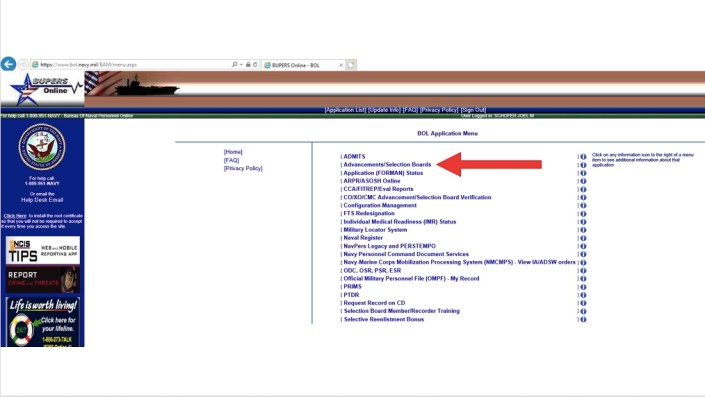
Now you should see a screen similar to this one:

As you can see, I was a “SELECT” for O6. If you actually were a non-select for promotion you’d see a “N” where my “S” is. If you were “scrubbed” from the promotion list, you’ll see an “H” for HOLD.
If you don’t see anything, then you didn’t fail to select. You probably weren’t looked at by the board. This most often happens to people who trained in the NADDS program in civilian training programs and weren’t on active duty for a whole year.
If you are on hold, I’d contact your Detailer to try and find out why.
Throwback Thursday Classic Guest Post – Full Time Outservice Fellowship Gouge
By Dustin Schuett, DO (with MCCareer.org editorial comments in italics)
Note: The views expressed in this blog are those of the author and do not necessarily reflect the official policy or position of the Department of the Navy, Department of Defense or the United States Government.
One of the strongest parts of Navy Graduate Medical Education (GME) is the ability to pursue Full-Time Outservice (FTOS) fellowship training. Being approved for Navy FTOS fellowship training makes you essentially a “free” fellow to whatever program you enroll in as you will continue to receive active duty Navy pay and allowances.
The biggest difficulties of a FTOS fellowship are typically logistical issues associated with being assigned to a ROTC or Reserve Unit Command. (For example, when I did my FTOS fellowship in Emergency Ultrasound in Delaware, I was assigned to the University of Pennsylvania ROTC unit.)
Here are some of the things I and some colleagues have learned thus far in our FTOS fellowship experiences that I wish I would have known before I started fellowship and even before PCSing from my prior Navy command.
- Big key: when in doubt, ask. Mark Sullivan at the Navy Medical Corps GME Office is your go-to for any questions/issues. He’s a phenomenal resource who does a great job helping out and keeping you informed leading up to and during your FTOS fellowship. (His contact info can be found on the right hand side of this page.)
- Look to see if you’re eligible for a retention bonus running concurrently to your fellowship and fellowship payback entitling you to additional money without added payback.
- If you’re going from an actual Navy command, I strongly recommend taking advance dislocation allowance (DLA, money to partially reimburse a member for the expenses incurred in relocating the household on a PCS)
- The location of your fellowship is likely not near a major Navy base with normal Navy admin support. Many are assigned to a ROTC unit or Reserve center which may be severely lacking in admin support.
- I’m currently 8.5 months into waiting for my DLA from PCSing last June and wishing I would have taken advance DLA.
- Start your state license application process early. Unless your fellowship is in the state where you are already licensed, you will likely need to get licensed in that state. This can take 3-4 months or even longer. For more arduous states like Massachusetts, I would recommend starting the October before you start fellowship. (Normally you can used any state license to practice in the Navy, and this same requirement should apply to FTOS training, but the civilian hospitals almost always want you licensed in the state they’re in. Mine did.)
- You are still required to complete the Body Composition Assessment (BCA) and the Physical Readiness Test (PRT) because you are still on Active Duty. The opportunity to skip the PRT if you scored an “Excellent Low” average with no event below “Good Low” should still apply, but check with your command.
- Because you are on Active Duty, even if you are exempt from the PRT, you will still have to pass the BCA within standards.
- Check-in is extremely variable with some commands having a full orientation day. My NROTC Unit in Boston had us coordinate a time to check in with the civilian administrative assistant. This was approximately a 2 hour process to check in, stop PCS leave, and complete the basic unit transition paperwork. It was very informal and done in civilian attire
- Command structure varies by area. If you are part of a ROTC unit, you fall under their CO and abide by their rules. Leave is arranged through your command and the rules of when you must be on leave depend on your command. The NROTC Boston rules are if you’re flying or driving more than 300 miles, you have to be on leave. (They will also do your fitreps as well. My reporting senior was a Marine Colonel at the ROTC unit.)
- Leave is typically performed through NSIPS. On arrival at your new command, see what needs to be done to get you transferred to their NSIPS roster so that you can request leave. Since you’re not actually doing work at the ROTC/Reserve unit, almost any leave will be approved.
- International leave still has the same rules as at a regular Navy command, so plan in advance for any trips out of the country and engage your Chain of Command early.
- Access to mail.mil email is variable. My account was disabled by my old command soon after I arrived while a friend doing fellowship across town still can access his email account with his CAC reader. Plan to not have access to your military email during fellowship, so save important emails and email addresses you may need outside of Outlook just in case.
- Fitreps in FTOS fellowships are almost exclusively non-observed. There are stories of rare commands completing observed Fitreps, but this is not the norm. (I do know someone who was able to contribute to the ROTC command and got a ranked fitrep.) You can still put text into the block 41 narrative detailing your accomplishments during your fellowship to include publications, meeting presentations, obtaining board certification, etc.
- You will have a non-observed Fitrep when your rank’s normal Fitrep hits (January for LT, October for LCDR, April for CDR) and a non-observed departing Fitrep when you check out. The only exception could be a CAPT in fellowship with potentially just a July regular non-observed Fitrep.
- Funding for TAD/conferences is usually through your fellowship or out of your own pocket. There may be very limited opportunities to get TAD funded by your local Navy command, but check with your command first. Most commands have no issue with placing you on no-cost TAD or special liberty for trips to conferences/meetings and other travel outside of your leave boundaries required by your training program.
- You will be on your command’s random urinalysis (UA) roster. Most commands understand that you have a busy and often inflexible schedule. When my name has come up for random UA, I received an email a day or two ahead saying the available times with the opportunity to reply if I could not make those times with the understanding that another time ASAP would need to be worked out.
- If you will be taking your Board Certification Exam or the final step of your Board Certification Exam soon before reporting or while PCSing, you will be eligible for Board Certification pay once you have been notified of passing. Board certification pay requests are routed through Mark Sullivan at the Medical Corps GME Office in Bethesda. You will need to route an endorsement through your CO at your unit, but the majority of the paperwork and the funding is handled by the GME office.
- If you are in zone for consideration by a promotion board, being in a FTOS Fellowship does not change this. I highly recommend doing everything you can to prep your record including ensuring all documentation is correct, you have an officer picture, and everything else listed in the Promo Prep document Dr. Schofer has put together 6-12 months BEFORE PCSing from your pre-fellowship command. It is exponentially easier to do this at an actual Navy command than through a reserve/ROTC command. Your access to BUPERS Online (BOL) and other CAC-enabled sites may be limited during your fellowship and most of the time you will be very busy. Getting your record ready 6-12 months before your start fellowship ensures you have plenty of time to correct any discrepancies well in advance of the board.
- Letters to the board can potentially help your promotion odds. FTOS fellows in the past have had their fellowship program directors write letters to the board detailing their performance in fellowship, some even had the fellowship directors write the letter hitting all of the Fitrep performance traits (Professional Expertise, Command Climate/EO, Military Bearing, etc.) specifically to replicate a Fitrep as closely as possible.
- Moonlighting is not permitted in any form during FTOS fellowship. Sorry. Your co-fellows may be moonlighting a ton and making more money, but keep in mind they’re likely making around $70,000 from the fellowship while you are making $100,000 plus and potentially close to $200,000 if you’re able to do the retention bonus/fellowship loophole plus untaxed money in the form of Basic Allowances for Housing (BAH) and Subsistence (BAS).
- Industry/externally funded travel/courses may come up during your fellowship. These are often great opportunities to obtain additional education and training without paying for it. You will need a Proffer letter from the company specifically detailing what is being offered in terms of monetary value in travel, lodging, meals, education etc. You will send this Proffer letter to Mark Sullivan who will also need an email from your fellowship program coordinator/director stating that the training is an integral part of your education and that it is being offered to all fellows and not just because of your affiliation with the DoD.
- Mark will then forward this on to Navy legal who will reply with any requests for information and usually give you a final decision within a few weeks. The decision will be sent in a Navy standard letter detailing your being allowed to proceed. Often, the company sponsoring your travel will need a copy of this letter for their records.
- Try to stay as far ahead as possible for this. I had an instance where the entire process was able to be completed and approved in a 2 week period, but ideally a month or more should be allotted. It’s a pretty simple process overall and you do not want to get into an unauthorized commitment situation.
- My command has allowed me to take special liberty for all of these courses so far which has allowed me to save up leave.
- Keep in mind that while you’re FTOS, you’re still in the Navy. You may not need to shave/put your hair in a bun every day, but don’t show up for your PRT with a full beard (yes that happened and yes the whole unit got an email from the XO about it).
- Enjoy the time in fellowship and being as close to a civilian as many of us will have for a 10-20 year stretch of our lives!
- What other questions do you have about FTOS fellowship? Please leave a comment or email me at djschuettdo < at > gmail < dot >com and I will try to answer any further questions.
FY-21 Active Duty Captain Staff Corps Selections
UNCLASSIFIED//

ROUTINE

R 131727Z MAY 20 MID110000675859U

FM SECNAV WASHINGTON DC

TO ALNAV

INFO SECNAV WASHINGTON DC
CNO WASHINGTON DC
CMC WASHINGTON DC

BT
UNCLAS

ALNAV 056/20

MSGID/GENADMIN/SECNAV WASHINGTON DC/-/MAY//

SUBJ/FY-21 ACTIVE-DUTY NAVY CAPTAIN STAFF CORPS SELECTIONS//

REF/A/DOC/SECNAV/21JAN20//

AMPN/REF A IS THE FY-21 ACTIVE-DUTY NAVY CAPTAIN STAFF CORPS PROMOTION
SELECTION BOARD CONVENING ORDER.//

RMKS/1.  I am pleased to announce the following Staff Corps Officers on the
Active-Duty list for promotion to the permanent grade of Captain.

2.  This message is not authority to deliver appointments.  Authority to
effect promotion will normally be issued by future NAVADMINs requiring
NAVPERS 1421/7 preparation and forwarding of document to PERS-806.

3.  Frocking is not authorized for any officer listed below until specific
authorization is received per SECNAVINST 1420.2B.

4.  For proper alphabetical order read from left to right on each line.  The
numbers following each name to the right indicate the relative seniority
among selectees within each competitive category.  Note:  An (*) by the name
indicates the selectee was merit reordered to the top of the promotion list
in accordance with reference (a).  Members are directed to verify their
select status via BUPERS Online.
                             Medical Corps
Ayala Marco Antonio          0045  Baldwin Andrew James         0062
Baldwin Thomas Michael       0033  Barna Michael M              0042
Bonaparte Kenneth Owur       0016  Brown Zachary Wade           0065
Dainer Hugh M                0011  Deaton Travis Granger *      0001
Diallo Hamma A               0030  Endicott Todd John           0067
Foster Christin Michel       0013  Freitag Gregory H Jr         0026
Fu Diana C                   0031  Gaconnet Cory Paul           0022
Gada Satyen M                0037  Galifianakis Alexander       0046
Galindo Roger M              0019  Gertner Jeffrey Wayne        0047
Granados Adolfo Jr           0032  Gregg Marion Anderson        0059
Grote Heather Juliann        0020  Hammer Noa Christopher       0052
Hickey Bradley William       0048  Hudson Arlene J              0014
Hudson Kerry Ann             0049  Johnson Jeffery Chad *       0003
Johnston Mickaila J *        0004  Kavanaugh Michael J          0068
Kearns Michel J *            0002  Kleyensteuber Brian Th       0041
Kotora Joseph G              0070  Kuskowski Leonard Jose       0009
Lam Alan Stephen             0058  Lamb Shannon Vanderpas       0051
Lee Rachel U                 0039  Leonard Elizabeth Anne       0044
Longwell Jason Jon           0069  Mai Vinh Q                   0027
Mancuso Wendy Gaza           0028  Matiasek Matthew Russe       0053
Matthews Karlwin J           0007  Mercado Michael Gasmen *     0005
Nguyen Josephine Cam         0043  Nguyen Mark Minhduy          0008
Nipper Thomas Willi II       0056  Osullivan Shauna Franc       0050
Parker Austin L              0036  Peterson Joel N              0029
Peterson Lisa Adelaide       0025  Pittner Douglas E            0038
Platz Timothy Alan           0054  Polk Travis M                0034
Praske Steven P              0017  Reimann Carolyn Ann          0023
Richter Kenneth Edwin        0063  Rivera Lisa Katherine        0061
Shaw Corey Ammon             0066  Singley Jeffrey W            0015
Smith Wayne R *              0006  Sprosty Michele Elizab       0035
Steely John Hugh             0024  Tiller Michael Mason         0018
Tracy Heather J              0057  Waters Sonya Nwannette       0010
Weis David A                 0012  White Sharese M              0021
Wilkerson Rashad Clift       0060  Wisniewski Paul John         0055
You David Mong               0064
                             Dental Corps
Anderson William Micha       0009  Bahrani Yasir Fouad          0007
Brown Cecilia Millicen       0013  Buss Kathleen Dawn           0012
Caraveo Sherry Angelic *     0001  Cragen Bart Marvin           0010
Draude Jeffrey A             0015  Erickson Kristi Ellen        0008
Fox Patrick James Jr         0006  Koontz Gregory Leonard       0016
Liu Garin Michael            0005  Merchant Keith Roshana       0004
Neal John Jeffrey            0014  Stefanos Sennay Mussie       0002
Welch Rasha Hanna            0003  Weldon David Scott           0011
                             Medical Service Corps
Bailey Jerry J               0007  Carter Willie Dexter         0008
Coon Scott Darwin            0006  Corpus Noel Mendoza          0012
Gilliard Richard Jr          0014  Grande Michael John          0005
Jamerson Matthew Hunte       0011  Kelly William Edward         0004
Lauby Melissa D Hiller *     0002  Lowe Michael Arthur          0003
Mcmahon Robert Tho III       0009  Milavec Stacie Ann           0013
Morlock Marcy Marita *       0001  Wilfong Erin Renee           0010
                             Judge Advocate General's Corps
Chockley Phillip A           0006  Hamon Philip John            0009
Josephson Elizabeth H        0007  Myers Amanda Rodrigue        0002
Obert Steven R               0003  Pascucci Peter P             0010
Pasieta Katherine Shep       0005  Pohanka Mary Beth            0004
Stormer Ryan                 0008  Tang Angela J                0011
Werner Daniel                0001
                             Nurse Corps
Basford Kenneth Ross         0009  Belcar Karen Ann             0013
Boyer Phillip Andrew *       0002  Conrardy Julie Anne          0003
Dickerson Charles E          0011  Ferguson Bridgette Dia       0014
Garner Kathryn A             0006  Gray Karen Marie             0007
Gryn Eric C                  0005  Keith Christopher Doug       0010
Loe Mathew R                 0008  Oboza Salee Jane P           0004
Rice Daniel Franklin         0012  Tillmon Susan Marie *        0001
                             Supply Corps
Anderson Ryan Paul           0037  Andrews Sean Mark            0007
Baker Donald Edward          0025  Bowmer Mark S *              0002
Brown Patrick William        0029  Buczkowski Christopher       0036
Capper Keith Alan *          0004  Edwards Stefan               0019
Erno Vincent V               0015  Haney Dale Allan             0020
Hoak Ronald Leroy II         0016  Holdorf Peter J              0034
Huber David James            0032  Jackson Kenneth Joseph       0021
Koch Carl W                  0035  Leblanc Shani Sharee         0013
Madson Cass Kotte            0022  Mihalik Craig Andrew         0014
Miller Frank D               0030  Newell Christopher Ala       0028
Pavlik David Wright          0031  Perry Ryan Matthew           0008
Pestar Joseph Charl Jr       0027  Peth Joseph Heinrich         0026
Rivera Allen                 0011  Rodebush David William       0018
Tamayo Phoebe Ubina          0009  Trout James A                0033
Uribe Juan Carlos            0012  Wahlgren Kristian Lowe *     0003
Walker Shannon Wayne *       0001  Wallace Alexander III *      0005
Williams Melissia Andr       0024  Williams Michelle Mari       0006
Wilson Daryl M               0017  Wright Glenn Allan           0010
                             Chaplain Corps
Amedick Michael David        0004  Anderson John G              0010
Baker Michael Ray            0008  Berrens Matthew Karl         0009
Coates Stephen M *           0001  Dinkins David Duane          0003
Ianucci Thomas Anthony       0005  Moore Robert Anthony         0011
Riley William Sylveste       0006  Rodriguez Santiago           0002
Wheeler Dennis Michael       0007
                             Civil Engineer Corps
Adams Jeremy P               0015  Allen Dean Edwin *           0002
Carey Ryan Philip            0017  Carroll Frank Wilson         0014
Coggins Chris Michael        0008  Crosby Jason A               0006
Dasher Bobby Don Jr          0005  Kubic Charles Brian          0012
Litteral Andrew Lee          0011  Obeirne Michael K            0003
Paul Brent C                 0007  Santiago Angel Luis *        0001
Senthill Atiim Donald        0013  Solina Constance Lynne       0016
Wienrich Susanne Marie       0004  Willey Allen E               0009

5.  Released by the Honorable James E. McPherson, Acting Secretary of the
Navy.

BT
#0001
NNNN
UNCLASSIFIED//
DOD Launches Financial Education Website for Military Spouses
Here’s a link to this announcement:
DOD Launches Financial Education Website for Military Spouses
Tips to Build Your Career During Residency
Here are the slides I used for this episode of the podcast:
Tips on Building Your Career During Residency
OB/GYN Virtual Town Hall for GME Applicants on 15 MAY at 1700 EST
Updated to include the slides.
The OB/GYN Specialty Leader, CDR Shannon Lamb, and the Program Directors of the OB/GYN Residency Programs at Naval Medical Center San Diego (CDR Kevin Byrd), Naval Medical Center Portsmouth (Lt COL Trimble Spitzer), and Walter Reed National Military Medical Center (LTC Rhiana Saunders), would like for you to join us for a virtual town hall meeting on Friday, May 15, at 1700 EST, to provide an opportunity to hear about a career as a Navy physician in Obstetrics and Gynecology, and to answer questions you may have about the residency programs available.
The dial in information is:
Dial-In Number:
Commercial, (210) 249-4234
DSN, 421-3272, (312) for Overseas DSN
*** The Conference ID and PIN are needed to dial in***
Conference ID: 2015# Pin Code: 323521#
During the initial discussion, please ensure your phones are on MUTE so everyone is able to hear and the conference is not interrupted with background noise. Once the speakers open the conversation to questions, you may then un-mute your phone if you have a question to ask.
You may also pre-submit questions to the specialty leader at:
Shannon dot V dot Lamb dot mil < at > mail dot mil
A summary of the questions/answers and discussion will be made available on the armed forces district ACOG blog.
We look forward to speaking with you.
VR,
CDR Shannon Lamb
Navy Times – Higher Education Just Became a Much Bigger Factor on Navy FITREPs
Here’s a link to this article:
Higher Education Just Became a Much Bigger Factor on Navy FITREPs
Here are the other related and recent posts:
Updated Fitrep Prep and More Detail on Fitrep and Promo Board Changes from Recent NAVADMIN 137/20
AMSUS 2020 – Save the Dates 6-10 DEC
Save the date for the 129th AMSUS Annual Meet to be held on 6-10 December 2020 at the Gaylord National Resort & Convention Center in National Harbor Maryland! This year’s theme “Federal Health: A Global Vision Beginning in Your Community” continues to support federal health professionals and honors the legacy of federal medicine’s tremendous impact in advancing and improving health for all Americans and international coalition partners! A data call is forthcoming, and additional guidance for BSO-18 personnel.
See a few important deadlines:
- AMSUS Lecture Abstracts and AMSUS Annual Award Nominations due 17 JUL 2020
- AMSUS Poster Abstracts due 3 AUG 2020
*Award Recipients will be announced late SEP 2020
For additional details, and information, check out: www.amsus.org
 Joel Schofer's Career Planning Blog