More TSP Lifecycle Funds and Finance Friday Articles
Starting July 1, 2020, you will have ten Lifecycle (L) Funds to choose from instead of the five currently available. They’re adding the additional L Funds so that the target dates will be separated by only five years instead of ten, allowing you to more precisely target the time when you think you’ll need your money. Six more L Funds will be added, and the L 2020 Fund, having reached its target date, will be rolled into the L Income Fund. See the fact sheet Additional Lifecycle (L) Funds for more information.
Here are my favorites this week:
My Real Estate Performance in the Coronavirus Era
The Six Big Money Items You Should Do as a Resident
Here are the rest of the articles:
5 Personal Finance Truths for the Military
Averting My Gaze from the Stock Market
Divvying Up Dollars When You Have a Surplus
How to Optimize Your Money in Retirement
Love Your Job? Why You Should Still Pursue Financial Independence
Massive Up and Down Moves in Stocks in the Same Year Are More Common Than You Think
The Story of Stocks and the Three Bears
Tips for Dealing With Your First Market Downturn
Vanguard and Fidelity investors didn’t flinch as the market tanked
Vanguard Total Stock Market Mutual Fund vs ETF: What’s the Real Difference?
What Percentage of Your Current Income Will You Need in Retirement?
Where the Private Real Estate Market Stands Six Weeks Into COVID-19
Throwback Thursday Classic Post – The Book – Chapter 3 – Career Progression and Promotion Board Math
Introduction
When you start your Naval career, the future is largely a mystery. As you progress in your career, things will crystalize, you’ll become wiser, and you’ll think, “It would have been nice to know all of this in the beginning.”
I’m going to try and tell you what you should have known about career progression and promotion board math from the beginning.
Career Progression
This diagram below demonstrates the typical career progression of a Medical Corps officer who has no prior service. Assuming you are not picked early for promotion, you typically promote every six years. You will become a Lieutenant Commander (LCDR) at approximately 6 years, a Commander (CDR) at 12 years, and a Captain (CAPT) at 18 years. I had no prior service, I have never been promoted early, and this is exactly the timing I experienced in my career.
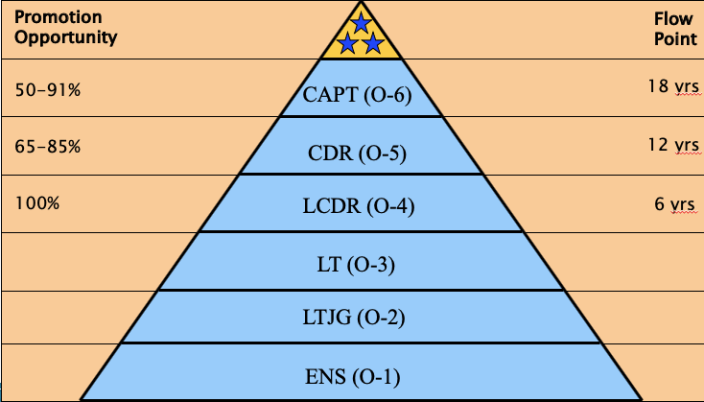
Along the left are the ranges of promotion opportunity for each rank from fiscal year 2010-2021. In each year, the promotion opportunity for LCDR has been 100%. In theory, if all the Lieutenants are suitable for promotion they can all be promoted to LCDR. When it comes to the promotion opportunities for CDR or CAPT, interpreting them is a touch more difficult because we have to talk about promotion board math.
Promotion Board Math
In Fiscal Year 2019 (FY19), people were very excited about a 90% promotion opportunity for the FY19 Staff Corps O6 promotion board. But it was easy to misinterpret this opportunity. It did not mean that 90% of CDRs were selected for CAPT.
Where Does the Promotion Opportunity Come From?
The short answer is from manpower projections. How many physicians are getting out or retiring? What is the current Medical Corps manning level for that rank? What are future needs anticipated to be? What is the size of the promotion zone? The answers to all of these questions determines the promotion opportunity and guide Navy Personnel Command (NPC) and the Bureau of Medicine and Surgery (BUMED) when they are making their decision.
As you can see here, the promotion opportunity varies from year-to-year:
| FY10 | FY11 | FY12 | FY13 | FY14 | FY15 | FY16 | FY17 | FY18 | FY19 | FY20 | FY21 | |
| LCDR | 100% | 100% | 100% | 100% | 100% | 100% | 100% | 100% | 100% | 100% | 100% | |
| CDR | 80% | 80% | 80% | 80% | 80% | 70% | 70% | 65% | 75% | 85% | 77% | |
| CAPT | 80% | 80% | 80% | 60% | 60% | 60% | 50% | 70% | 80% | 90% | 81% | 91% |
Historical promotion opportunities for FY10-21.
But as you can see here, the percentage who are promoted from the in zone group is substantially lower:
| FY10 | FY11 | FY12 | FY13 | FY14 | FY15 | FY16 | FY17 | FY18 | FY19 | FY20 | FY21 | |
| LCDR | N/A | N/A | N/A | 97% | 89% | 90% | 93% | 88% | 85% | 87% | 91% | |
| CDR | N/A | N/A | N/A | 58% | 66% | 49% | 53% | 44% | 40% | 52% | 53% | |
| CAPT | N/A | N/A | N/A | 55% | 43% | 47% | 39% | 34% | 37% | 41% | 51% | 53% |
Historical percentage of in-zone candidates selected for promotion for FY10-21.
Promotion Board Zones
There are three “zones” for promotion – below zone, in zone, and above zone. Medical Corps officers are below zone for two years, in zone for one year, and above zone until they are either selected for promotion or get out of the Navy. A few people are usually picked early or below zone, but most people will not get picked until they are in or above zone.
FY19 O6 Promotion Board Math
In FY19, there were 74 CDRs in zone for promotion. To figure out how many officers can be selected for promotion, you have to multiple the zone size by the promotion opportunity. For example, if you take the 90% promotion opportunity everyone was excited about and multiply it by the zone size of 74, you’ll see that they could have promoted 67 CDRs to CAPT during the board:
90% opportunity X 74 people in zone = 66.6 (rounded up to 67) people they can pick for O6
These 67, though, were picked from CDRs who were below zone, in zone, or above zone. Usually, there is a small number picked from below zone, and a much larger number from the in zone and above zone categories. Here were the results:
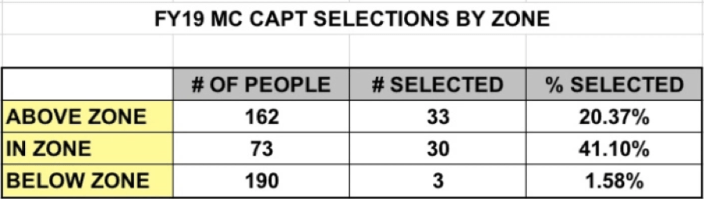
As you can see, the 90% promotion opportunity only led to a 41% selection rate for those who were in zone. The remainder came from the below and above zone CDRs.
The Bottom Line on Career Progression
The typical career progression occurs with a promotion every six years, as detailed in the diagram below. The promotion opportunities listed, though, result in a much lower chance of getting picked when you are in zone because the selections come from those below, in, and above zone.
Operation BUSHMASTER 2020 Cancelled
Joint Chiefs Vision Changes Military Education Philosophy
Here’s a link to this DoD article:
Financial Podcasts I Recommend
For those looking to get some financial education through their earbuds or while driving, here are the podcasts I recommend and actively listen to as well as one I don’t listen to but you should consider.
Two investment advisors give an educational and entertaining summary of recent market/financial news 1-2 times per week.
Many know that Vanguard was founded by John Bogle, and those who follow his investing principles are self-named “Bogleheads.” This podcast will teach you those principles.
Creative Planning is an investment advisory firm. Its President, Peter Mallouk, and Director of Financial Education, Jonathan Clements, who was a Wall Street financial columnist for 20 years, provide a monthly podcast series discussing recent market events, investment philosophy, and give monthly tips.
Financial Residency or Physician Finance Minute
Ryan Inman is a fee-only financial advisor who happens to be married to a GS physician at NMCSD. Financial Residency is the podcast that I recommend but don’t personally listen to because I find it to be too basic. That said, if you are a beginner to intermediate when it comes to personal finance, I think this is a podcast that you should strongly consider to build your financial knowledge base. For those with a short attention span, he also offers the Physician Finance Minute, which is literally 1-2 minutes of financial learning each day.
This podcast is hosted by a former investment manager. He does an excellent job of reviewing personal finance and economics topics in shows that are usually about 30 minutes in length.
Jimmy Turner, a practicing Anesthesiologist, and co-host Ryan Inman, the host of the Financial Residency Podcast above, teach you all of the personal finance topics you wish you had learned in medical school.
Peter Kim is also a practicing Anesthesiologist and entrepreneur who focuses this podcast on ways that physicians can create diverse streams of passive income.
This podcast from Morningstar is hosted by Christine Benz and Jeff Ptak as they talk to influential leaders in investing, advice, and personal finance about a wide-range of topics, such as asset allocation and balancing risk and return.
Our finances, portfolios, and the markets are affected daily by the policies and politics coming out of Washington. In each episode of WashingtonWise Investor, host Mike Townsend, Charles Schwab’s Vice President for Legislative and Regulatory Affairs, focuses a non-partisan eye on the stories that matter most to investors, and his guests offer actionable suggestions for what to do—and what not to do—with your portfolio.
Fellow Emergency Physician James Dahle, MD has created a digital and print media empire. You can’t go wrong if you make this your solitary source of financial information. There is a blog, internet forum, podcast, and book, so no matter how you prefer to ingest information you can find what you are looking for on his site.
AMSUS Call for Abstracts
2020 ANNUAL MEETING CALL FOR ABSTRACTS NOW OPEN
Theme – Federal Health: A Global Vision Beginning in Your Community
The portal to submit an abstract for a lecture or for a poster presentation is now open at https://www.amsus.org/events/call-for-abstracts-2/ .
- Lecture abstract deadline extended to 17 July 2020
- Poster abstract deadline extended to 3 August 2020
Please read the instructions and this year’s breakout and poster presentation topics to ensure the greatest relevance and learning objectives.
For additional details, and information, check out: www.amsus.org
77th Secretary of the Navy Sworn in Friday
Here’s a link to the Navy Times article:
77th Secretary of the Navy Sworn in Friday
Here’s a link to his first message:
SG Message – One Team One Fight
Esteemed Colleagues,
The stress and anxiety over COVID-19 remains significant throughout our country. Aside from the unknowns surrounding this contagion, the pandemic has introduced limitations to daily social life, forced individuals into lengthy periods of isolation, and spurred concerns over financial matters. For those who are beginning a ROM status, this state of stress can feel intensified.
As we continue to confront the challenges we face from COVID-19, we must all have the confidence that regardless of the setting, we never work alone, nor should we feel that we have to suffer in silence. No one is alone in this fight – our One Navy Medicine team must remain vigilant and help those most in need. This pandemic has touched each of us in one way or another. Many of us know someone directly affected by this virus, and emotions are difficult to process when you are restricted from being with them. Sadly, many have been laid to rest without their loved ones present –and this tragedy in itself is on a greater level for our Sailors and Marines.
We are all leaders no matter where we sit in the organization, and I expect each of you to reach out to your colleagues and shipmates to see how they are doing. In addition to our formal mechanisms of PDHA and PDHRA, I ask that we continue to engage and stay close to these individuals and provide them all the time and support needed as they transition back to their regular duties.
Throughout this fight against COVID-19, our mental health providers have taken on the onus of responsibility, and although their roles are often unsung, the work they do each day has been commendable. Whether at the MTF setting or with embedded mental health teams, our psychiatrists, psychologists, psychiatric mental health nurse practitioners, licensed clinical social workers, behavioral health technicians, and Navy Chaplains continue to leverage principles of high velocity learning to be resourceful and innovative while enhancing mission readiness. Below are a few examples I would like to share with you:
- Special Psychiatric Readiness Intervention Team (SPRINT). In early April, we mobilized a SPRINT to Guam to provide needed assistance to the TR Sailors in quarantine at the time. In collaboration with the 3rd Medical Battalion, Naval Hospital Guam and the Guam Chaplain Corps, this SPRINT used innovative methods to deliver remote Psychological First Aid. These very methods continue to be impactful and have been used at other commands since.
- Virtual Peer Support. Through its Caregiver Occupational Stress Control program, Naval Hospital Jacksonville pioneered a website enabling virtual peer support for those dealing with stress at the hospital. In addition, providers with Naval Medical Center San Diego developed a web tool to help personnel manage everyday stress.
- Telehealth. Throughout this fight, many of our providers have also begun to embrace telehealth and this has been especially true for mental health specialists. Telehealth continues to serve as a significant tool allowing for that provider-patient connection when there are movement restrictions. This capability is destined to grow more robust in this new normal.
In closing, please remember that there are many avenues to getting healthcare and counseling and there is NO WRONG WAY to access it! I can assure you that regardless of where you serve or what you do, NO ONE IS ALONE IN THIS FIGHT – you will always have the full force of Navy Medicine’s power with you. Together, our talent, knowledge, toughness, creativity, and teamwork will get us through all the challenges we face from COVID-19 and will emerge a stronger and even more capable organization.
In a time when the Fleet and Marine Corps have never needed us more, you are making a positive difference for them every day. Thank you!
With my continued respect and admiration,
SG Sends
V/R,
Bruce L. Gillingham, MD, CPE, AOA
RADM, MC, USN
Surgeon General, U.S. Navy
Chief, Bureau of Medicine and Surgery
On-Line Sessions for Students Interested in Dermatology
There are two sessions, one for HPSP and one for USUHS students:
HPSP Session (here is the flyer)
- WHEN: TUES/June 16 1800-1900 EST.
- WHAT: The Army, Navy, and Air Force Dermatology Program Directors/Consultants/Specialty Leaders are hosting a joint Dermatology interest meeting. Please join us for an overview of all tri-service dermatology programs, Program Director POCs, how/when to apply, and what the future of military dermatology looks like.
- DIAL-IN INFORMATION for Zoom call:
- Dial by your location
- +1 301 715 8592 US (Germantown)
- +1 646 558 8656 US (New York)
- Meeting ID: 879 1582 1355
- Password: 080442
- Dial by your location
USUHS Session
- Dermatology Virtual Interest Group
- THURS/JUNE 4 1200-1300 EST
- Dial-in details: +1 505-738-3207 (PIN:729 126 110#)
- For Video: meet.google.com/oyx-euad-mnv
- Flyer with all the info is here
Finance Friday Articles
Here are my favorites this week:
When Your Income Becomes Your Enemy
Why is the Market Doing Well Lately?
Here are the rest of this week’s articles:
4 Financial Tips for DINKS (Dual Income No Kids)
5 Ways Investment Performance Measurements Can Be Fuzzy
6 simple ways to take action in your financial life without hurting your long-term goals
A One-of-a-Kind Market Environment
At Ease (Make Sure Your Life Insurance Beneficiaries are Up-To-Date)
Bubble Behavior During a Depression
From Medical Degree to Financially Free
Here Are the 2020-2021 Post-9/11 GI Bill Rates
How COVID-19 is Changing the Housing Market
How Much of the Bear Market Losses Have Been Recovered?
How Our Annual Spending Determines Our Retirement Needs
Physician in Transition: A Fast Track Guide to Financial Security
The Different Types of Real Estate Crowdfunding Deals
The Diversification Drag & The Management of Luck
The Top 10 Things Doctors Need to Know About Disability Insurance
Thoughts from a mom investing for college
To SBP, or Not to SBP? Evaluating Your Survivor Benefit Plan Option at Retirement
 Joel Schofer's Career Planning Blog