Finance Friday Articles
- A midyear update on Vanguard’s economic and market outlook
- Best Speculative Assets to Hedge Your Portfolio
- How to Figure Out Your GI Bill Strategy
- Learning from Playground Taunts on Financial Forums
- Pass on the Investment Casino
- Should You Lower Your Exposure to US Stocks in Favor of International Stocks?
- The Emergency Fund: It’s Still Useless!
- What Bond Fund Should You Hold
- When “Professionals” Time the Market: A Case Study
**Short-Fused Nom – Due Mon, 26 Jul** O-3/O-4 EA/XO, Small Market and Stand-Alone Organization, DHA (San Antonio)
Please see attached short-fused nom for a new DHA position in San Antonio:
Highlights:
– O-3/O-4, any Corps
– Report 7 Sep 21, 12 month orders
– DHA leadership experience; should have served at Military Treatment Facility in a mid-level officer role.
– Should have headquarters-level administrative experience in resource management, legislative matters organizational management, manpower issues, human resource actions (military and civilian), training, space management, and/or correspondence management.
– Experience in healthcare operations and planning; knowledgeable of characteristic features of the MHS beneficiary population; be familiar with DHA and DoD healthcare policies, programs and processes.
Anyone interested needs to send me (Joel dot M dot Schofer dot mil < at > mail dot mil) their CV/bio by COB Monday, July 26th. Sorry for the quick turn!
DHA Ready Reliable Care High Reliability Organization Awards
Details for these awards are in the following files:
Rescheduled Operational Medical Officer and GME Q&A Session – Friday at Noon Eastern
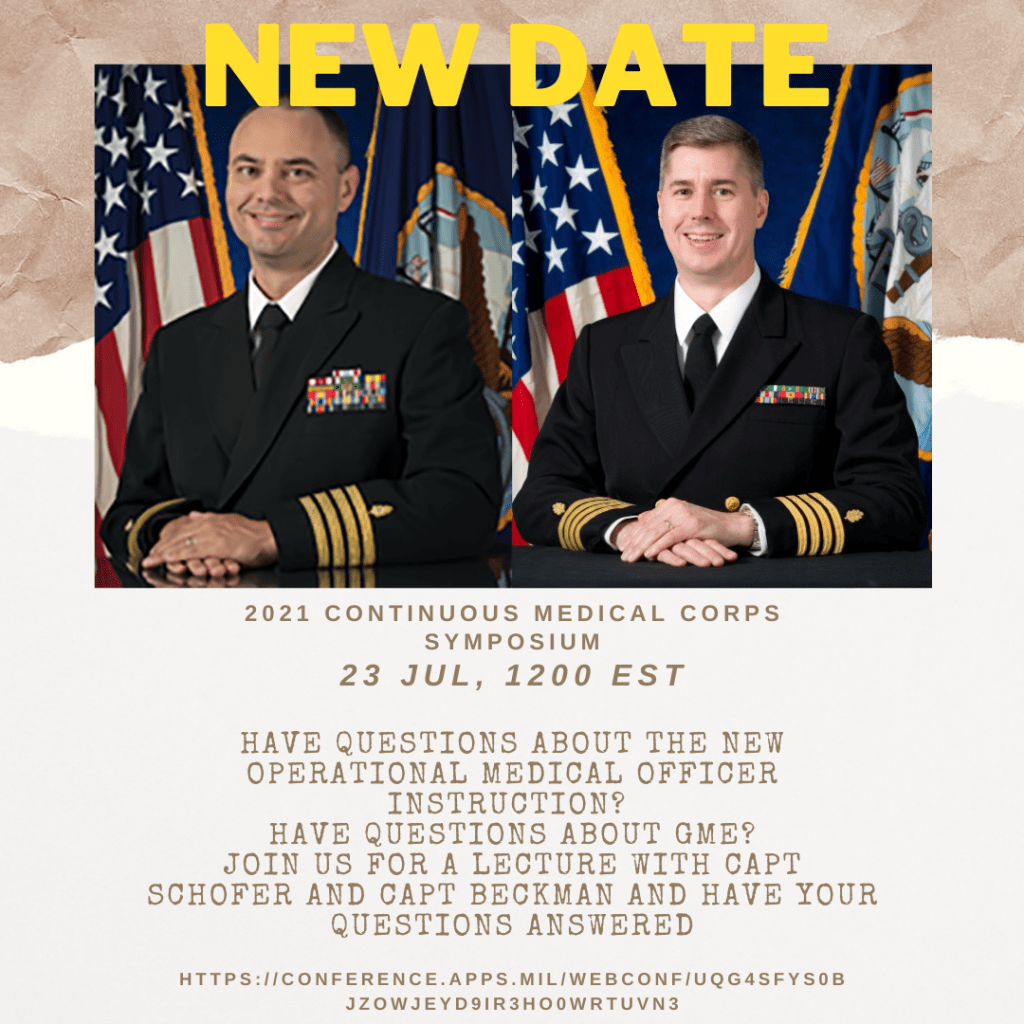
The GME and OMO talk has now been rescheduled for 23 July at 1200 EST. Please join us virtually at https://conference.apps.mil/webconf/uqg4sfys0bjzowjeyd9ir3ho0wrtuvn3 to have your questions answered regarding the new OMO instruction and GME Note that was just released.
The session will be recorded for asynchronous viewing and that link will be available following the session. Please direct any questions to LCDR Jennifer Eng-Kulawy in the Corps Chief’s Office (contact in the global).
Virtual Senior Leadership Course Openings
The two Senior Leadership Courses (hosted by Naval Leadership and Ethics Center) in August still have several vacancies. Courses are currently being conducted virtually, so it is a great opportunity to get the training and save command travel funding. Dates for the courses are 2-6 Aug and 9-13 Aug, and registration is via CANTRAC. More info follows.
Course Description: The Navy Senior Leader Course (SLC) presents a 5-day seminar for Navy Senior Officers at the pay grade of O6, O5 and O5 selects. This course is designed to facilitate formal leadership and ethics education for Navy Senior Officers to support Fleet Centered Leader Development (FCLD) and the CNO’s Leader Development Outcomes. The course will prepare senior officers heading to fleet-wide positions requiring responsible, and comprehensive leadership abilities by promoting professional growth in ethics, self-awareness, leader development, and decision making. SLC is an education class not a training class taught using the adult learning environment that benefits from seminar participation and experiential learning focusing on inter-active leadership development. All students will participate in a personality assessment that is required to be complete prior to the class convening.
Process: Officers requesting SLC must contact their Command Staff Education and Training (SEAT) officer. SEAT Officers will register officers utilizing CeTARS / eNTRS. The class CIN is H-7C-0107; the Newport class CDP is 19UT; and the Dam Neck class CDP is 19UV.
The Newport Course POC is CDR Jill Skeet, NC, USN and has offered to assist anyone have issues registering via CANTRAC.
July Sailor-to-Sailor Newsletter
Shipmates,
With July marking the start of the Navy’s first PFA cycle in over a year and a half, this month’s edition of our Sailor-to-Sailor newsletter, leads off with what Sailors need to know about some new rules now in place. Also, we have featured a wrap up of some of the significant topics discussed at last month’s CNP Worldwide Town Hall broadcast.
Here’s the link to the July newsletter: https://go.usa.gov/x6hGy
Other highlights in this month’s edition include:
– Coaching in the Ranks is Important – Here’s Why
– MyNavy HR Transformation to Revolutionize Personnel and Pay Systems
– Blended Retirement System CY 2022 Continuation Pay Announced
– Changes Coming to CLREC Navy Global Deployer App
Your feedback on the Sailor-to-Sailor newsletter is always welcome. You can reach us at MyNavyHR@navy-mil or on our social media properties @MyNavyHR on Facebook, Twitter and Instagram to have your voice heard.
Thank you for everything you are doing and stay safe!
V/r,
The MyNAVY HR Team
Finance Friday Articles
- 5 best states for veterans to retire
- Courtside Seat for Estate Planning
- Financial Considerations for Moonlighting as an Independent Contractor
- I DON’T KNOW HOW TO INVEST AND I’M AFRAID OF MAKING EXPENSIVE MISTAKES
- Is Tax-Loss Harvesting Worth It?
- Keeping Our Heads
- Simple strategies for reducing inflation risk
- Six Important Reasons Not to Retire Early
- Strongest Inflation in 13 Years
- Why Do We Always Focus on the Bad Stuff?
 Joel Schofer's Career Planning Blog