Uncategorized
Asset Location
Here’s a tip on asset location from one of my favorite blogs and authors, Jonathan Clements from Humble Dollar:
After deciding what investments to buy, we should consider asset location. What’s that? It involves divvying up investments between taxable and retirement accounts. If investments generate large annual tax bills—think taxable bonds and actively managed funds—we’ll typically want to hold them in a retirement account.
Jonathan’s advice is the traditional advice. Put your taxable bonds, like the Thrift Savings Plan (TSP) F and G funds, into your retirement accounts. This is what I do. My F and G funds are in the TSP, clearly a retirement account, and my international bonds (which they don’t have in the TSP) are in an individual retirement account (IRA).
I don’t own actively managed funds, and I also don’t invest in real estate investment trusts (REITs), although I have in the past and I think about it pretty frequently.
There is another school of thought, though. The White Coat Investor has a different take. You can read about them in his posts entitled My Two Asset Location Pet Peeves and Bonds Go in Taxable!
Of note, just about everyone says to put actively managed funds or REITs in a retirement account, so you won’t find any arguments there.
If you’re really interested in this concept/discussion, the Bogleheads Wiki on tax efficient fund placement is a great read as well.
Military Health System Achievements in 2019 Provide Strong Foundation for Year Ahead
Here’s a link to this article from the Defense Health Agency:
Military Health System Achievements in 2019 Provide Strong Foundation for Year Ahead
Check Your Beneficiary Designations
Here’s a tip from one of my favorite blogs and authors, Jonathan Clements from Humble Dollar:
CHECK YOUR BENEFICIARY DESIGNATIONS. Your retirement accounts and life insurance will typically pass to the beneficiaries specified on those accounts, not the people named in your will. If your family situation has changed, or you simply don’t remember who you listed, take a moment to review your beneficiary designations.
Don’t let the ex-spouse get your money when you die! Update your beneficiaries.
How to See Your Beneficiaries for the Thrift Savings Plan (TSP)
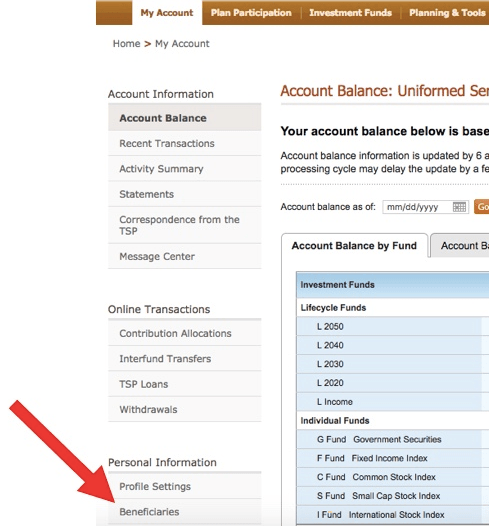
If you log on to the TSP page, you need to click on the link along the lower left, marked by the large red arrow:
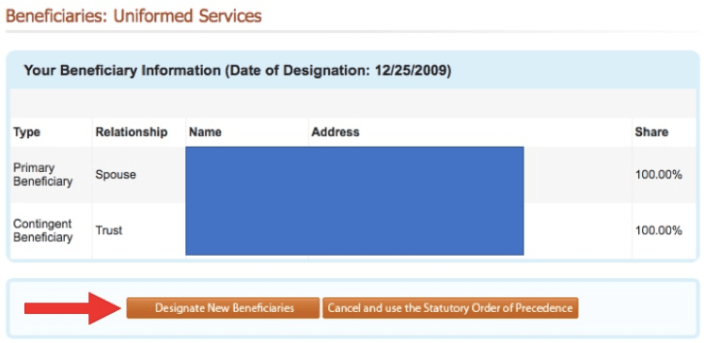
 Then you’ll see this, and you can change them at the bottom:
Can You Now Sue the Military for Medical Malpractice?
Here’s a Navy Times article that answers that question:
Explainer: Can you now sue the military for medical malpractice?
MOAA – President Signs NDAA: What the Law Includes, and What’s Next
Here’s a link to this good NDAA summary:
President Signs NDAA: What the Law Includes, and What’s Next
Finance Friday Articles
Here are my favorites this week:
10 Things That Matter Most In Personal Finance
End of the Year Financial Checklist for High Earners
Here are the rest of this week’s articles:
7 Things to Learn From the Periodic Table of Investment Returns
Creating a Personal Finance Curriculum: 5 Questions
Big overhaul set for IRAs could be more or less taxing
Explaining the Different Types of Real Estate Crowdfunding Platforms
Eyes Forward – Saving vs Spending
How Did These Physicians Create Passive Income?
Joining a Cult: The Financial Independence Counterculture
Military spouses will get reimbursed up to $1,000 for professional relicensing costs
Real Estate Investing for Doctors
Retirement and 529 Changes from the SECURE Act
Six Months of Part-Time Work. Or How to Save $60,000 on Taxes.
December Message to the Military Health System Team from the Assistant Secretary of Defense for Health Affairs, HON Thomas McCaffery
MHS Team:
Earlier this month, I joined many of you at the annual convening of AMSUS (the Society of Federal Health Professionals) at National Harbor, Maryland, to discuss the status of the Military Health System: what we’ve achieved, where we’re going as an organization, and how we will get there. Directly following AMSUS, I testified before the House Armed Services Committee alongside the Military Department Surgeons General, Joint Staff Surgeon, and the Director of the Defense Health Agency. Each engagement provided an important opportunity – and critical audiences – to share our steps in carrying out reform across the military medical enterprise to better meet the Department’s needs, and to reaffirm the MHS’s collective vision for the future.
I underscored the new challenges an ever-changing security environment presents to our military and, more specifically, to military medicine – challenges requiring our organization to adapt and evolve to best serve the combatant commands and the Military Departments as we together advance the National Defense Strategy. This period of MHS reform is a time to embrace change and forge an improved system of military health that delivers on our readiness mission to ensure that troops are fit to fight, and that medical professionals are ready to support them in training and on the battlefield.
To better deliver on our mission, the MHS is laser focused on three key areas of organizational reform. First, consolidated management of the direct care and purchased care systems. Second, a reinvigorated focus on readiness within the direct care system. And third, optimizing the size and composition of the military medical force, including the recruitment, education and training, and sustainment of skills to deliver on our readiness mission. For the most current updates on our MHS reform areas of focus, I’m attaching the prepared statement that the DHA Director LTG Place and I provided to the HASC at the recent hearings.
I would like to thank Army Surgeon General LTG Dingle for inviting me to speak at the MEDCOM Leadership Lecture Series on 10 December. This event afforded me the opportunity not only to speak about my leadership philosophy and approach, but also to hear MEDCOM leaders’ thoughts and perspectives on the various changes underway in the MHS.
In the weeks ahead, I hope many of you are able to enjoy some well-deserved time with friends and families over the holidays. For those deployed or unable to take R&R due to serving our warfighters and patients: thank you for your selfless service to the Nation. Each of you across the MHS is playing a part in significant change in our enterprise – helping to inform those changes, making them real, and dedicating your talent and expertise to our mission. I am grateful for your contributions and look forward to our continued work together in the New Year.
Tom
Should You Invest in Real Estate?
Just about everyone who invests does so in major asset classes including stocks, bonds, and cash equivalents. When it comes to real estate, though, you’ll find widely divergent opinions about its importance in an investment portfolio. There are some well-respected people and institutions who say that real estate investing is unnecessary, and there are others who will tell you it should be your primary asset class. I’ve recently debated whether I should start investing more heavily in real estate, so I wanted to lay out the basic arguments for and against real estate investing.
What is Real Estate?
The answer to this question is not simple because real estate investing comes in many forms. There are relatively passive ways of investing in real estate, such as Real Estate Investment Trusts (REITs). According to Investopedia, a REIT is “a type of security that invests in real estate through property or mortgages and often trades on major exchanges like a stock.” In other words, you can simply invest in a REIT like you do any other stock, mutual fund, or exchange-traded fund (ETF). Just send your money to your investment company, and you own a little slice of passive real estate.
There are more active methods of investing in real estate, such as fixing and flipping. You purchase a property, you make improvements to it, and then you sell it to someone, hopefully for a profit. As you can imagine, this would take quite a bit more work than investing in a REIT.
There are probably over 100 other ways you can invest in real estate. If you’re interested, I’d check out an article on Bigger Pockets, one of the largest websites about real estate investing, entitled “The Top 100 Ways to Make Money in Real Estate.”
Arguments Against Investing in Real Estate
Regular readers know that Vanguard is my go-to source for both advice and my own investments. Vanguard considers real estate an alternative investment, and according to them “alternatives usually come with more risks and higher costs.” They believe that a diversified portfolio of stocks and bonds provides enough diversification and that alternative investments are unnecessary. Only “sophisticated investors” should consider alternatives, and they see direct real estate investment as “expensive and time-consuming.” Most people have exposure to real estate in the equity in their house and diversified stock/bond funds that often include REITs, real estate companies, and mortgage-backed securities. For these reasons, Vanguard doesn’t think additional investment in real estate is necessary.
Another argument against real estate investing is that it can quickly become a second job. While you can hire property managers, they are probably not going to provide the level of service that the owner would provide. Most of us are already fully employed and don’t need a second job. In addition, owning investment properties can create additional legal risk.
When you purchase an individual property, it is like buying a single stock. You are taking what is called an uncompensated risk. Larry Swedroe defines an uncompensated risk as, “Risk – that is, the risk of owning single stock or sector of the market – that can be diversified away. Since the risk can be diversified away, investors are not rewarded with a risk premium (higher expected return) for accepting this type of risk.” Essentially, you are putting all your eggs in one basket that is not diversified by location or property type. Investing in real estate via a REIT can avoid this problem because REITs invest in properties that are diversified.
Real estate is an illiquid asset class with high transaction fees. While I can sell my stock or bond mutual funds or ETFs in seconds on-line and pay extremely low expenses to do so, it will take me weeks or months to buy or sell a property. In addition, I’ll likely pay 5-10 percent of the price in transaction costs.
Arguments for Real Estate Investing
Real estate is easily acquired, most often by purchasing your own single family house or condominium. You have to live somewhere, and there are several tax advantages to owning where you live. Interest payments on your mortgage and property taxes are probably tax deductible. If you sell your property, capital gains of up to $250,000 if you’re single or $500,000 for couples are tax-free. In addition, paying a mortgage forces you to save by making regular payments, some of which pay off the principle balance of your loan. That is money you’ll get back when you sell.
When compared to stocks or bonds, which have a global, efficient market, real estate often has a local, inefficient market. This means that if you are willing to look, you can probably find some bargains out there much more easily than you can find a bargain stock. Here’s a review of a good book on real estate investing for physicians.
One of the goals of diversification is to have investments that are not correlated with each other. In other words, when investment A drops in price you have investment B that does not. When compared to stocks and bonds, real estate is not perfectly correlated with other investments and therefore provides diversification. An article about the diversification benefit of REITs makes for an interesting read, if you’re interested, although it is a little old. Vanguard came to the conclusion that over-weighting REITs in a target date fund was not worth it. And this very well regarded guy doesn’t believe in over-weighting REITs either.
You can use leverage or “other people’s money” to increase investment returns. Instead of buying a property for $120,000, you could buy three $160,000 properties with a $40,000 down payment on each. This can increase your returns, but in a down market it can also dramatically increase your losses. As many found out during the housing market crash, leverage is a double-edged sword.
Real estate is an inflation hedge. Burton Malkiel says, “A good house on good land keeps its value no matter what happens to money.” Rents and property values tend to rise as prices rise, preserving your purchasing power. Since your mortgage payment doesn’t change with inflation, while rents are going up your mortgage payment remains the same. Stocks do hedge inflation somewhat, but the companies they represent and the stocks themselves tend to get hurt as the prices of raw materials rise.
The Bottom Line
There are a lot of different ways to invest in real estate, passively investing in REITs, fixing and flipping, owning rental properties, and all sorts of other investment opportunities. Like Vanguard, I don’t think it is necessary to invest in real estate, but it is something to consider if you think you will either enjoy it or believe the value it adds to your investment portfolio is worth the effort.
Intermediate and Senior Leadership Courses Available in the DC Area (Local Attendees Only)
Navy Medicine Professional Development Center (NMPDC) in Bethesda will be hosting facilitators from the Navy Leadership and Ethics Center (NLEC) for the instructing of two separate leader development courses in the coming months. Courses are as follows:
- Intermediate Leadership Course (ILC)
- 3-7 February 2020
- O4s (to include O4 selects)
- Senior Leadership Course (SLC)
- 6-10 April 2020
- O5s (to include O5 selects)
These are great opportunities for Navy Medicine officers local to the DC area to attend leader development courses while being offered locally. Currently these classes are only being offered to local attendees.
The point of contact for registering for the courses is LT Ryan Rigby (contact is in the global).
If you want to read how to get into these courses, you can read about them in this document.
 Joel Schofer's Career Planning Blog