2022-23 Low-Residency Graduate Education Program – O2-O5 – Due 30 JUN
PERS-4415 (where all the medical Detailers reside) has said they will support applications for this, but only for people with orders into a shore billet or in the early portion of their shore orders:
CLASSIFICATION: UNCLASSIFIED
ROUTINE
R 131905Z JUN 22 MID600051969159U
FM CNO WASHINGTON DC
TO NAVADMIN
INFO CNO WASHINGTON DC
BT
UNCLAS

NAVADMIN 134/22

PASS TO OFFICE CODES:
FM CNO WASHINGTON DC//N7//
INFO CNO WASHINGTON DC//N7//
MSGID/GENADMIN/CNO/N7/JUN//

SUBJ/ACADEMIC YEAR (AY) 2022-2023 LOW-RESIDENCY GRADUATE EDUCATION PROGRAM//

REF/A/DOC/OPNAV INSTRUCTION 1520.23C-CH3//
REF/B/DOC/DOD INSTRUCTION 1322.10//
REF/C/DOC/DON MEMORANDUM OF 23MAY22//

NARR/REF A IS NAVY DIRECTIVE ON GRADUATE EDUCATION.
REF B IS DOD INSTRUCTION 1322.10, POLICY ON GRADUATE EDUCATION FOR MILITARY
OFFICERS.
REF C IS DON MEMORANDUM DATED 23MAY22 WHICH AUTHORIZES AY 2022-2023 LGEP
EXECUTION//

RMKS/1. This NAVADMIN announces the Low-Residency Graduate Education Program
(LGEP) Academic Year (AY) 2022-2023 and provides guidance for applications.

2. Background:
   a. LGEP provides naval officers in paygrades O-2 to O-5 with a Department
of the Navy-funded graduate degree opportunity in strategy, management and
international relations through a low-residency delivery model at selected
regionally accredited partner universities or colleges.
   b. The LGEP pilot program will offer studies that are designed to fit into
shore duty tours, allowing officers with compressed career paths to stay
close to the waterfront or flight line while earning a Master's degree. LGEP
study programs range from 16-24 months at partner universities that may
include Old Dominion University (Master of Arts in International Studies with
a Concentration in Strategic Leadership), William and Mary (Executive Masters
of Business Administration), American University (Master of Science in
Management with a Concentration in Strategy and Security), Johns Hopkins
University (Master of Arts in Global Policy), University of California San
Diego (Master of Advanced Studies in International Affairs) and the
University of Washington (Executive Masters in Public Administration).
   c. Participants will remain at their duty stations and spend limited time
on campus, completing the majority of the course material online or via
phone.

3. Application and Selection Process:
   a. The application window will close on 30 June 2022.  Up to 60
participants will be selected for Academic Year 2022-2023.  Target applicants
are due-course warrior scholars who display all the qualities of dedicated
career officers who aspire to command.
   b. Qualified candidates will meet the following prerequisite education and
work experience criteria: O-2 to O-5, a Bachelor's degree from an accredited
college or university, and a history of strong academic performance
demonstrated by college transcripts.
   c. Candidates should submit their application package to
shania.m.truelove.civ(at)us.navy.mil via encrypted email or the SAFE tool at
https://safe.apps.mil no later than 30 June 2022.  Packages must include the
following: Commanding Officer's endorsement; Detailer/Moderator endorsement;
applicant biography; academic transcripts (unofficial are acceptable for the
initial application) from all undergraduate and higher education to include
transfer credits; statement of purpose explaining why the applicant is
interested in LGEP and how the education would benefit the DON. GRE/GMAT
scores are not required.  The Office of the Assistant Secretary of the Navy
(Manpower and Reserve Affairs)(OASN(M&RA)) will forward the applications to
the Services for approval prior to the Service Members' acceptance to LGEP.
   d. Applicants will first apply to LGEP and, if selected, go through an
expedited application process with the selected partner school.  Applicants
will be matched with school programs based on factors to include geographic
location, career progression, prioritized student program preference, and the
probability that the applicant will be accepted into the school's graduate
program based upon previous academic performance.  Once provisionally
accepted into the LGEP, students must provide official transcripts to the
prospective university's graduate program, along with other information as
required.
   e. LGEP selectees will be announced by 15 July 2022 via email from the
Naval Education Division (NED), OASN (M&RA). The LGEP program will be
centrally funded and cover tuition, required books up to $500.00 per
semester, and local travel within a 75 mile radius.  Selectees will be
responsible for internet access to participate in online assignments and web-
enabled interactions with instructors and other students.

4. Service Obligation:
   a. Per references (a) and (b), selected candidates must sign and commit to
a Continued Service Agreement, which will incur a service obligation within
the DON of three times the number of months spent in the academic program
served concurrently with other obligations, up to a maximum of a three-year
service obligation.  The service obligation will commence upon completion of
or withdrawal from the program, and will be incurred whether or not the
service member successfully completes the academic coursework or degree.

5. Point of contact:
   a. Shania M. Truelove at email: shania.m.truelove.civ(at)us.navy.mil.
   b. Submit applications to shania.m.truelove.civ(at)us.navy.mil via
encrypted email or the SAFE tool at https://safe.apps.mil, with notification
to Shania M. Truelove shania.m.truelove.civ(at)us.navy.mil) of package
submission.

6.  This message will remain in effect until superseded or canceled,
whichever occurs first.

7.  Released by VADM J. W. Hughes, Deputy Chief of Naval Operations for
Warfighting Development (N7)//

BT
#0001
NNNN
UNCLASSIFIED//
SG Message: Deputy Surgeon General Transition
Shipmates:
Spring and summertime bring lots of change and transition to our military. Thousands of Sailors PSC around the world with their families. New leaders join organizations and others transition to new opportunities; that consistent flow of change keeps us strong.
Navy Medicine Deputy Surgeon General, Rear Admiral Shaffer will be retiring on 8 July after an illustrious 33 year career. These past few years, I have had the honor to witness first-hand Rear Adm. Shaffer’s servant leadership and her commitment to our One Navy Medicine Team. She is an incredible problem solver, a team builder, and a terrific partner. Through the many challenges of COVID-19 – from the vaccination effort to the greater DSCA response – she was always fully engaged in keeping us healthy and helping us succeed in our mission. And whenever I have needed counsel, she was always there to provide sage advice and keep us on track.
Succeeding Rear Adm. Shaffer is a tall order. It was recently announced that Rear Admiral Darin Via, Commander, Naval Medical Forces Atlantic, was selected to serve as the new Deputy Surgeon General, and he is more than up to this task. Like RADM Shaffer, Rear Admiral Via brings a wealth of operational and leadership experience. He has played pivotal roles on the frontlines in Iraq and Afghanistan, and it should also be noted that he will be the first former Hospital Corpsman to serve as DSG.
Please join me in congratulating RADM Shaffer on a career well-served and a warm welcome to RDML Via.
With my continued respect and admiration,
SG Sends
Finance Friday Articles
- 5 Moves To Consider Making During This Extreme Volatility With Crypto
- 7 Ways to Increase Your Savings Rate
- 10 Frugal Hacks to Automatically Save Money for Busy Professionals
- 10 Things The Wealthy Do Differently
- 10 Years Of Fake Retirement Later: The Most Important Takeaways
- Crypto billionaire says Fed is driving current downturn
- Cryptocurrencies All Fall Down
- How I Made $30,000 Taking Doctor Surveys
- Insuring Infirmity
- Is It Just ‘Too Hard?’ Know Your Circle of Competence
- Just Keep Buying Book Review
- Keep It Going
- Ken Dychtwald Breaks Down The Four Stages Of Retirement
- Lemons to Lemonade
- Six Things That Might Go Right
- Think Outside the Portfolio
- TSP Responds to Customer Service Complaints
- Which is Safer: Rental Houses or Stock Investments? (a Case Study)
- Winning the End Game
2022 Update – What Should You Do If You Didn’t Promote?
If you are particularly interested in this post, I’m sorry. You or someone you care about probably failed to promote. In reality, nowadays it is normal and expected to fail to promote to O5 and O6, so you have company. Here are my suggestions for those that fail to promote.
Try to Figure Out Why You Didn’t Promote
First, try to figure out why you didn’t promote. Because the promotion board members are not allowed to speak about your board, you’ll never actually find out why you failed to promote, but you can usually take a pretty educated guess if you talk to the right people (like me).
If any of these things happened to you, they are likely a main reason you didn’t promote:
- Any PFA/BCA failures.
- Legal issues, such as a DUI or any other legal trouble.
- Failure to become board certified.
There are other things that could happen to you that make it difficult but not impossible to promote. They include:
- You have not been operational or deployed at all, or you have done so much less than your peers.
- Having non-observed (NOB) fitreps before the board, such as those in full-time outservice training.
- Spending too much time in the fleet as a GMO, Flight Surgeon, or UMO. This is mostly because it causes you to come into zone for O5 while you are still in GME, and is more of a problem if your residency is long.
- Never getting a competitive early promote (EP) fitrep. Many officers who fail to select have never had a competitive EP fitrep in their current rank. This can be because they were stationed places without competitive groups and they get 1/1 fitreps, or it can be because they were in a competitive group and did not break out and get an EP. To me this is the #1 ingredient to promote…competitive EP fitreps. If you don’t have them, you are really up against it unless you are in a senior operational position that carries a lot of weight.
- Receiving potentially adverse fitreps. This most commonly happens when you are at an operational command and your reporting senior is not someone who is used to ranking Medical Corps officers, although it could happen for other reasons (like your reporting senior felt you deserved this type of fitrep). The most common situation would be if there is a competitive group of 2 officers but both are given must promote (MP) fitreps instead of 1 getting an EP and the other the MP. When both get an MP, it reflects poorly on both officers unless the reason for this is CLEARLY explained in the fitrep narrative, which it often is not. The other thing that happens is that a reporting senior gives you a 1/1 MP instead of a 1/1 EP. If you are ever getting a 1/1 fitrep, make sure you get an EP. You should consider getting a 1/1 MP an adverse fitrep. If there is no way around this, often because the reporting senior has a policy that they don’t give newly promoted officers an EP, make sure that this policy is clear in the fitrep narrative.
- Having a declining fitrep. Mostly this happens when you go from getting an EP to an MP on your fitrep under the same reporting senior. If it is because you changed competitive groups, like you went from being a resident to a staff physician, that is understandable and not a negative. If you didn’t change competitive groups, though, make sure the reason you declined is explained.
- Making it obvious to the promotion board that you didn’t update your record. The most obvious ways a promotion board will know you didn’t update your record is if your Officer Summary Record (OSR) is missing degrees that you obviously have (like your MD or DO) or if many of the sections of your OSR are either completely blank or required updating by the board recorders. Remember that although promotion board recorders will correct your record for you, anything they do and any corrections they make are annotated to the board. While a few corrections are OK, you don’t want a blank record that the recorders had to fill in. It demonstrates that you didn’t update your record.
Who Actually Promotes?
So who actually promotes to O5 and O6? In general, the officer who promotes has:
- Achieved board certification.
- Spent time in both a military treatment facility and in the operational or headquarters setting.
- A demonstrated history of excellence as an officer. In other words, whenever they are in a competitive group, they successfully break out and get an EP fitrep. Being average is just not good enough anymore.
- No PFA failures, legal problems, declining fitreps, or potentially adverse fitreps.
- Updated their record, and if they previously failed to select they reviewed their record with their Detailer and actively worked to improve it.
What Do You Do If You Failed to Promote?
Realize that it is not the end of the world. Based on the recent promotion board statistics (which you can get in the Promo Prep), most officers were passed over for O5 or O6, but a large number of the officers selected were from the above zone group.
If you do nothing, you will continue to get looked at by promotion boards until you retire, resign, or are forced out of the Navy. There is no limit to the number of chances you get to promote and your record will be evaluated for promotion every year. That said…
You need to try to promote. Consider sending a letter to the promotion board. What do you say in this letter? First, briefly state that you want to be promoted and to continue your career in the Navy. Second, explain what a promotion would allow you to do that you can’t do at your current rank. Answer the question, “Why should they promote you?”
For example, if you want to be a Department Head at a large military treatment facility (MTF), a senior operational leader, or a Residency Director (or whatever you want to do), tell them that you need to be promoted to be competitive for these jobs. The Navy wants to promote leaders. Make it clear to them that you are a motivated future leader.
Try and get letters of support to attach to your letter. These letters should be from the most senior officers who can personally attest to your value to the Navy. In other words, it is probably better to get a letter from an O6 who knows you well than a 3 star who doesn’t. If you are not sure who to ask for letters, ask those more senior to you or your Detailer for advice. Your Specialty Leader is always someone to consider if he/she knows you well and can speak to your contributions to the specialty and Navy.
Have your record reviewed by your Detailer, Specialty Leader, other trusted senior advisor, or by me. Because of promotion board confidentiality, you will never know the reason(s) you did not promote, but most of the time experienced reviewers can come up with an educated guess. They’ll often find things that you were not even aware of, like potentially adverse fitreps, or information missing from your record. My promo prep document will help you as well.
Do everything you can to get “early promote” or “EP” fitreps. This is largely accomplished by continually striving for positions of increased leadership. You need to get a job that has historically led to a promotion while keeping in mind that the new MC career path emphasizes that all need to be operational.
As a LCDR who got passed over for CDR, try to get one of these jobs and excel at it (this list is not exhaustive and these positions are not the only path to CDR, but they are a good start):
- Assistant Program Director
- Division/Department Head
- Fleet Surgical Team (FST) Specialty Staff
- Global Health Engagement (GHE) Staff Officer
- Group/Senior Flight Surgeon (FS)
- Medical Battalion Specialty Staff
- Medical Executive Committee (MEC) Member
- Regimental Surgeon
- Senior Undersea Medical Officer (UMO)
- Ship or Group Senior Medical Officer (SMO)
- SMO/Medical Director
If you are a CDR who got passed over for CAPT, try to get one of these jobs and excel at it:
- Assistant Specialty Leader or Specialty Leader
- Chief Medical Officer (CMO)
- Director/Large Department Head at a NMRTC/MTF
- Division/Group/Wing Surgeon
- FST Officer-in-Charge (OIC) / CATF Surgeon
- GHE, Headquarters, or Navy Personnel Command (PERS) Staff
- Group UMO
- LHA/LHD/CVN SMO
- MEC Chair
- OIC
- Program Director
- Senior GHE Billet
Meet with your chain-of-command. After you’ve been passed over is not the time to be passive. You need to sit down with your leadership and get an honest assessment from them of how you’re doing and what they would recommend continuing to advance your career. You may not like what you hear, but it is better to find out early if they don’t think you’re doing a good job or that you are unlikely to break out on your fitreps. That way you can try and put yourself in a better situation by changing commands.
Things You Should Not Do
In addition to the above list of things you should do, there are a few things you should not do:
- Do not lie in your letter to the board. In other words, don’t tell them you want to do Executive Medicine if you don’t really want to. Your record reads like a book, and if it tells a story that is contrary to what your letter says, this is unlikely to help you and may hurt you.
- Do not send long correspondence. Promotion boards have to read everything sent to them, and a long letter may not be appreciated. Keep it brief and to the point.
- Do not ask your current CO to write you a letter to the board if they’ve done an observed fitrep on you. His or her opinion about you should be reflected on that fitrep, so they don’t need to write you a letter. If they’ve never given you an observed fitrep or there is some new information not reflected on prior fitreps, they could either write you a letter or give you a special fitrep. Ultimately it is up to them whether they do either of these or none.
- Do not discuss anything adverse unless you want the board to notice and discuss it. This issue comes up frequently and people will ask me for advice, but ultimately it is up to the individual officer. The one thing I can guarantee is that if you send a letter to the board and discuss something adverse, they will notice it because they will read your letter! If you think there is a chance the adverse matter will get overlooked, it is probably better not to mention it and keep your fingers crossed.
Never Stop Trying
Those are my tips for those who find themselves above zone. Most importantly, if you want to promote, NEVER STOP TRYING. You can usually stay in as a LCDR for 20 years, and I personally know of people who got promoted their 9th look!
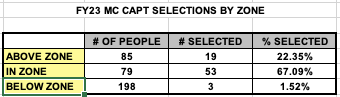
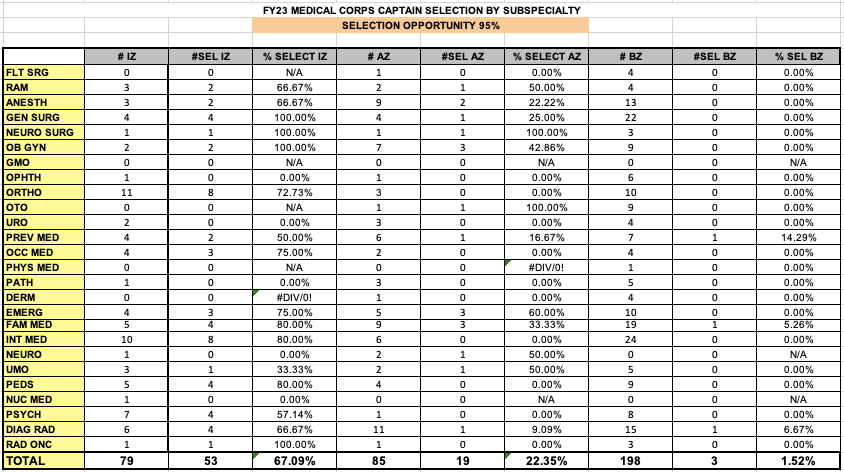
FY23 O6 Promotion Board Stats
I don’t have the detailed stats for all the Corps, so here is the PERS file with the basic and diversity stats for MC, NC, MSC, and DC:
Here are the detailed stats for the MC:


 Joel Schofer's Career Planning Blog